Executive summary
Fund managers are investing in their own AI capabilities like never before. Well over half of all managers on Carta today subscribe to either Claude or ChatGPT. So far in 2026, one of those two model providers has been rapidly gaining ground among managers, with new adoptions and spending among existing customers both rising at remarkable rates.
This first-of-its-kind Carta report relies on data pulled directly from management company general ledgers to show how AI adoption among investment firms is starting to manifest in manco spending.
The majority of fund managers on Carta pay for AI models. In Q3 2026, 57.7% of fund managers on Carta had made a payment over the prior 12 months to either Anthropic, the maker of Claude, or OpenAI, the maker of ChatGPT. After experiencing a surge in adoption so far this year, Claude now has the deepest market penetration among fund managers of any single model, reaching 49.7% in Q3, while ChatGPT sits at 46.2%. Over the past year, the percentage of managers using Claude has more than tripled.
The sums fund managers are paying for AI are also on the rise. About 75% of managers that rely on Claude spent more on AI in Q3 2026 than in Q1, and more than half of those managers increased their spending by at least 150%. Among a fixed cohort of firms that subscribed to Claude since the start of 2025, spending in the first nine months of 2026 was 8.8 times higher than in the same period last year.
This acceleration of AI spending coincides with a decline in the overall growth rate of software spending among fund managers on Carta, suggesting that AI is helping at least some managers reduce costs. Each year from 2023 to 2025, the median growth rate in software spending among managers was at least 15%. In 2026, that median growth rate plunged to 2.9%.
And while correlation does of course not prove causation in either direction, there is some correlation between AI spending and fund performance. VC fund managers that pay for either Claude or ChatGPT are more likely to land in the top quartile of net IRR among their peer cohorts and less likely to be in the bottom quartile.
The data for this analysis comes from the mancos of U.S.-based fund administration customers on Carta. It’s these mancos that typically pay firm-wide expenses such as software licenses and subscription fees. The analysis includes both VC and PE firms, with VC accounting for the majority of the sample.
Key takeaways
AI adoption is stronger in VC than PE: Among VC investors, about 65% of mancos on Carta with at least $250,000 in total annual expenses have made payments in the past year to Anthropic, and 66% are customers of OpenAI. Among PE managers, those figures stand at 57% and 51%, respectively.
Larger firms are more likely to pay for AI: Mancos with at least $2.5 million in total annual expenses—the highest tier of spending in this analysis—are about four times more likely to be Claude customers than mancos with less than $100,000 in expenses, the lowest spending tier. About half of all firms with between $100,000 and $500,000 in total expenses are Claude customers.
AI is among the most common software tools among managers: Just under 50% of fund managers on Carta paid for Claude over the past 12 months, and about 46% paid for ChatGPT. Both figures exceed the share of firms paying many other leading software vendors, including names like Microsoft, Zoom, Adobe, Grok, DocuSign, and Slack.
Claude and ChatGPT adoption
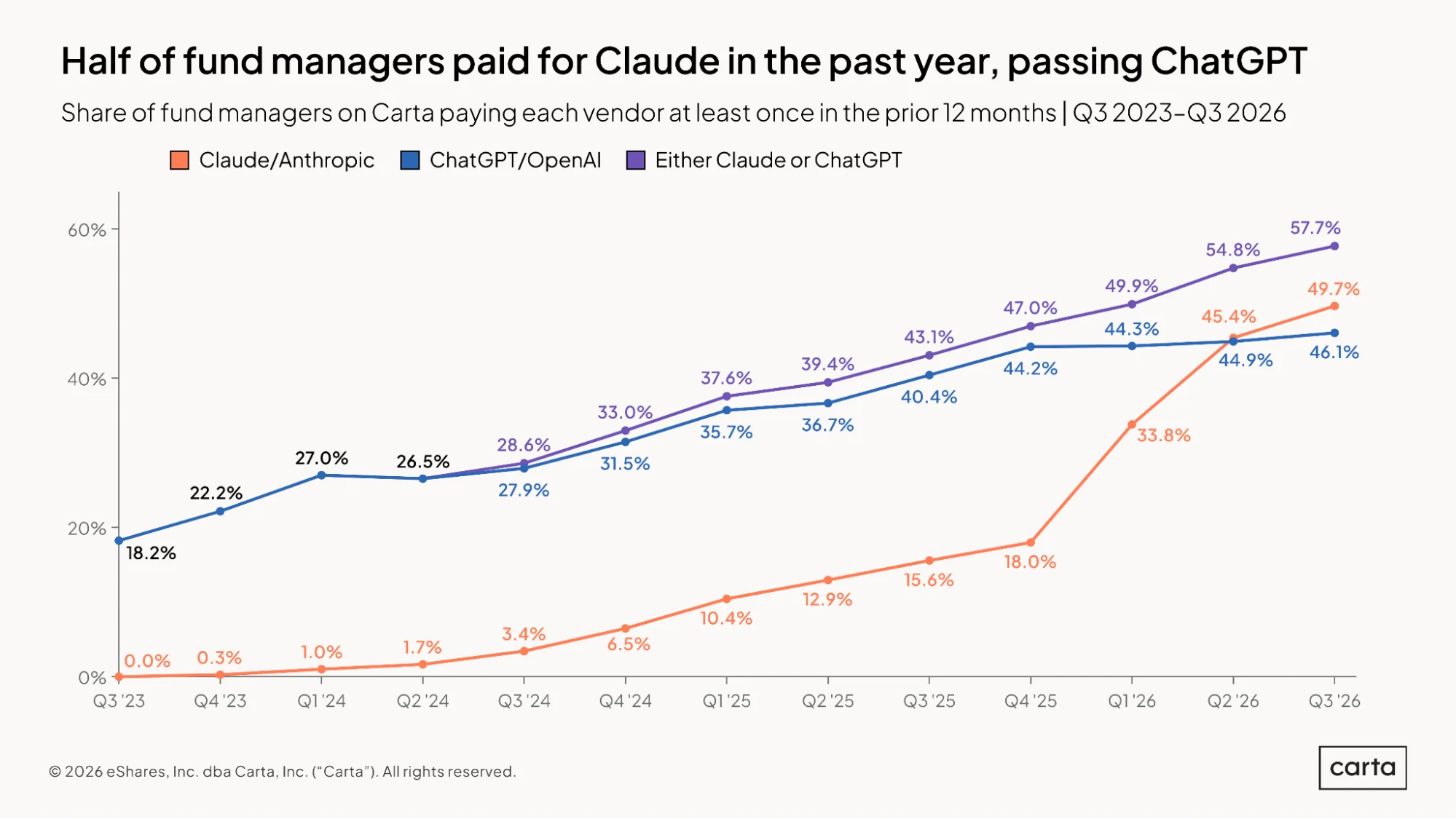
Over the past two years, the percentage of fund managers paying for at least one of the top two AI model providers has grown at a steady clip, typically rising by two to four percentage points each quarter. For individual model providers, however, recent adoption rates have been anything but steady.
Until the end of 2025, OpenAI’s ChatGPT was the clear AI market leader among fund managers. But Anthropic’s Claude closed the gap with stunning speed during the first two quarters of 2026 and has now eclipsed ChatGPT in terms of market penetration, aided by a concurrent acceleration of the company’s R&D and model performance.
While the share of firms using Claude jumped 27 percentage points from Q4 2025 to Q2 2026, the share of firms using either Claude or ChatGPT rose by a relatively scant eight percentage points over the same span. This signals that many of Claude’s new customers in 2026 are not new AI adopters, but previous ChatGPT customers who are either adding Claude to their AI arsenals or turning to Claude as a replacement. Still, ChatGPT’s adoption rate has also risen over the past year, if at a much slower rate.
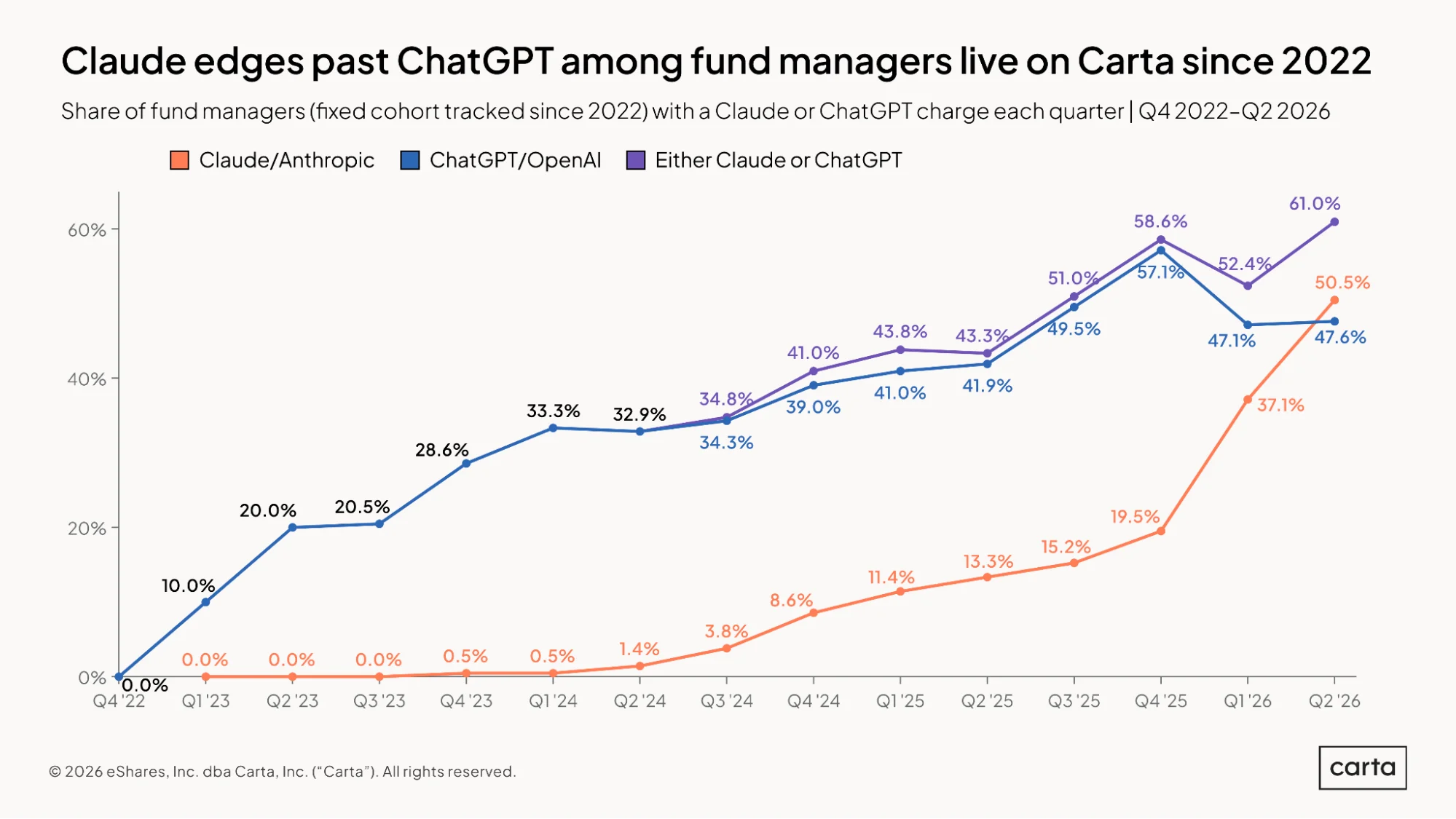
The recent trend of model adoption is similar across a fixed cohort of fund managers that have been active on Carta since the beginning of the AI era, with Claude surpassing ChatGPT earlier this year as the most-used AI tool. This cohort provides an apples-to-apples comparison of how adoption has changed within a consistent sample of funds, removing the potential confounding variable of new funds joining Carta and being added to the sample midstream.
The most significant difference between this cohort and the full sample that preceded it is that, among this fixed cohort, the share of firms subscribing to either of the two major providers declined by several percentage points in Q1 2026, driven by an even larger drop in ChatGPT use. The next quarter, however, the share of firms subscribing to either provider gained back all of those losses, and then some. Perhaps some firms that stopped paying for ChatGPT in Q1 waited until the next quarter to start paying for Claude.
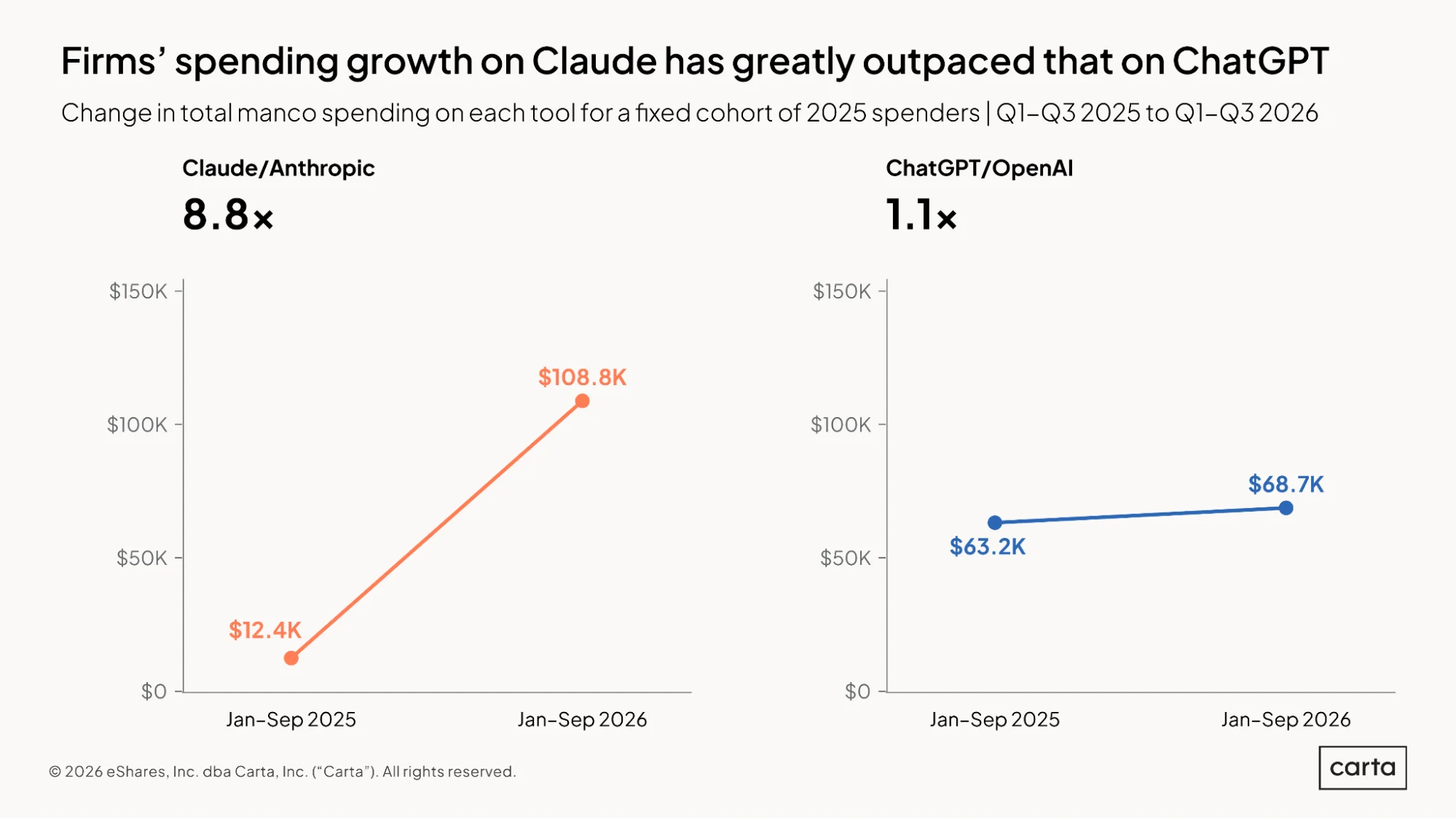
As shown in the two previous charts, new adoption of Claude among managers has spiked in 2026, with much flatter growth in new ChatGPT adoption. The same trend applies to growth in spending among existing users, with spending among existing Claude customers growing year over year at a much faster rate in 2026 than among ChatGPT customers.
Among a fixed cohort of mancos that maintained Claude subscriptions in 2025, combined spending on Claude was 8.8 times higher in the first nine months of 2026 than in the same period the year prior. For a similarly constructed cohort of ChatGPT subscribers, combined spending in 2026 was 1.1 times higher than in 2025. Sample size differs between the two subscriber groups, so comparing raw spending totals between the two cohorts is of limited utility.