Most private equity-backed portfolio companies are working toward a concrete goal set by their sponsors. It might be to increase EBITDA by 10% in the next 12 months, or to reignite growth in advance of a planned exit. Whatever the case, PE ownership has set a target it expects company leadership to hit, on budget and on time.
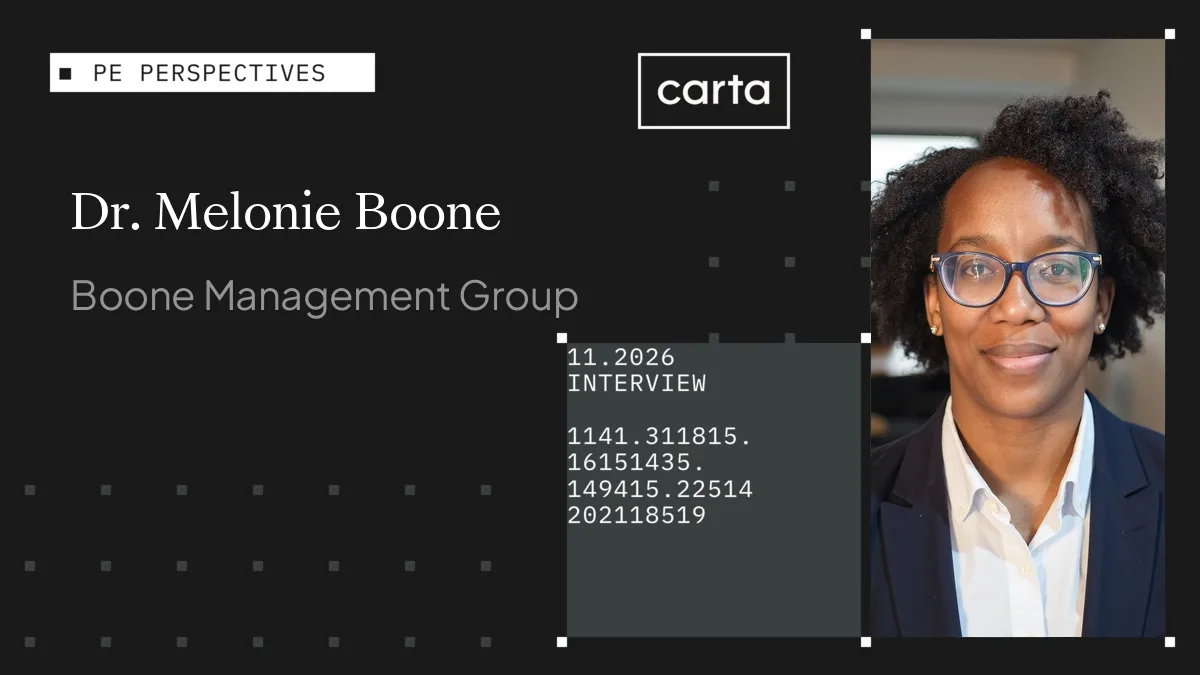
What happens when a PE-backed executive is struggling to meet their goal, and they don’t know why? Sometimes, they call Dr. Melonie Boone.
Boone is the CEO and founder of Boone Management Group, a management consulting firm that takes a unique approach to improving performance. BMG specializes in using positive psychology to help PE-backed portfolio companies hit specific financial and strategic targets, using principles that Boone—who holds a Ph.D. in organizational leadership—has spent her entire career studying.
In this conversation, which has been edited for length and clarity, we spoke with Boone about the tenets of her approach, the common behavioral problems she encounters at PE-backed portfolio companies, how executives can avoid those problems, and how communication breakdowns within company leadership can directly impact financial results.
CARTA: You come at the management consulting business from a particular angle, with a focus on how positive psychology can drive financial outcomes. How would you define positive psychology in this kind of corporate setting?
MELONIE BOONE: A lot of people think that it’s about being a cheerleader, rah rah, everything is perfect, we’re going to be worth a zillion dollars tomorrow. And that’s not what it is. My particular space I focus on is positive psychological capital. So it’s looking at a leader or a team’s level of hope, efficacy, self-esteem, resilience, and optimism. It’s more about how you deal with ambiguity, and what lens you view a challenge from.
If I had to boil it down, it’s about how do you look at all of the challenges you face—the burnout, the short staff, the financial goals—how do you look at all these things from a place of opportunity?
It sounds like the overarching principle is that people who are happy and optimistic and thinking positively are more likely to perform well than people who aren’t.
Absolutely. And there are years of research that backs that up. That’s not an opinion—that is a researched fact.
When you begin working with companies and investors, do you often find they are already thinking about these sorts of concepts?
I think they are not really thought about at all. Typically, when a company is trying to improve performance, you’ll hear executives say, “We need to hire more salespeople. We need more software engineers.” The reality is that, no matter how many of those things you spend money on, if you are not addressing the underlying behaviors that are causing growth to stall, you’re missing part of the picture. You don’t hear that talked about in the private equity space, but it really should be.
We try to tie a financial impact to these behaviors. They actually do drain margins. It’s kind of this hidden EBITDA tax that no one is recognizing, because it doesn’t show up on the P&L. But if you’re not diagnosing and identifying what the behaviors are and then trying to address them, you’re literally leaving millions of dollars on the table.
What are some of the most common behavioral problems at PE-backed companies you find yourself working to address?
The most common things we see are decision latency, key-person dependency, and middle-management friction.
Decision latency is about delayed decisions. I worked with a COO once who heard that and said, “Well, I make really fast decisions.” But we’re not just looking at you, right? We’re looking at your team, and we’re finding that the team goes to him to make all of the critical decisions. But before they go to him, they might hem and haw for weeks because they’re not sure if they should ask him, or how best to frame it. By the time the decision is made, weeks have passed, and that delayed decision is costing them operational hours.
Key-person dependency is when decisions have to route to a specific person, or when there’s one person who does the bulk of the work or has most of the understanding around a specific concept or process.
And middle-management friction, or mid-tier friction, it’s like a game of telephone. Say the executive leadership team sits in on the board meeting where they set the strategy. The ELT translates that strategic intent and passes it down to the mid tier, and so on. And things get lost along the way. By the time it gets to the front-line workers, sometimes the priorities have filtered through what the VP or director thinks the priorities should be versus the priorities that everyone aligned on.
When you’re brought on to work with a company, where do you start?
We have a suite of diagnostic tools that were created based on my 30-plus years of experience and a decade of research around positive psychological behaviors. I will tell you, every intake call starts the same way: “We are a family. We work hard together. We win together. We love each other.” We use our tools to actually dig below that surface to understand what’s really happening.
We will interview five to 10 people, and then we also distribute a questionnaire that they can send to as many people as they want, all the way down the org. We want to see the full breadth of information. And then we have other tools that ask questions to understand how aligned the leaders of the organization are around some of these key behaviors that we see.
We leverage data to get past the interview phase. Everybody is going to tell you exactly what you want to hear in that first intake. We start with the data so we can understand the behaviors that are causing whatever challenges the business is trying to address.
Once you identify these problems, how do you go about trying to make changes?
We come in from a positive angle. We look at different team members and identify their strengths, what we call superpowers. And it’s about, how do you leverage those superpowers to bridge the gaps that you’re finding? We have a team matrix that shows, this person is really strong here, and this person is strong here, and this person is weak here. We spell it out, and we do alignment sessions.
We try to embed with clients for six to 12 months, because we truly want to be there and pivot when we have to pivot. We attend team meetings. We get as immersed as we can in the business, because that’s how you actually change behavior.
When you work with a PE-backed company, do you usually get connected through the PE sponsor, or brought on by the company itself?
It’s a combination of both. We actually just submitted a proposal to work with a PE group across seven portfolio companies. Regardless of how it originates, they typically come to us when they’re trying to figure out how to get to a level that they know they should be able to reach. It’s like that gut feeling where you know something’s not right, and you’re not hitting the numbers you thought you were going to. And we help uncover what’s going wrong.
I love to work with private equity, because it’s high stakes. We don’t work with leadership teams that are struggling. We work with high-performing teams that make high-stakes decisions every single day, and there’s something that’s just not clicking, and they’re trying to figure out what it is.
From this behavioral psychology perspective, are there aspects of working at a PE-backed company that are different from other types of companies?
It’s the pressure. You tend to have some very specific goals that need to be accomplished on a very tight timeline. And that sense of pressure can turn people against each other. It’s not done purposefully. We don’t walk into any team and hear, “I hate X. I hope her job never gets better.” Most teams genuinely care about each other. But it’s just the pressure. They’re squeezed from so many different directions.
Maybe the CFO goes to a board meeting, and things aren’t where they’re supposed to be. The CEO is getting calls from the sponsor saying the numbers don’t look right this month. In private equity, EBITDA is life. It’s a different beast. It takes a person who’s wired differently to work in that type of setting and to thrive and to love it, and to wake up and want to go do it every single day.
We’ve been talking mostly about executives and people in the C-suite. In your experience, is that where most of these sorts of behavioral problems at companies tend to arise?
It truly does start at the top. When you have a senior team that is aligned and has these collective behaviors and strengths, it trickles down to the mid-tier level, and from there it trickles down to the front lines. Where we find a lot of the disconnects is in going from the C-suite to a VP, or C-suite to director. Everybody below that is just following the example from what’s being said at the top. So when you feel that disconnection higher up, that’s when we tend to see different interpretations of priorities.
If I’m a CEO at a PE-backed company who wants to apply these positive psychological principles in my organization, what’s a good place to start?
The first step is to do your own diagnostic and ask a few simple questions. How long did the last major decision take to be fully executed? Was that the time that I expected? How often do my leaders come to me for resolution on things they can decide themselves? It’s a lot of self-reflection.
CEOs should start asking these questions and forcing their teams to think about it and do the math. Look at your monthly salaries you pay out. If a decision took 20 days longer than you thought, do the math on what that 20 days of salary was, because it kept them from doing something else that they should be doing. It’s costing you money.
When we say 15–20% of EBITDA is leaked annually because of these behaviors, that is true. We’re seeing it in the research. Every time we start working with a client, it reaffirms that this is happening. But for a lot of executives, it’s not even that they’re ignoring it. They just don’t know it exists.