Executive summary
By several measures, the startup fundraising market looks friendlier to founders today than at any point in the past several years.
To begin with, startups are raising more capital. Collectively, companies on Carta pulled in more than $49 billion in Q3 2026. Over the past two quarters, they’ve raised north of $100 billion. That’s the strongest six-month stretch for fundraising since Q4 2021 through Q1 2022.
Startups are raising that capital at higher valuations. At every fundraising stage, median valuations are significantly higher in 2026 than in 2025. At most stages, median valuations are now higher than in 2021, at the height of the pandemic bull market.
While achieving these lofty valuations, founders are retaining more ownership than ever before. Median dilution in new funding rounds continues to plummet at every stage. And fundraising timelines are accelerating, with the typical time between priced rounds shrinking at most stages over the past year, in some cases by multiple months.
More capital. Higher valuations. Less dilution. Less time between rounds. For founders, it’s an appealing combination.
But there’s a key caveat. As these shifts have taken place, the number of new VC rounds closing has declined. In Q3, total deal count across all stages was down 21% year over year.
When a startup does successfully raise capital, recent metrics are increasingly encouraging. Particularly in terms of valuations, the sky seems to be the limit.
But will a startup be able to raise capital at all? For many founders in the market today, that may be the most pertinent question.
Q3 highlights
Capital is pouring into the hardware sector: Through the end of Q3, hardware startups on Carta had raised nearly $34 billion in 2026, more than doubling the amount of cash raised during the first three quarters of 2025. Compared to other major sectors, hardware startups at both seed and Series A tend to raise larger rounds and attain higher valuations.
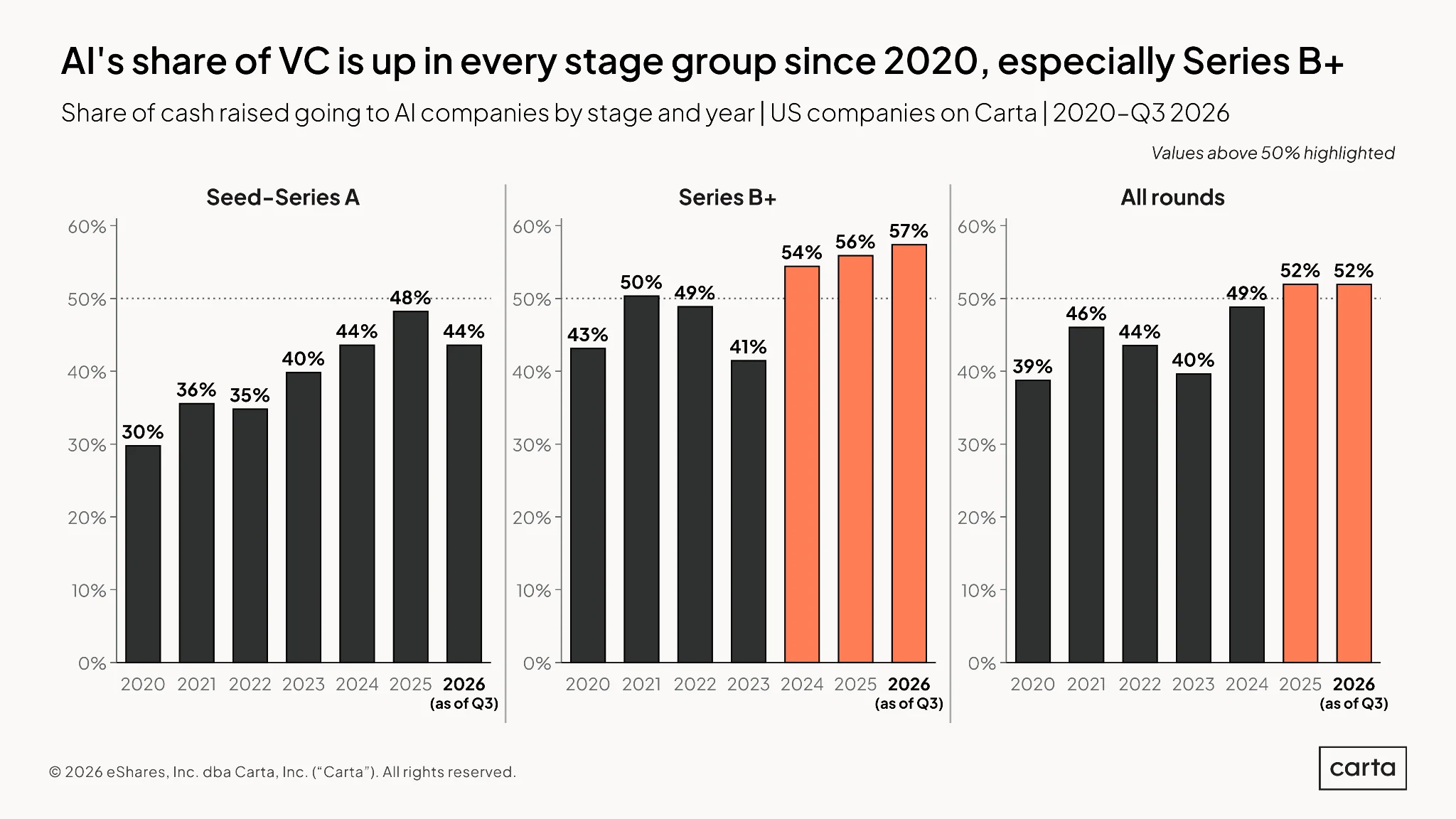
AI is eating up a larger share of late-stage funding: About 57% of all capital invested on Carta so far this year at Series B and beyond has gone to AI startups, the highest share of AI fundraising ever for these late-stage rounds. At seed and Series A, AI accounts for 44% of cash raised this year, down from 48% in 2025.
Silicon Valley is as central as ever: Startups based in the Bay Area are responsible for more than 40% of all cash raised on Carta so far this year, more than three times higher than New York, the next busiest startup hub. Aided by this Bay Area boom, California has claimed about 53% of all cash raised in 2026, and the West census region’s share is at 60%.
Fundraising overview
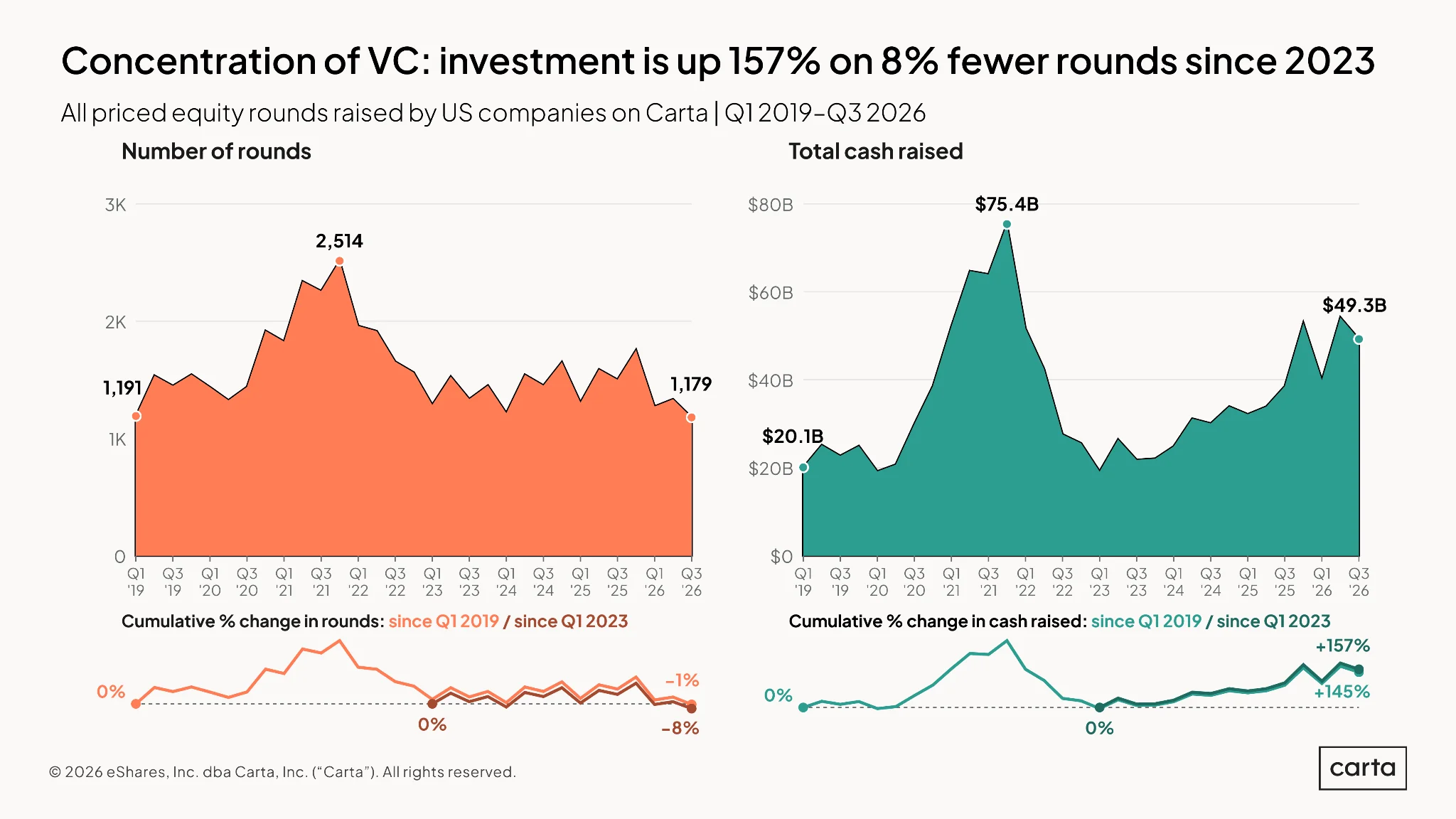
Companies on Carta combined to raise $49.3 billion in new venture funding across 1,179 rounds in Q3. Since the market’s recent low point in early 2023, quarterly fundraising totals have been steadily climbing, boosted by the massive sums being raised by the most highly regarded AI startups. Over the past two quarters alone, startups on Carta have added more than $100 billion to their collective coffers.
As investors have poured more and more capital into the venture ecosystem in 2026, the number of rounds being raised has slightly declined. For example, the amount of cash raised in Q3 2026 is 157% higher than the total from Q1 2023, while the quarterly round count is 8% lower. This means that, over that same span, the average VC round size has more than doubled.
Read the full report
Submit the form below to access the full report and receive a copy in your inbox.


DISCLOSURE: This communication is on behalf of eShares, Inc. dba Carta, Inc. ("Carta"). This communication is for informational purposes only, and contains general information only. Carta is not, by means of this communication, rendering accounting, business, financial, investment, legal, tax, or other professional advice or services. This publication is not a substitute for such professional advice or services nor should it be used as a basis for any decision or action that may affect your business or interests. Before making any decision or taking any action that may affect your business or interests, you should consult a qualified professional advisor. This communication is not intended as a recommendation, offer or solicitation for the purchase or sale of any security. Carta does not assume any liability for reliance on the information provided herein. ©2026 Carta. All rights reserved. Reproduction prohibited.