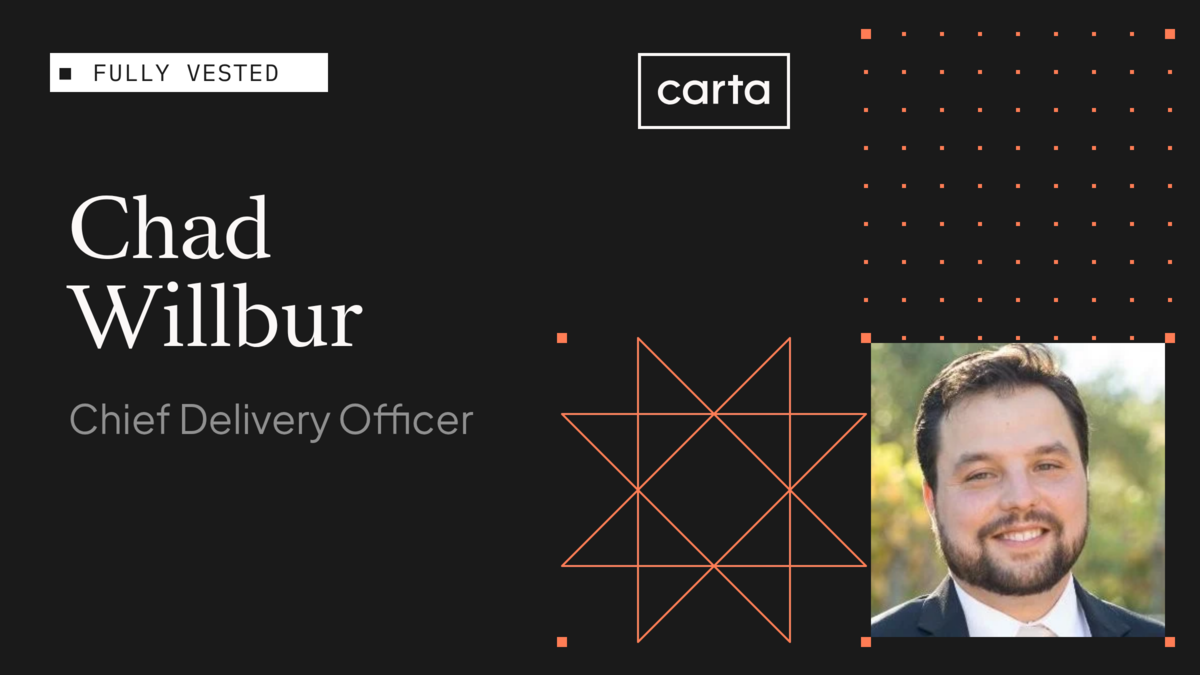
Chad Willbur has spent the past 25 years thinking about how to bring financial services for the private market into the modern era. Now, he’s taking on his biggest opportunity yet.
As Carta’s new chief delivery officer, Chad leads the organization that delivers services of all kinds to Carta’s customers. Whether it’s a company seeking a new 409A valuation, a fund CFO compiling their latest tax documents, or an LP visualizing the breadth of their investment portfolio, Chad’s delivery organization plays an integral role in making sure Carta’s customers get all the data and documents they need, exactly when they’re needed.
From his earliest days as a boutique valuations analyst to a series of roles over the past decade at Carta, Chad has witnessed the transformation of the private markets during the 21st century firsthand. In his new role, he will help shape the way that companies, GPs, and LPs interact with Carta as that transformation continues.
“When I joined Carta, a lot of our value was digitizing things that previously lived in spreadsheets, PDFs, and email. As private markets have grown, the complexity has exploded,” Chad says. “Funds have become more sophisticated, investors expect better data, reporting requirements have increased, and customers increasingly expect institutional-quality infrastructure much earlier in their lifecycle. AI represents another evolution. We’re moving toward a model where software can increasingly execute workflows itself, with human experts providing judgment, oversight, and relationships.”
In this conversation, which has been edited for length and clarity, Chad discusses this new model for delivering service and much more, including his background in financial services, the role of the delivery organization, how AI is changing the way customers interact with Carta, how customer feedback has shaped his priorities, and the problems he’s most excited to solve in his new role.
CARTA: You joined Carta almost 10 years ago. How have your roles and responsibilities evolved over that time?
CHAD WILLBUR: When I joined Carta in January of 2017, my first real role was to build out the valuations function. Just in that first year, the speed and scale at which that organization grew was amazing. Alongside the cap table product, we went from being a pretty scrappy and small outfit to being one of the largest providers in the world.
The job has evolved along with Carta. We started as primarily an equity management company. Today we’re an operating system across a much larger part of the private capital ecosystem. Over the last 10 years, I’ve had the opportunity to build and lead businesses across valuations, financial reporting, tax, advisory services, and, increasingly, implementations and broader customer delivery.
What’s been really interesting to me is that it’s a lot of very similar problems across everything that we do. You’re pulling in information, you’re normalizing that into some sort of deliverable, and then you’re delivering that to the customer. And sitting behind it is a team of the world’s best experts to be able to answer questions they might have as it relates to whatever the deliverable might be.
What have you taken away from those prior roles at Carta that will inform how you approach the job of chief delivery officer?
One of the biggest lessons is that technical excellence is necessary, but it’s not sufficient.
You can produce a technically perfect valuation or tax return. But if the customer doesn’t know what’s happening, or if it takes too long, or if they have to fight through your organization to get an answer, that’s not a great customer experience. Customers don’t care which internal team owns something. They expect Carta to solve the problem.
The second lesson is around scale. I’ve watched teams go from relatively small groups of experts to businesses serving thousands of customers. You can’t scale by just continually adding people. You need great people. But you also need technology, strong operating systems, and clear accountability.
If someone isn’t familiar with the delivery function, what would you want them to know about the organization’s role in Carta’s business? How does the delivery team help create that customer experience?
The simplest explanation is: Product builds what Carta sells. Sales brings customers to Carta. Delivery makes sure Carta actually delivers the outcome we promised.
It’s a large organization, with more than 500 people spanning implementations and ongoing services across Carta. That includes getting customers implemented, fund administration, tax, valuations, financial reporting, investor services, LP services, and a number of other operational and advisory functions. We work across all Carta’s major customer groups: companies, GPs and funds, and LPs or allocators.
It’s pretty rare that a customer doesn’t touch at least one area, if not multiple areas, of our delivery group. We see every day where the software works beautifully, where customers struggle, and where people and technology need to come together to produce the outcome.
In terms of how we work with those customers, the most important thing is to have empathy. You have to understand where customers are coming from and try to put yourself in the shoes of the person you’re talking to, and make sure you listen. The other thing is that speed and accuracy matter more than anything else. If you’re able to get their question answered very quickly and well, that is the best possible outcome. Everything else flows from there.
What is your mandate as chief delivery officer? What specific problems were you brought in to solve?
My mandate is twofold: elevate quality standards and direct ownership across our service model, and guide the integration of AI agents into our client-facing operations.
On the operational front, we took a deliberate look at our delivery model to double down on what matters most to our clients: speed, technical precision, and direct access. Historically, our setup separated technical execution from client communication, but we’ve re-engineered our delivery model so that the specialists doing the actual work are the ones speaking directly with clients. We’re also actively strengthening our talent across the board by bringing on seasoned managing directors and veteran accountants who have the deep technical authority to solve complex challenges and deliver results.
On the AI front, my role is driving our operations from manual processing to more agent-driven workflows. This allows AI agents to absorb tedious administrative tasks while our senior experts concentrate on high-value strategic guidance, rigorous quality control, and key decisions.
How will fund administration service concretely change under your leadership?
First, Carta customers will experience direct, single-point access. They’ll work directly with the experts executing their work for faster answers and tighter quality control.
Second, turnaround times will collapse. A huge portion of traditional fund admin latency comes from manual data entry and back-and-forth communication: emailing us for a number, having a team manually run calculations behind the scenes, and emailing back. We’re eliminating that friction by embedding AI agents directly into our accounting workflows and putting agent capabilities directly at the fingertips of the fund CFO.
Third, our team's role shifts from manual processing to high-value guidance. While AI agents handle repetitive tasks like capital-call bookings or bank reconciliations, our accountants spend their time reviewing edge cases, providing strategic advice, and maintaining oversight.
How do you reimagine service in an agent-driven world?
Historically, interacting with fund services required logging into systems, pulling reports, and asking human teams to execute back-office steps, whereas in an agent-driven world, AI agents handle basic repetitive execution proactively.
We book roughly a million transactions a month using AI agents right now, handling tasks like capital call bookings, creating asset classes, and mapping journal entries automatically. Every time an agent processes a transaction or receives a correction, it logs that context into a memory system. Over time, the agents learn customer-specific rules, like whether a fund only executes capital calls on Wednesdays.
Longer-term, service won't be a human emailing an agent or clicking a web portal; it’ll be agent-to-agent. Through tools like Carta Plugins, a CFO’s AI agent will speak directly to Carta’s AI agents via APIs to execute tasks, settle queries, and report back automatically.
What is Carta’s perspective on keeping the human in the loop?
Instead of “human in the loop,” we really look at it as the human being the tool call.
For straightforward tasks where our accuracy data is exceptionally strong, like cash reconciliations, agents just run with it without human intervention. But when you get into complex, judgment-heavy, or client-facing workflows, the agent generates a draft and issues a tool call to a human expert. It asks them to step in, review, verify, or handle a specific step like a security callback before anything actually goes out the door. If a calculation or tone needs tweaking, the human makes the edit, which directly trains the agent for the next time around.
AI agents strip away the tedious administrative legwork, but they’re never going to replace human judgment, technical depth, and trust. As agents handle more of the manual processing, we’re positioning senior, veteran accountants right next to our clients. Agents execute the work, but human hands provide the final stamp of approval every time.
How has input and feedback from customers shaped the way you’re approaching the role so far?
Feedback from the customer matters more than just about anything.
One thing customers consistently tell us is that they value Carta’s technology, but when something is important or complicated, they also want access to someone who deeply understands their business. That’s a big part of how I’m thinking about the organization, especially as we rely more on AI and give customers more ownership of their own data. Technology should remove administrative work from our experts. But it shouldn’t remove expertise from the customer relationship.
That’s particularly important in businesses like fund administration and tax. The better our technology gets, the more opportunity we have to put senior accounting and tax professionals closer to customers.
How will you judge success in this new role? What will that look like to you six months from now, a year from now?
The numbers obviously matter—retention, customer satisfaction, delivery times, quality, productivity, and margins. But metrics are just the result of actions. If we can get the input right on the delivery side and work with Product to make the product better, all the financial metrics will figure themselves out.
Qualitatively, I’ll know we’re succeeding when a few things start happening. One, customers trust us more. They know who owns their problems, and they feel like Carta is ahead of them, rather than reacting to them. Two, our people feel more ownership. They get to spend more time with customers and less time doing administrative work, which will become easier as AI is more closely integrated into our regular workflows. And finally, delivery feels like one unified organization. Customers shouldn’t experience Carta as a collection of departments.
If we’re sitting here a year from now and customers are happier, our people have better tools, senior professionals are closer to customers, and we’re delivering substantially more work without needing to scale headcount at the same rate—that’s success.

DISCLOSURE: This communication is on behalf of eShares, Inc. dba Carta, Inc. ("Carta"). This communication is for informational purposes only, and contains general information only. Carta is not, by means of this communication, rendering accounting, business, financial, investment, legal, tax, or other professional advice or services. This publication is not a substitute for such professional advice or services nor should it be used as a basis for any decision or action that may affect your business or interests. Before making any decision or taking any action that may affect your business or interests, you should consult a qualified professional advisor. This communication is not intended as a recommendation, offer or solicitation for the purchase or sale of any security. Carta does not assume any liability for reliance on the information provided herein. ©2026 eShares, Inc. dba Carta, Inc. All rights reserved. Reproduction prohibited.