
Venture-backed startups and their investors both hoped that 2026 would be the year when the exit floodgates would open and some much-needed returns could start flowing back to LPs.
So far, they’ve got their wish, with exit proceeds soaring during the first half of the year. But the picture is more complicated than the headline numbers might suggest.
First, the positives. IPOs in the U.S. have already raised more than $140 billion in proceeds in 2026, meaning this year should easily outpace 2021 to become the most lucrative year in history for public listings. In the first half of this year alone, IPO proceeds more than tripled the full annual total from 2025.
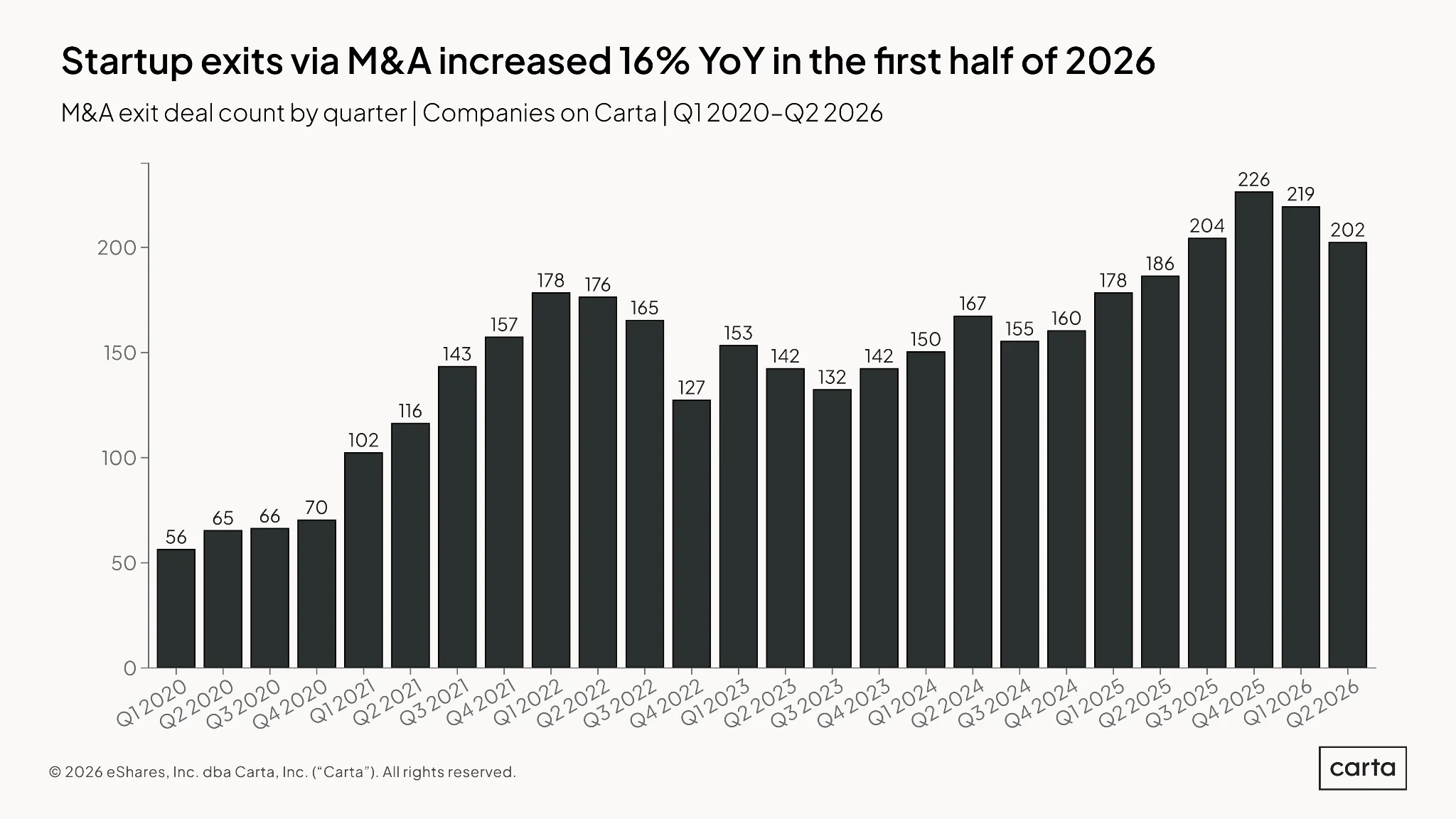
Startups on Carta also completed 421 exits via M&A during H1 2026, marking the busiest first half on record for startup M&A and a 16% year-over-year bump. Across all deal types, total VC-backed exit value in H1 topped $2 trillion.
“We’re seeing a lot of IPO activity,” says Aman Verjee, founder and general partner at Practical Venture Capital. “That’s good news. I think it’s great for liquidity to LPs.”
Now, the complications. Some $75 billion of those IPO proceeds and $1.7 trillion of the overall exit value can be attributed to a single deal, the long-awaited IPO of SpaceX. Two other acquisitions by SpaceX added another $300 billion or so to the exit total. It’s been an extraordinarily top-heavy market, with more jumbo IPOs from leading AI labs potentially in the offing in H2.
These mega-transactions supply important grease for the skids of the VC ecosystem. But they’re also clearly outliers. What does the exit environment look like for the rest of the startup market?
“It’s a good time for some,” says Isabelle Freidheim, founder and managing partner of Athena Capital, an investment firm that backs late-stage companies preparing for an exit. “And a more challenging time for others.”
The startups with reason for exit optimism
The vast majority of the companies mulling exits in the back half of 2026 are not frontier AI labs with valuations measured in the hundreds of billions of dollars. But those frontier labs provide a useful model for the sorts of traits investors are looking for, in both IPOs and M&A.
To line up a successful exit today, Freidheim says having a strong AI story is essentially non-negotiable. Not every company needs to employ an armada of Ph.D.s tasked with developing proprietary models. But exit candidates do need to demonstrate a compelling narrative for how they’re using AI to work more efficiently, build an effective competitive advantage, and win over customers.
In most cases, the proof for this AI narrative lies in strong recent growth. Companies that have been able to ratchet up their ARR and post impressive net revenue retention will likely find themselves well positioned for liquidity events.
“There’s a lot of appetite for AI growth companies,” Freidheim says. “Those are likely to command higher valuations.”
In terms of AI storytelling, investors are particularly interested in companies building vertical software designed to fit into unique workflows and address unique problems within a certain sector or ecosystem. For strategic acquirers who may have otherwise tried to develop such vertical systems in-house, these sorts of targets can serve as an appealing shortcut.
“There are a lot of strategics thinking, what’s next for us in terms of our technology offerings, and how do we build that technology?” says Kip Wallen, senior director of thought leadership at M&A specialist SRS Acquiom. “Do we go out and buy it?”
The startups with more work to do
Today’s exit environment doesn’t look so friendly to those companies that have not kept pace with the rapid rate of change seen in the startup market over the past few years.
Thousands of startups that were founded before the November 2022 launch of ChatGPT (the unofficial beginning of the AI revolution) are still actively seeking exits. Many of these companies are still pegged to valuations they attained back in 2020 or 2021, when the valuation environment for software startups was far more friendly.
To varying degrees, most of these companies have tried to implement AI into their offerings. In some cases, this retrofitting has been comprehensive, allowing companies to transition into a new phase of AI-powered growth. In others, it’s been a surface-level shift. For this latter group, the exit window remains as difficult to navigate as it has been for the past three or four years.
“They’ve been waiting, hoping not to accept lower valuations.” Freidheim says. “But the environment hasn’t fundamentally changed. Founders are coming to terms with where valuations are today. Ultimately, a valuation is what someone is willing to pay.”
The current market may also present challenges to companies facing certain macro headwinds that continue to persist. In Wallen’s view, many investors are still shying away from targets with significant exposure to things like oil prices, interest rates, tariffs, and ongoing wars in Europe and the Middle East.
“The volatility around some of these geopolitical events is maybe starting to wear a little thin with buyers,” Wallen says.
How startups can shift the narrative
Most IPO investors and strategic acquirers are looking for targets that fit a specific profile. But just because a company doesn’t fit that archetype of strong AI-powered growth doesn’t mean it is destined to wither and die on the vine.
“Most of them are not bad companies,” Freidheim says of the startups still facing exit headwinds. “They’re profitable, but they’ve become slower-growing, or what many in venture capital would call zombie companies. They’re growing, just not at the pace investors have come to expect from venture-backed technology companies.”
Investors see a few possibilities for this population of startups. They can continue to develop their AI offerings and try to better match the desires of public investors and strategic acquirers. They can improve their financial profile in other ways, aiming to spark more growth. Some startups may choose to join forces, hoping increased scale will lead to increased investor appeal.
“You have to work on your AI gameplan if you can,” Verjee says. “And if you can’t, you’ve got to come up with some way to reset. Maybe the answer is you have to consolidate with other companies. At some point, if you can cut costs, be profitable, continue to grow, maybe find other ways than IPO, be a part of a consolidation or a profit equity play—those are all things that people should be considering now.”
Yet these sorts of strategic shifts will only go so far. The exit market is growing more and more bifurcated, and in 2026, the rate of that bifurcation seems to be accelerating. Which companies will end up on which side of this growing divide? For now, the best answer is only two letters long.
“We’re seeing have and have-nots, where the AI companies are sucking up a lot of money and doing really well,” Verjee says. “If you have that story, you can get public and get to an exit. If you don’t, I think life is very, very complicated.”
Subscribe to the Data Minute newsletter

DISCLOSURE: This communication is on behalf of eShares, Inc. dba Carta, Inc. ("Carta"). This communication is for informational purposes only, and contains general information only. Carta is not, by means of this communication, rendering accounting, business, financial, investment, legal, tax, or other professional advice or services. This publication is not a substitute for such professional advice or services nor should it be used as a basis for any decision or action that may affect your business or interests. Before making any decision or taking any action that may affect your business or interests, you should consult a qualified professional advisor. This communication is not intended as a recommendation, offer or solicitation for the purchase or sale of any security. Carta does not assume any liability for reliance on the information provided herein. This post contains links to articles or other information that may be contained on third-party websites. The inclusion of any hyperlink is not and does not imply any endorsement, approval, investigation, or verification by Carta, and Carta does not endorse or accept responsibility for the content, or the use, of such third-party websites. Carta assumes no liability for any inaccuracies, errors or omissions in or from any data or other information provided on such third-party websites. © 2026 eShares, Inc. dba Carta, Inc. All rights reserved. Reproduction prohibited.