Executive summary
Across the tech ecosystem, executives have spoken repeatedly in recent months about the need to flatten their organizations in the age of AI. This typically means fewer management layers. It also means many companies are more sharply focused on the individual contributors (ICs) who perform the actual work.
This shift in priorities is apparent in Carta’s latest data on new-hire compensation.
Compared to where the market stood at the start of 2024, ICs have experienced bigger gains in both median salary and the median size of initial equity grants than any other level of employee seniority. For ICs one step below senior status, for instance, the median salary benchmark for new hires is up 18.5% over this span, while median initial grant size has risen by 25.4%.
This stands in stark contrast to compensation shifts for many more-senior roles. Take senior directors: Among this cohort, median salary benchmarks have climbed 6.3% since the start of 2024, while median equity grant size is up by just 3.9%. For employees at the VP level and above, meanwhile, the median size of initial grants has shrunk over the past two and a half years.
In terms of dollars and cents, of course, higher-ranking positions still earn substantially more. In fact, the median salary for new hires made in H1 2026 was more than twice as high for senior directors as it was for those ICs who are a step above entry level.
But the gap is narrowing. Many companies seem to believe that AI is simultaneously reducing the need for multiple layers of management and increasing the capabilities of top-level ICs. As the makeup of orgs transforms, their compensation practices are changing, too.
Key takeaways
Headcount growth is holding steady: At some companies, layoffs have been another side effect of the drive toward flatter organizations. Across the startup ecosystem as a whole, however, layoff figures from H1 2026 are actually down compared to both 2024 and 2025. On the whole, net headcount growth at Carta has held relatively steady from one month to the next since the start of 2024.
First hires are receiving more equity: Over the past two years, the median first hire made by startups on Carta received an initial equity grant equivalent to 1.75% of total company equity. This figure continues to climb from prior analyses. And for some first hires, it’s substantially higher: The 75th percentile for initial grant size among this cohort is 4.26% of fully diluted company equity.
Compensation remains highest in product and engineering: In terms of both salaries and initial equity grants, companies are still willing to pay more for talent in product and engineering than any other organization, with product at the top of the heap. Through the end of H1, the median benchmarks for a new hire in product were $180,600 in salary and an initial grant comprising about 0.024% of company equity.
Hiring and headcount
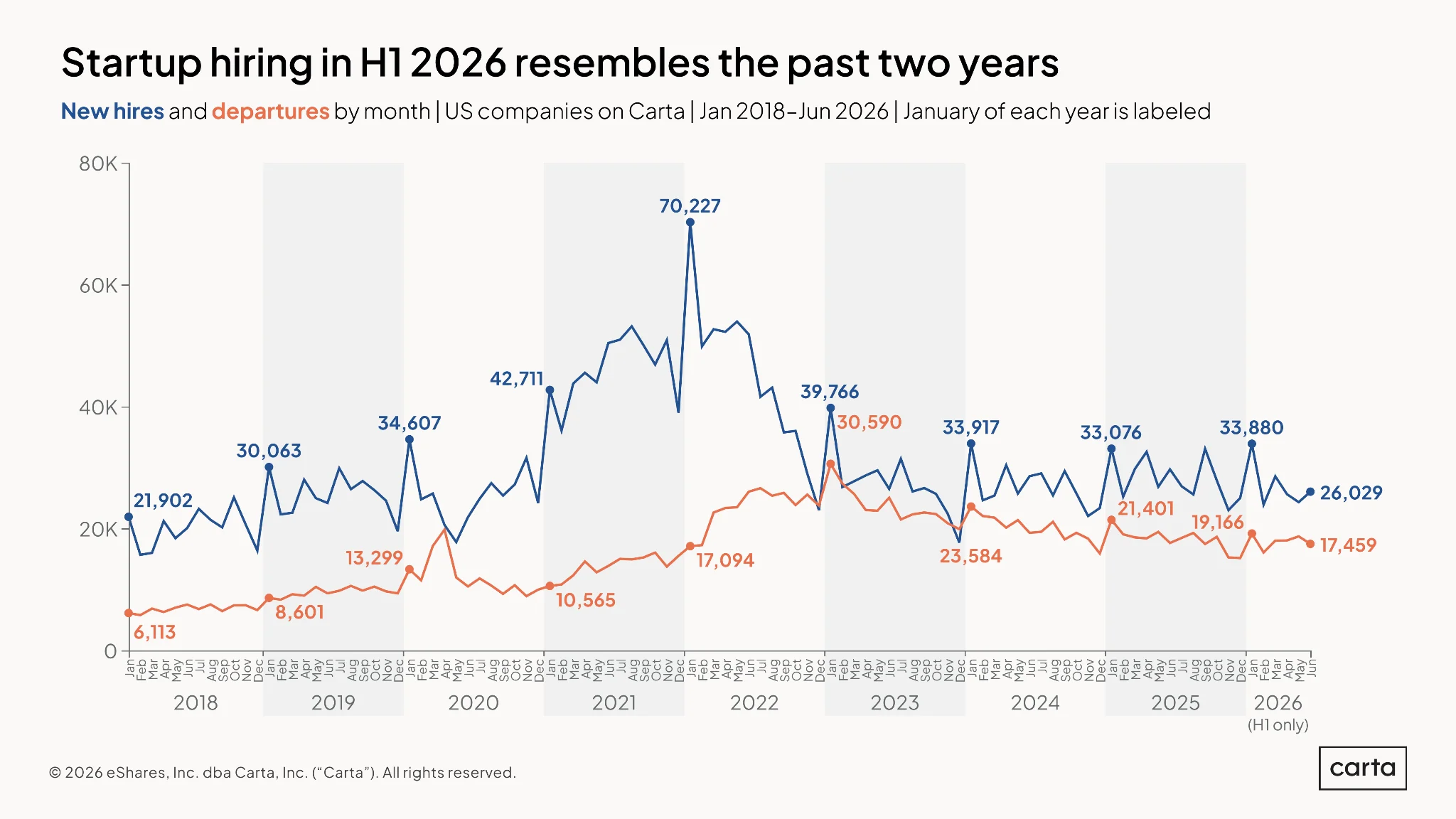
The startup job market has settled into a consistent rhythm in the past three years, with both new hires and departures peaking each January and then gradually declining as the rest of the year unfolds, with a few ups and downs in between. So far, 2026 is looking no different.
New hires have now outpaced employee exits for 30 straight months. In June, companies made 1.49 hires for each departure, representing a steady rate of growth across the startup industry. But employee growth rates in the age of AI still remain well below the levels seen from 2018 through 2022. For example, back in January 2019, companies made 3.49 hires for every departure.
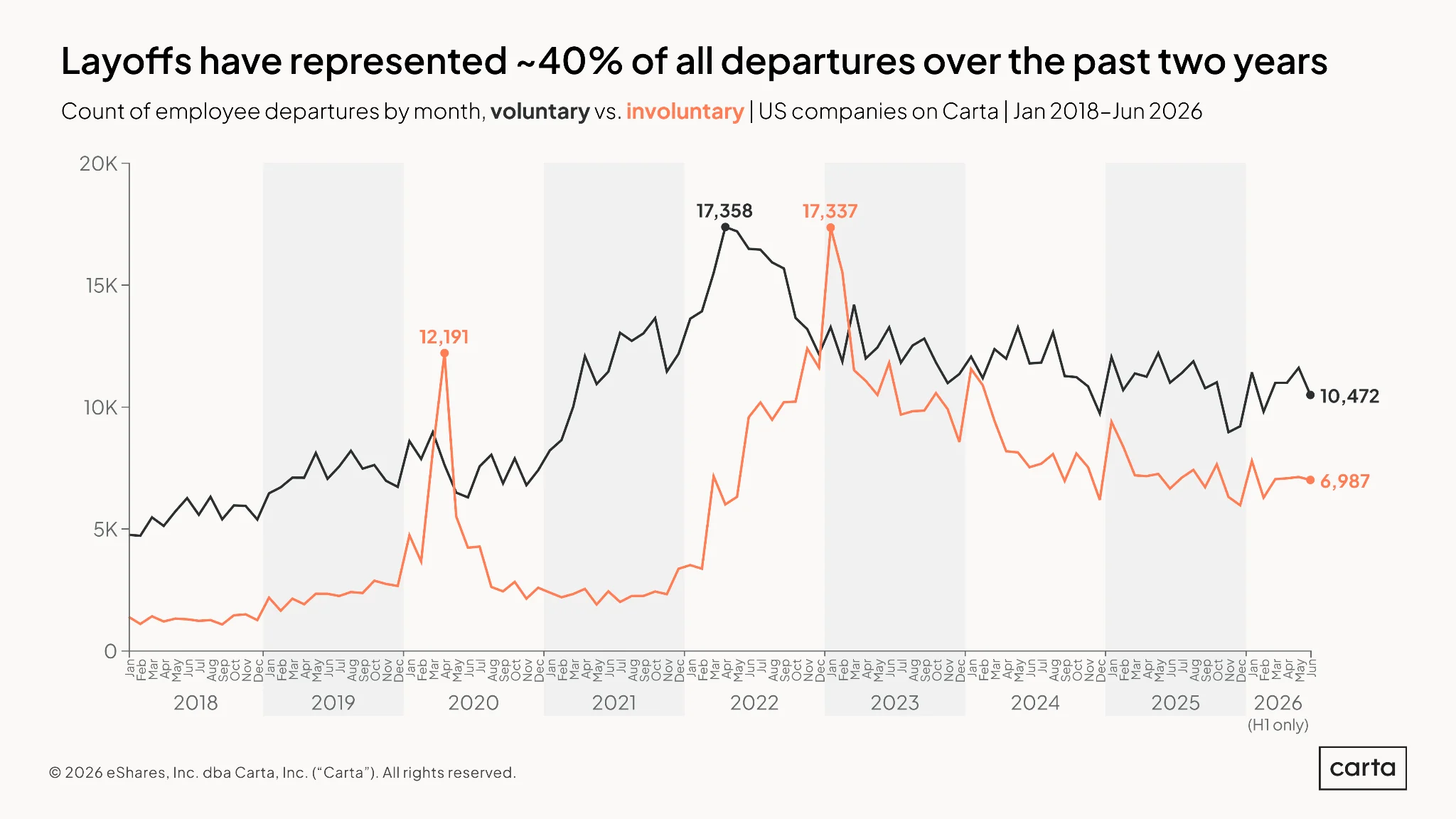
In June, 60% of all employee departures from companies on Carta were voluntary. The other 40% were involuntary, with layoffs accounting for most of these involuntary exits. This ratio of voluntary to involuntary departures has held relatively steady for the past two years.
Voluntary job departures have been more common than involuntary departures for most of recent history, with the exception of two market-wide spikes in layoffs that occurred in 2020 and 2023. Compared to that 2023 spike, the count of involuntary departures this June was down 60%. In general, the month-to-month pace of voluntary exits has been less volatile over the past several years than the pattern of involuntary departures.
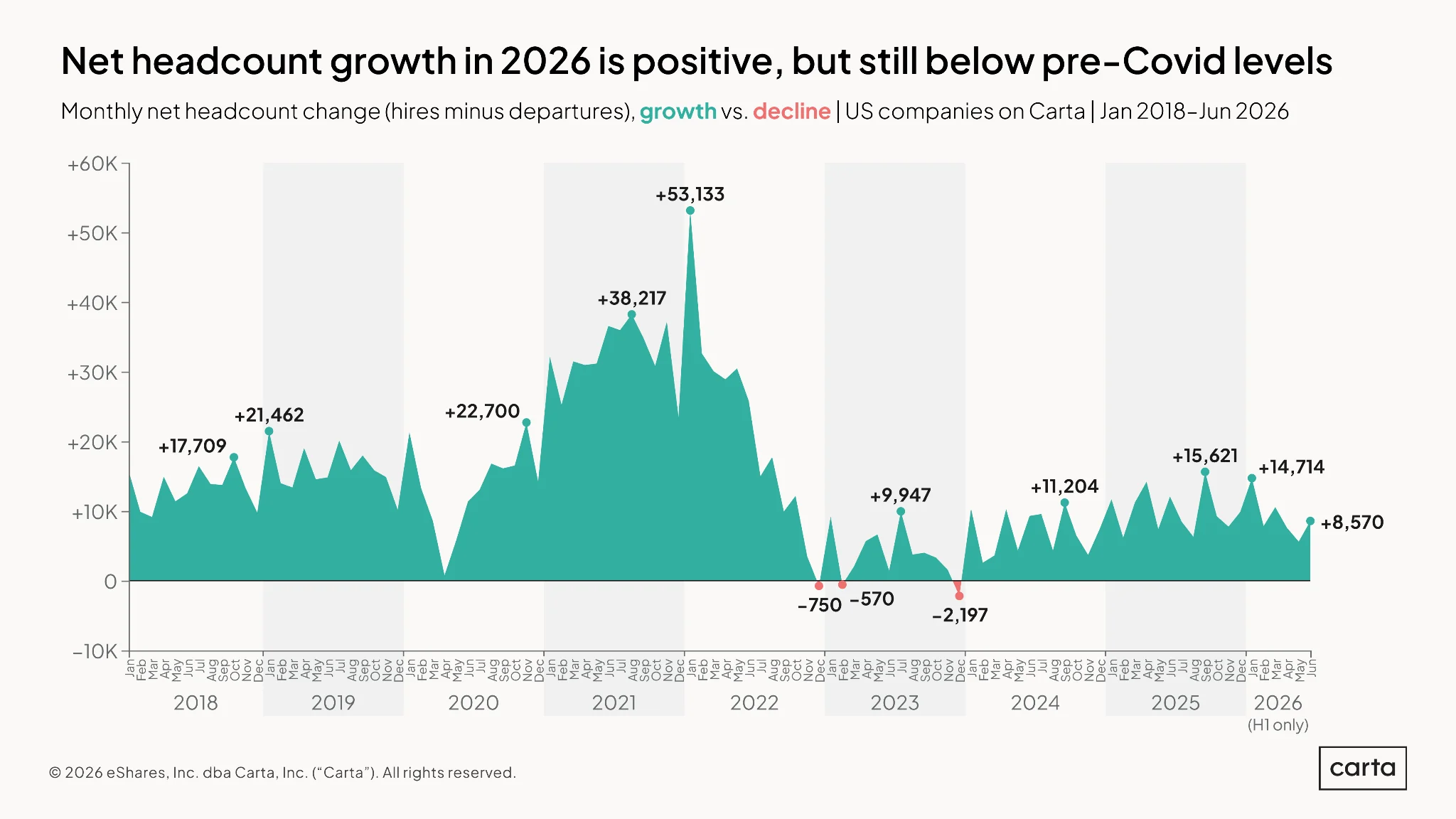
Over the past two and a half years, net headcount at startups on Carta has typically grown by somewhere between 5,000 and 15,000 people each month. The rate of growth in June was right in line with this recent trend, with companies making 8,570 more hires than they saw total departures.
From 2020 through 2023, headcount growth figures experienced wild ups and downs. The stability of the past two-plus years is more reminiscent of 2018 and 2019, the last time net headcount was growing at such an even rate from one month to the next. The difference: Total headcount was growing quite a bit quicker in the late 2010s. Hiring numbers in those years were roughly the same as in the mid-2020s, but departures in the late 2010s were far less frequent.
Read the full report
Submit the form below to access the full report and receive a copy in your inbox.


DISCLOSURE: This communication is on behalf of eShares, Inc. dba Carta, Inc. ("Carta"). This communication is for informational purposes only, and contains general information only. Carta is not, by means of this communication, rendering accounting, business, financial, investment, legal, tax, or other professional advice or services. This publication is not a substitute for such professional advice or services nor should it be used as a basis for any decision or action that may affect your business or interests. Before making any decision or taking any action that may affect your business or interests, you should consult a qualified professional advisor. This communication is not intended as a recommendation, offer or solicitation for the purchase or sale of any security. Carta does not assume any liability for reliance on the information provided herein. ©2026 Carta. All rights reserved. Reproduction prohibited.