Executive summary
At most stages of the fundraising lifecycle, founders in the Asia-Pacific, Middle East, and Africa (APAC & MEA) hold ownership stakes above their U.S. peers.
In both regions, the median founding team owns 51% of the company after raising a seed round. At each stage from Series A through Series C, median ownership among APAC & MEA founders is two to four percentage points more than for U.S. founders. The biggest gap is at Series A, where median ownership in APAC & MEA is 39%, compared to 35% in the U.S. By Series D+, the trend reverses, and U.S. founders are one point ahead (11% versus 10%).
The regions also differ in how company ownership is distributed beyond the founding team. APAC & MEA founders give up less equity than U.S. founders at Series A (17.7% median dilution versus 20.3%), and their companies reserve smaller ESOPs at most stages: 10% versus 12% at seed and 10.6% versus 17% at Series C. A smaller pool leaves less equity for later hires unless the pool is topped up, which dilutes founders, too.
This report analyzes founding structure, dilution, ownership retention, employee option pool sizing, and advisor and board equity across private companies headquartered in APAC & MEA on Carta. Where possible, analysis is broken out into four subregions: Australia and New Zealand (ANZ), East and Southeast Asia (ESEA), Middle East, North Africa, and South Asia (MENASA), and Sub-Saharan Africa (SSA). Comparisons to U.S. companies are provided throughout for reference.
Key takeaways
Solo founding is the most common structure: In APAC & MEA, 40% of startups founded in 2025 had a single founder, compared with 33% in the U.S. By industry, fintech stands out: only 31% of fintech companies launched in APAC & MEA since 2019 were solo-founded, and 16% were founded by teams of four or more.
APAC & MEA founders generally retain more ownership: From Series A through Series C, APAC & MEA founding teams tend to hold more equity than their U.S. counterparts. At Series C, the median founding team in APAC & MEA still owns 18% of the company, versus 16% for teams in the U.S.
ANZ stands apart on ESOP size: The median ESOP among ANZ companies is 13.3% of fully diluted equity, compared with 11.1% in SSA and 10.6% in both ESEA and MENASA. Even so, all four subregions sit below the U.S. median.
ESOPs are smaller than in the U.S., with one exception: At most stages, APAC & MEA companies allocate less of their fully diluted equity for ESOPs than U.S. companies. The exception is Series B, where the median is identical: 15.4% for both.
Founder journey
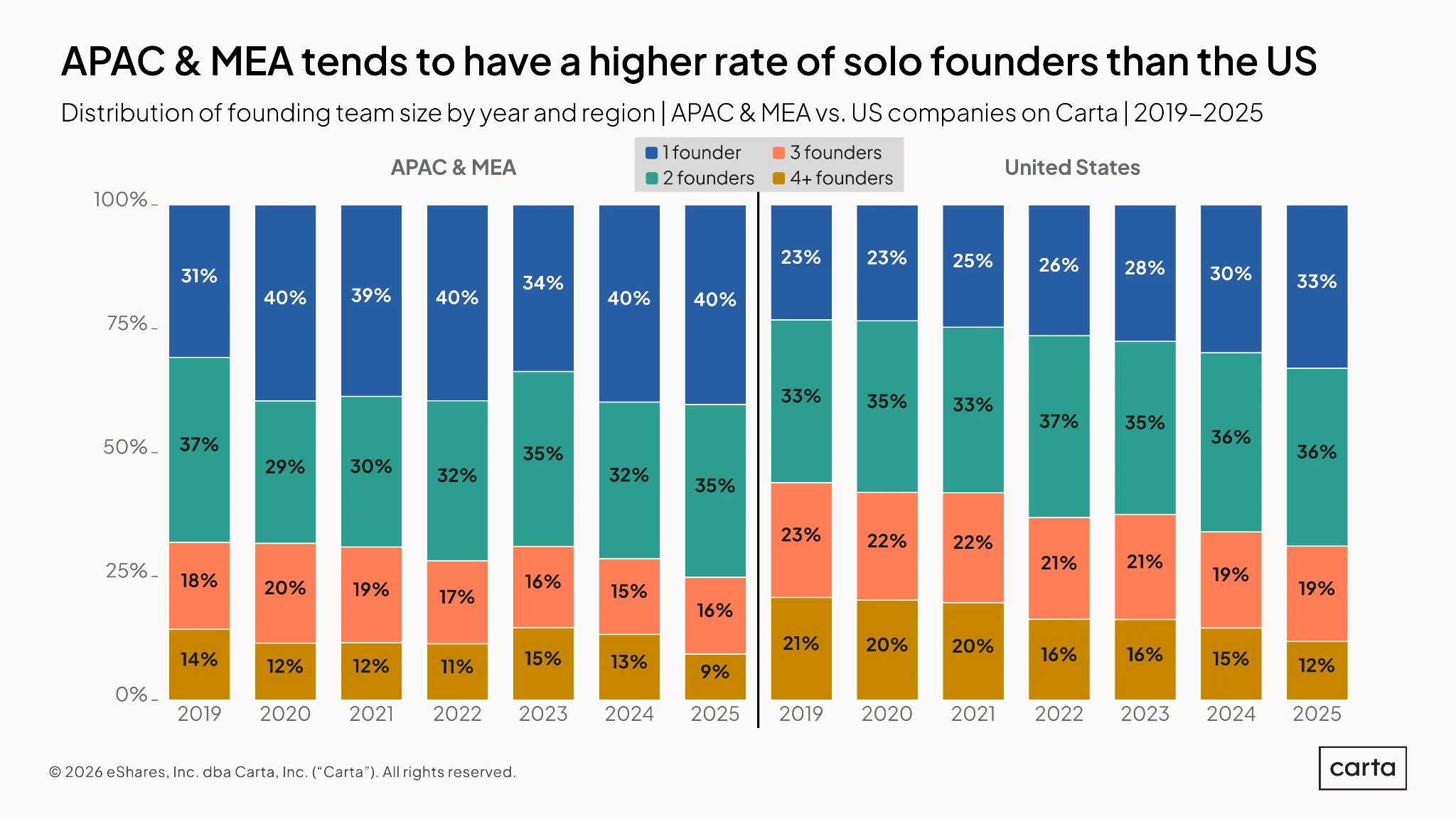
Going solo is the most common founding structure in APAC & MEA. Among APAC & MEA startups on Carta that were founded in 2025, 40% were founded by a single person, up from 31% in 2019. Throughout this period, the U.S. has had a lower prevalence of solo founders, reaching 33% in 2025. Both regions have similar rates of two-person teams, but APAC & MEA startups are less likely to have three or more founders.
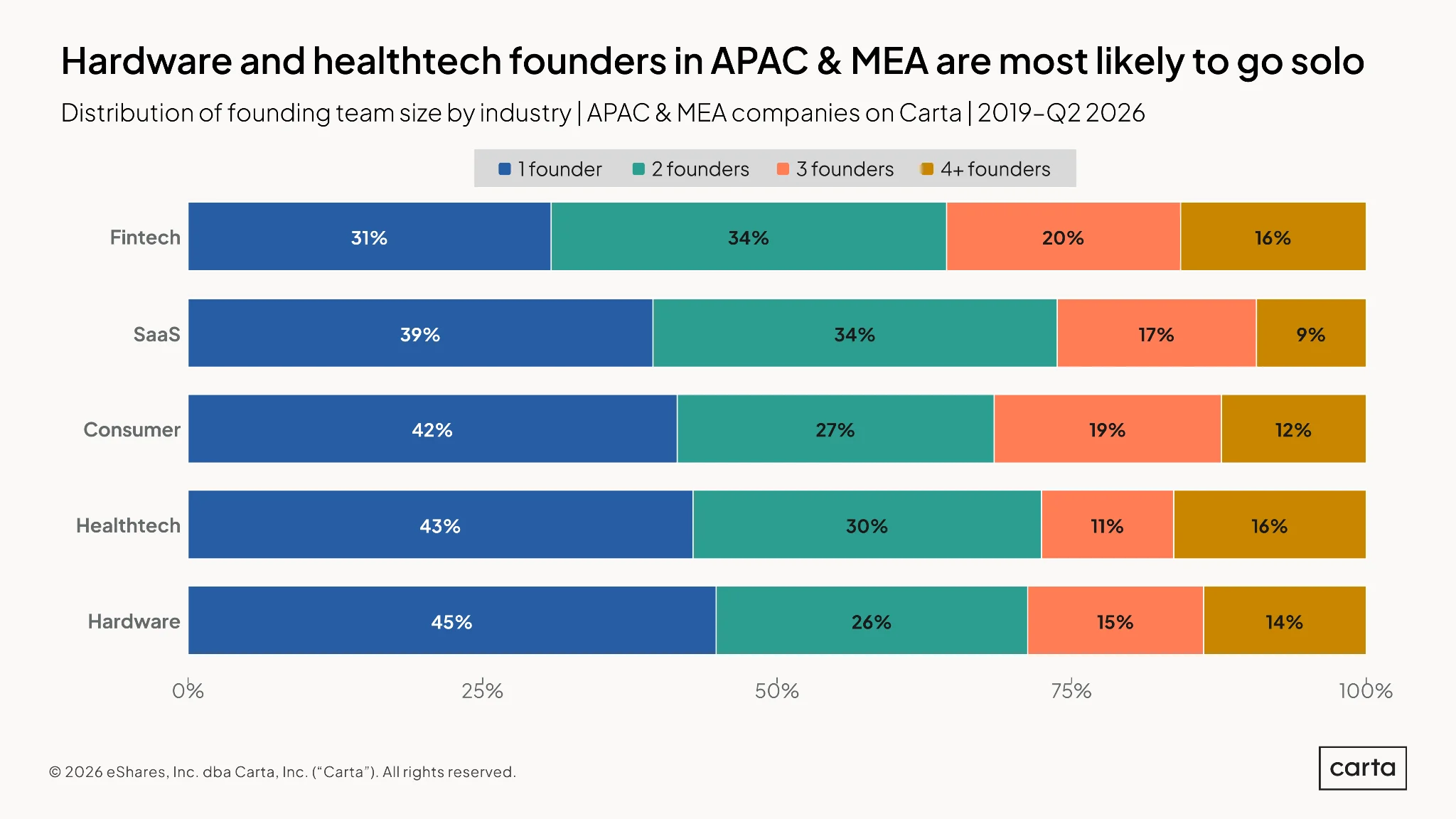
Hardware (45%) and healthtech (43%) have the highest rates of single founders in APAC & MEA among these major startup sectors. Fintech is different: only 31% of companies launched in the region since 2019 were solo-founded, and 16% were founded by teams of four or more.
Read the full report
Submit the form below to access the full report and receive a copy in your inbox.

DISCLOSURE: This communication is on behalf of eShares, Inc. dba Carta, Inc. ("Carta"). This communication is for informational purposes only, and contains general information only. Carta is not, by means of this communication, rendering accounting, business, financial, investment, legal, tax, or other professional advice or services. This publication is not a substitute for such professional advice or services nor should it be used as a basis for any decision or action that may affect your business or interests. Before making any decision or taking any action that may affect your business or interests, you should consult a qualified professional advisor. This communication is not intended as a recommendation, offer or solicitation for the purchase or sale of any security. Carta does not assume any liability for reliance on the information provided herein. ©2026 Carta. All rights reserved. Reproduction prohibited.