For employees at private companies, equity can be a highly valuable form of compensation. Whether it comes in the form of stock options or restricted stock units (RSU), equity offers workers a chance to own a stake in the company where they work. If and when the company grows over time, the value of that equity can also grow. In the best cases, it helps provide employees with long-term financial security, serving as a valuable nest egg for the future.
But equity does not compensate for not also having a 401(k) plan. When it comes to retirement planning, the two serve very different purposes. Equity is illiquid, concentrated in a single company, and dependent on a future liquidity event that may or may not materialize. A 401(k) plan is easy to liquidate at retirement, diversified, and independent of any specific transaction involving your employer.
Equity and a 401(k) plan can go hand-in-hand as part of a well-structured retirement plan. But one does not substitute for the other.
Yet today, close to half of all U.S. companies on the Carta platform do not offer a 401(k) plan option to employees, leaving employees to fend for themselves—or to be reliant on a future liquidity event—when it comes to retirement planning. And even if that future liquidity event occurs, its long-term benefits for employees may be muted. Over 70% of vested option grants are never exercised, and those that are exercised often don’t generate significant wealth for their owners.
This isn’t only a problem for rank-and-file employees. When workers feel more secure in their long-term financial planning, everyone benefits. New data from Carta and Vestwell shows that employees at companies with 401(k) plans are more likely to exercise their vested options than employees without a 401(k) plan. And employees who exercise options (or plan to exercise them in the future) are more closely aligned with the goals for growth set out by company leadership, since they have a direct financial stake in the company’s future.
In other words, having financial stability in the form of a 401(k) plan gives employees the freedom to fully participate in the upside of the company they’re helping to build.
Some states have specific regulations requiring companies to offer 401(k) or other workplace retirement plans to employees in that state or to facilitate employee access to a state-run retirement savings program. Others do not. In some cases, companies may be unable to fully fund a 401(k) plan for their employees—small, early-stage startups sometimes lack the resources to offer comprehensive benefits packages.
Once it’s achievable, though, offering a 401(k) plan is a meaningful goal. For companies aiming to set up their employees for long-term financial success, the combination of an equity plan and a 401(k) plan can build a foundation that makes real retirement savings achievable for all.
Key takeaways
At smaller companies, 401(k) plans are less common: Just 39% of companies on Carta with fewer than 25 employees offer a 401(k) plan to employees. At companies with between 25 and 100 employees, that figure rises to 49%.
401(k) savings compound: The more money employees are able to save in a 401(k) plan during their first year of employment, the more likely they are to maintain their savings in the future. The median employee with a 401(k) who earns at least $200,000 in annual salary will have more than $100,000 saved in their 401(k) plan after four years.
Employees with a 401(k) plan are more likely to exercise options: About 26.1% of employees with a 401(k) plan through their current employer exercise some or all of their options once those options are vested. For employees without a 401(k) plan, that exercise rate is 22.8%.
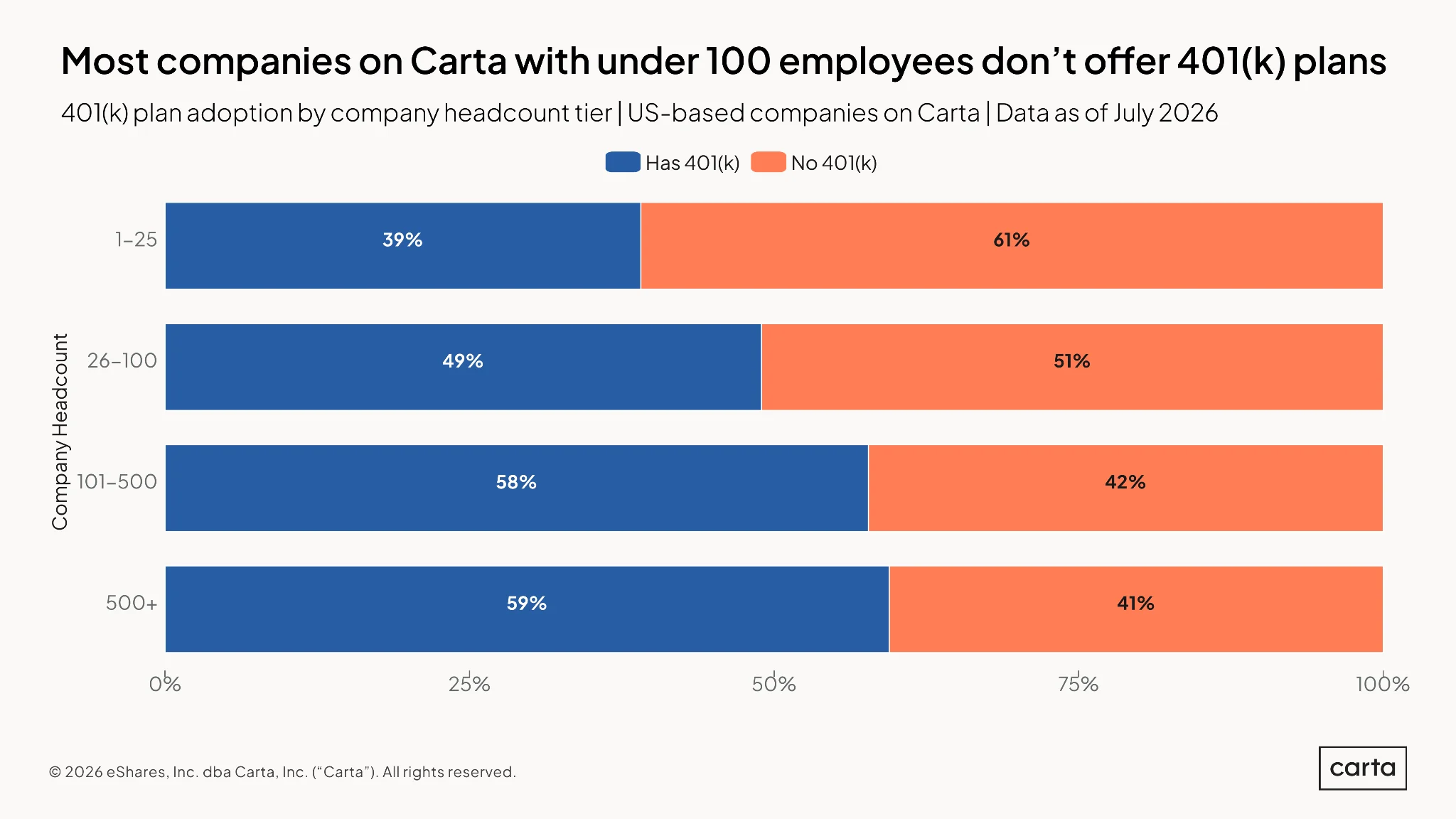
The more employees a company has, the more likely it is to offer a 401(k) plan. But the difference between the smallest and the largest companies isn’t as significant as you might expect.
Among the smallest companies on Carta (those with between one and 25 employees), just under 40% of businesses offer a 401(k), and just over 60% don’t. Among the largest companies (those with more than 500 employees), the math flips: About 60% of companies do offer 401(k) plans, and about 40% don’t.
Reaching 100 employees serves as an interesting dividing line. Above that threshold, a majority of companies offer a 401(k) plan. Below it, a majority of companies do not.
Policy Outlook: The SEC has lowered barriers for small employers that want to offer 401(k) plans directly to their employees, recently clarifying that pooled employer plans (PEPs)–structures that allow multiple unrelated employers to pool together under a single 401(k) plan–may rely on existing securities law exemptions. This significantly reduces the administrative burden that has historically made standalone plan sponsorship cost-prohibitive for smaller companies.
Read the full report
Submit the form below to access the full report, including charts on salary, equity, hiring trends, and company composition across stages and sectors.




DISCLOSURE: This communication is on behalf of eShares, Inc. dba Carta, Inc. ("Carta"). This communication is for informational purposes only, and contains general information only. Carta is not, by means of this communication, rendering accounting, business, financial, investment, legal, tax, or other professional advice or services. This publication is not a substitute for such professional advice or services nor should it be used as a basis for any decision or action that may affect your business or interests. Before making any decision or taking any action that may affect your business or interests, you should consult a qualified professional advisor. This communication is not intended as a recommendation, offer or solicitation for the purchase or sale of any security. Carta does not assume any liability for reliance on the information provided herein. ©2026 Carta. All rights reserved. Reproduction prohibited.
Vestwell disclosure: All content is provided for general information purposes and is not to be construed as a solicitation or investment advice. All investments involve risk and past performance is not a guarantee or indicator of future results. Investments in securities are subject to many risks, including possible loss of principal, market fluctuations, liquidity and interest rate risks, domestic and international risks, and inflation-related risks among others. Consider the investment objectives, risks, and charges and expenses of all investment options carefully before investing. Vestwell Advisors LLC is a subsidiary of Vestwell Holdings, Inc. Vestwell Advisors LLC is an investment advisor registered with the Securities and Exchange Commission. Neither Vestwell Advisors nor any of its parents, affiliates, or subsidiaries provides investment, tax, financial or legal advice. We recommend consulting with a financial professional before making any investment decisions. Prospectuses and other educational materials are available by contacting Vestwell Advisors at help@vestwell.com.