Early-stage software startups in the Bay Area have long garnered higher valuations than their peers in other parts of the U.S.
Over the past several quarters, however, what was once a relatively narrow valuation gap has turned into a chasm.
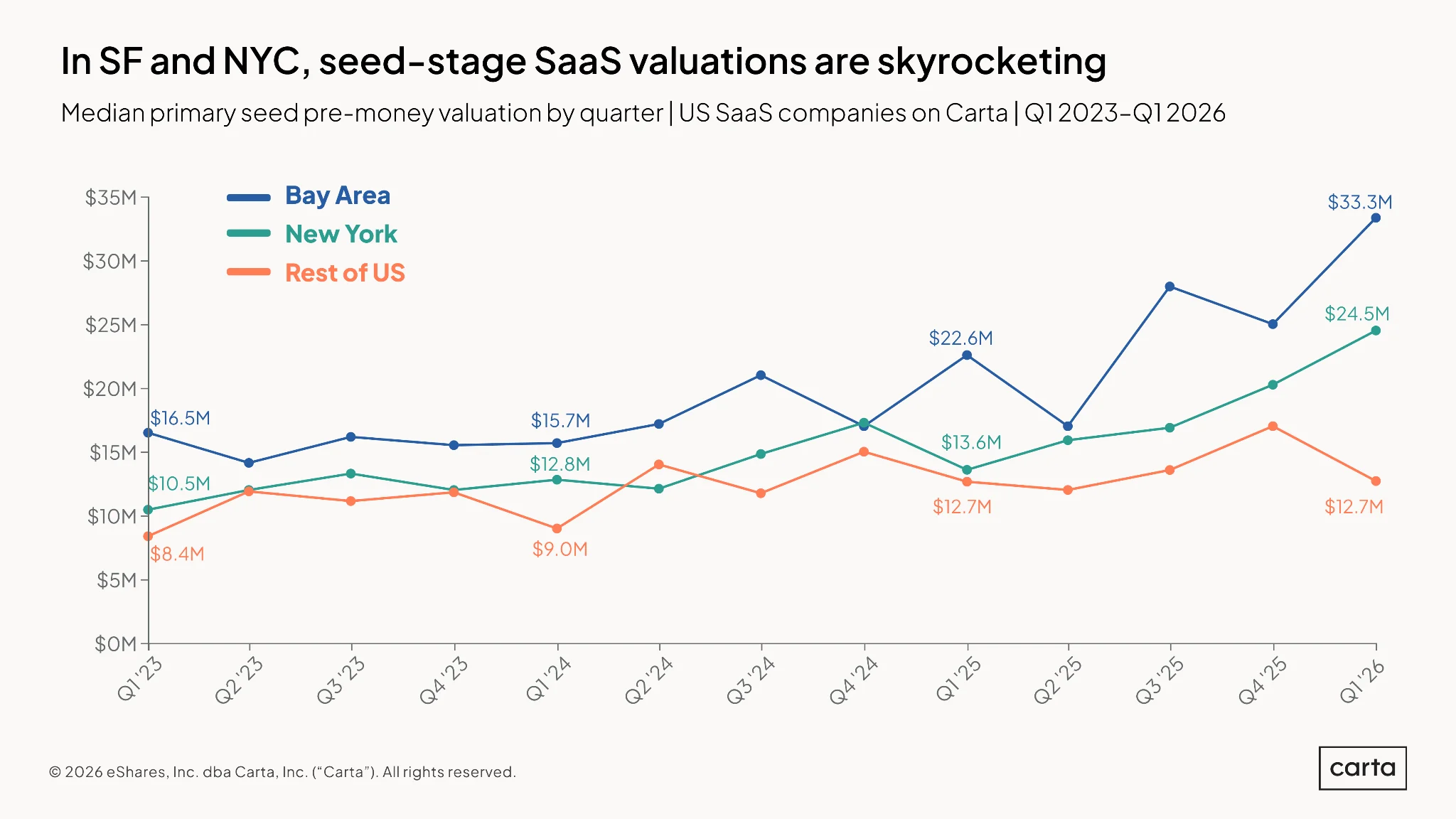
In Q1 2026, the median pre-money seed-stage valuation for SaaS startups based in the Bay Area climbed to $33.3 million, according to Carta’s new VC round benchmarking tool, reaching a new record high. Over the past three years, that figure has more than doubled.
One other major metro area has kept pace with the Bay Area’s valuation growth. In New York, the median seed-stage valuation in SaaS rose to $24.5 million in Q1 2026, continuing a sharp recent upswing: Over the past year, the median seed-stage SaaS valuation in New York has increased by 80%.
In the rest of the U.S., it’s a different story. Outside of the Bay Area and New York, the median seed-stage valuation in the SaaS sector has remained unchanged over the past year, sitting at $12.7 million. In Q1, a typical seed-stage software startup in New York carried a valuation that was 1.9x higher than a comparable company in the rest of the country. For seed-stage software startups in San Francisco, that premium reached all the way to 2.6x.
It comes as little surprise that the Bay Area and New York have thriving fundraising markets for early-stage software startups. Across all sectors and all stages, those two metro areas were the two busiest ecosystems for VC funding in the U.S. during 2025.
But, at least in early-stage software, the difference between these two VC hubs and the rest of the nation is growing more stark. The ongoing bifurcation that has become a defining trait of private markets during the mid-2020s is extending to the realm of geography, too.
“The proximity to people who are also doing interesting things is just an undeniable factor for San Francisco and New York,” says Hilary Howe, a New York-based partner at early-stage firm Seedcamp. “You get different flavors, right? In San Francisco, it’s very heavy on AI. In New York, you get a broader mix of sectors and industries. But it’s the proximity to those people, that sense of competition, of dealmaking, of just being one door away from the person you need to connect to—there’s a magic that happens with the density of minds that are working on very similar things.”
What it means for founders
In her work at Seedcamp, Howe helps lead follow-on investments into the firm’s existing portfolio companies and works with European startups as they expand into U.S. markets. In her view, the rapid rise of seed-stage software valuations in San Francisco and New York is inextricably linked to the rise of AI—particularly in San Francisco, which has emerged as one of the AI industry’s global hubs.
“You’re seeing prices drive up just due to the general excitement in that market and in those sectors,” Howe says. “It’s going to be more expensive in certain areas for certain types of talent. That’s a big factor driving up those valuation numbers.”
For early-stage startups, these sort of lofty valuations can be a double-edge sword. Investors and founders typically like to see a yearslong journey of constant, steady growth. This means that, for companies that attain high seed valuations, the bar for future funding rounds is set increasingly high.
Miss that bar, and trouble may ensue. A similar version of this dynamic played out at a large scale in 2022, when a widespread valuation reset in the tech market left many of the startups that had raised huge sums of VC funding in 2020 and 2021 in a quandary. Investors no longer believed those startups were worth the valuations they had recently achieved. Many companies have spent years trying to grow back into those earlier valuations, leading to delayed exit timelines and strategic resets as they try to regain their earlier growth.
A $30 million seed valuation can lead to plenty of excitement, promise, and hype. But it can also greatly increase the pressure to perform.
“Most companies have to figure out how to grow into that,” Howe says. “For example, we’re seeing very large numbers and very competitive rounds at seed. But I think Series B is proving to be a much harder round for companies to raise. Being able to grow into that valuation and continue to build upward from there [is important].”
What it means for VCs
From the perspective of an early-stage VC, higher seed valuations mean less room for error.
Take the example of a $10 million fund that wants to acquire 10% stakes in seed-stage software startups. If each of the startups it backs is valued at $5 million, that fund can invest in 20 different companies and diversify its risk. If each of the startups is valued at $20 million, the fund only has enough cash to make five investments, and there’s far less room for error.
The construction of a real portfolio is more complicated, but the point remains. For investors like Howe, writing checks at higher valuations requires a higher degree of confidence that the eventual exit will make it all worthwhile.
“For me, it really puts pressure on the size of the outcome,” Howe says. “We try to stay somewhat price-disciplined, but it’s such a dynamic market right now. We’re seeing a lot of pressure on that price discipline across all funds at the earliest stages. To be on the field and play where the game’s being played, you have to have some agility or flexibility.”
For software investors in particular, the rapid embrace of AI only ratchets up this pressure. Enthusiasm has run so rampant and valuations have climbed so high that, to many, it’s unclear whether the startup market is in the midst of a bubble or a boom.
But Howe cautions that AI is far from the only factor driving the early-stage funding market into a state of froth. In her view, other macroeconomic factors indicate that a broader secular shift in seed-stage valuations may be underway.
“It’s been maybe expedited or exaggerated with AI, but we were certainly trending in a direction of more concentration of capital among fewer funds, more multi-stage funds putting pressure on the earlier stages,” Howe says. “I think we have been seeing an evolution of venture, with the late-stage players being bigger, public markets being not as accessible. There were some structural changes that were happening, and we can credit AI with really speeding up that trend line.”
Subscribe to the Data Minute newsletter

DISCLOSURE: This communication is on behalf of eShares, Inc. dba Carta, Inc. ("Carta"). This communication is for informational purposes only, and contains general information only. Carta is not, by means of this communication, rendering accounting, business, financial, investment, legal, tax, or other professional advice or services. This publication is not a substitute for such professional advice or services nor should it be used as a basis for any decision or action that may affect your business or interests. Before making any decision or taking any action that may affect your business or interests, you should consult a qualified professional advisor. This communication is not intended as a recommendation, offer or solicitation for the purchase or sale of any security. Carta does not assume any liability for reliance on the information provided herein. This post contains links to articles or other information that may be contained on third-party websites. The inclusion of any hyperlink is not and does not imply any endorsement, approval, investigation, or verification by Carta, and Carta does not endorse or accept responsibility for the content, or the use, of such third-party websites. Carta assumes no liability for any inaccuracies, errors or omissions in or from any data or other information provided on such third-party websites. © 2026 eShares, Inc. dba Carta, Inc. All rights reserved. Reproduction prohibited.