
- Tender-offer activity reaches a four-year high as startup liquidity needs continue to mount
- Tender offers continue to grow in popularity
- Tenders are more common at later stages
- Subscription rates remain north of 90%
- Who participates in tender offers
- How tender offers are priced
- Subscribe to the Data Minute newsletter
For venture-backed companies on the lookout for liquidity, the appeal of tender offers has continued to grow in 2026.
Carta administered 71 tender offers during the first half of the year, with a combined transaction volume of some $3 billion. In both cases, those are the highest H1 figures logged in at least the past six years.
This increase in tender activity is being driven by some clear tailwinds. In certain segments of the market, traditional exits remain elusive, as they have been now for several years. These delayed exit timelines mean that many VCs who raised funds over the past decade still haven't generated significant returns for their LPs.
In the right circumstances, tenders can generate much-needed liquidity for investors, employees, and company executives while also laying the foundation for a future exit, serving as an increasingly important tool for startups navigating a market where liquidity feels more precious than ever.
“There’s been a real shift in how companies think about tenders,” says Nick Bunick, a partner at NewView Capital. “As companies stay private longer, it’s often impractical to defer liquidity until an IPO. Done right, tenders can help retain great employees, keep founders focused on building, and give companies greater control over their cap tables. The best programs treat tenders as a strategic tool, not a standing commitment, preserving flexibility around timing, size, and participation.”
Tender offers continue to grow in popularity
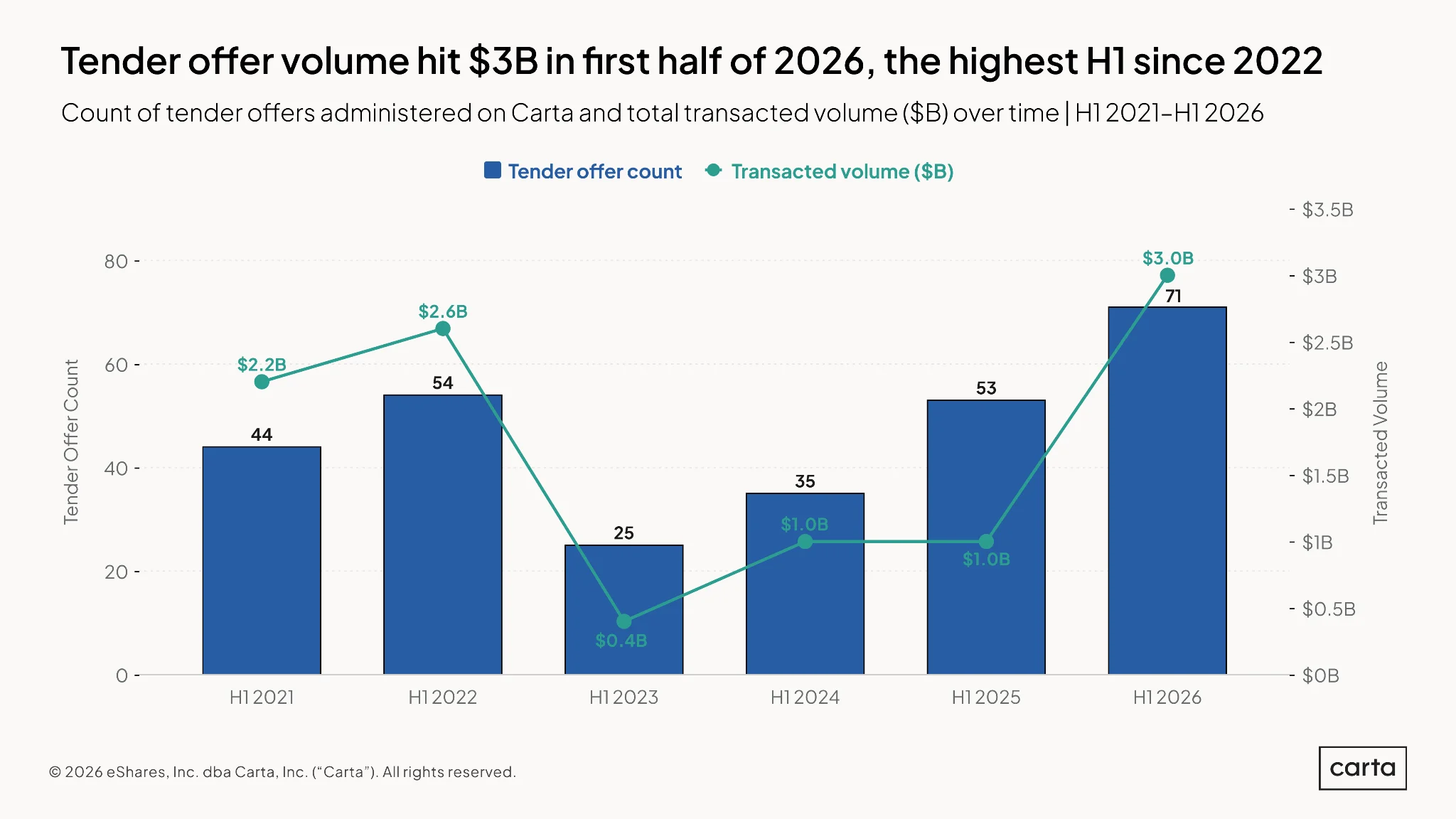
The total number of tender offers administered on Carta in H1 has now increased in three consecutive years, with combined transaction value also climbing significantly over that span. Year over year, transaction count was up 34% in the first half of 2026, while total transaction value jumped 200%.
This yearslong upswing in tender activity has overlapped with the slowdown in the exit market that began to emerge in the second half of 2022. With traditional liquidity opportunities harder to come by, companies have turned to tenders, particularly as a way to let long-term employees cash out some of their shares.
“We’ve seen an increase in the preponderance of tenders, especially at the later stage,” says Sam Lawson, managing partner at Flywheel Capital, a secondaries firm that’s active in the tenders market. “I think increasingly it’s being driven by companies recognizing that employees need liquidity in order to be able to retain and attract talent within this market.”
Tenders are more common at later stages
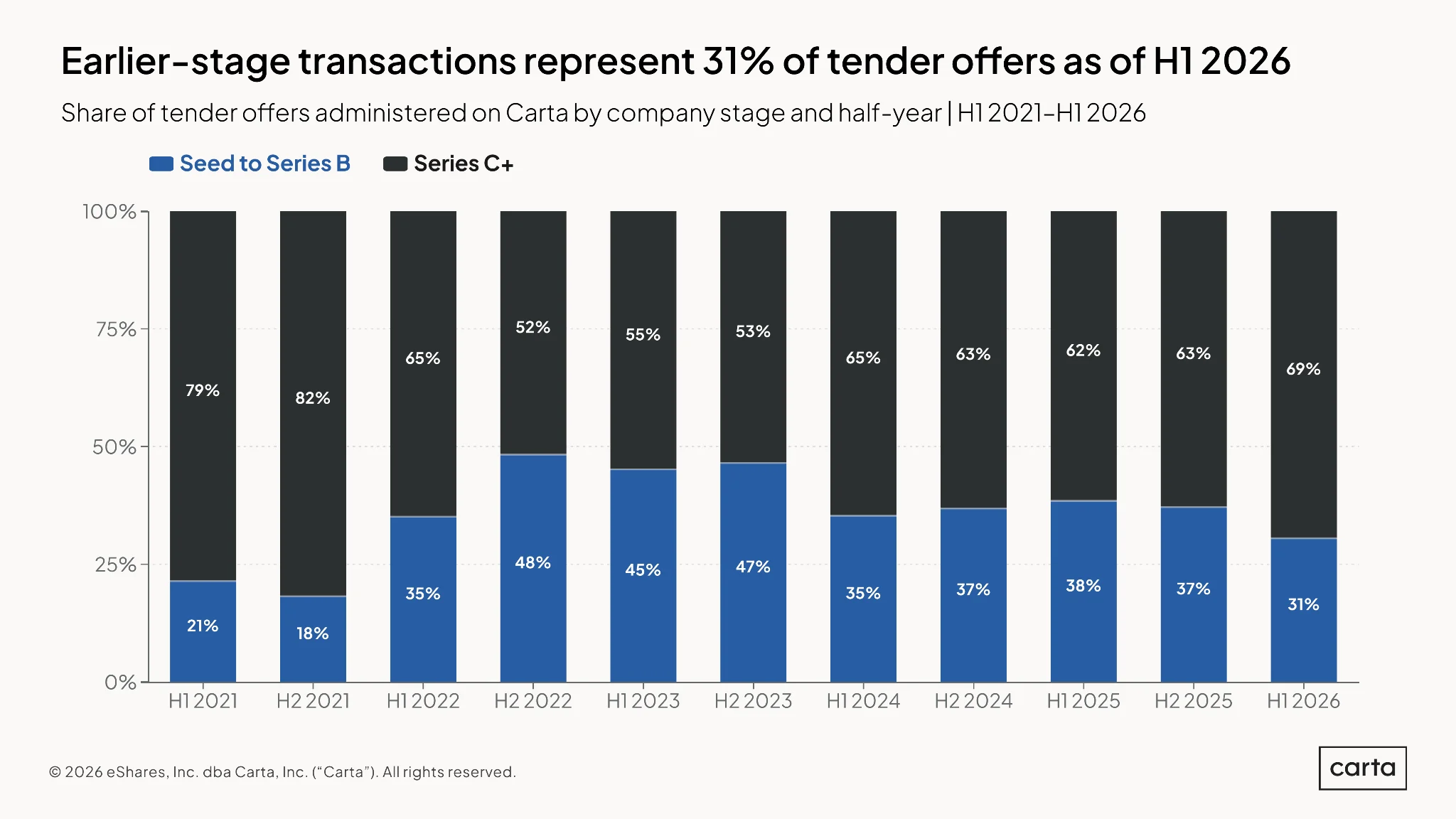
Nearly 70% of tender offers administered on Carta in H1 2026 were run by companies at Series C or later. This continues a recent trend of the market tilting back toward later-stage tenders, after early-stage tenders experienced an increase in popularity during 2022 and 2023.
In today’s market, the typical VC-backed company is staying private for longer than ever before. At the later stages of the venture lifecycle, a tender offer can provide liquidity at a point in a company’s timeline that might be similar to when an IPO could have been expected in an earlier era.
“That Series C, Series D stage is where you typically would have started to see liquidity via the public markets,” Lawson says. “I think that’s a good point for people to be thinking about liquidity. It helps create that continued sense of alignment for employees, and it helps bring in investors at the right time for that stage of growth.”
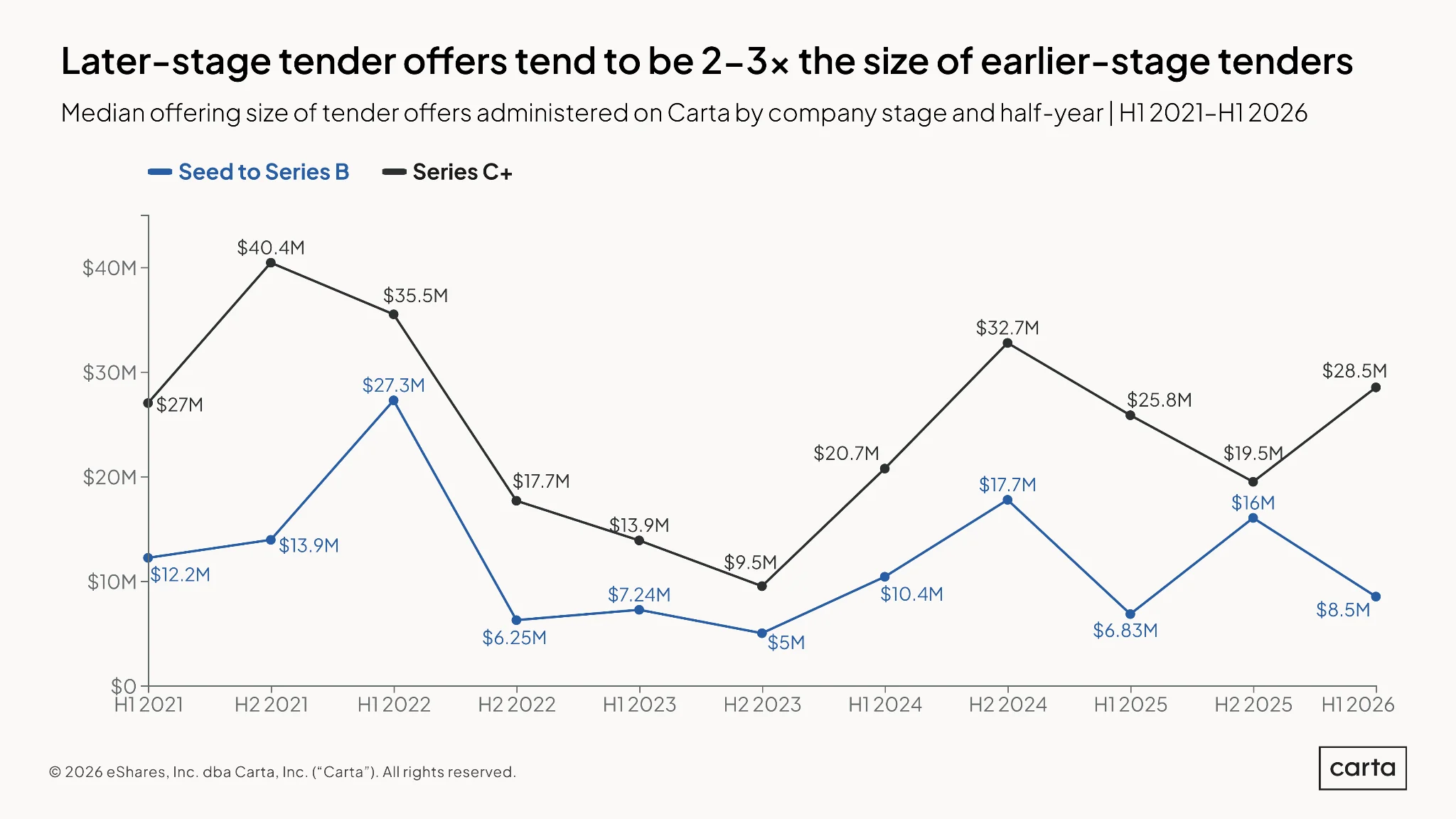
From one quarter to the next, median transaction sizes for tender offers among early-stage and late-stage companies have typically moved in a similar direction in recent years. But that wasn’t the case in H1 2026, when the median offering size for companies at Series C and later rose to $28.5 million, the second-highest semiannual total of the past four years, and the median offering size for companies from seed through Series B dropped to $8.5 million.
For later-stage tenders, the long-term trend line for offering size has been up over the past four years, mirroring similar increases seen in the sizes of primary venture rounds and in median valuations. As investors have begun to pursue larger startup investments in the primary market, they’ve done so in the market for tenders, too.
Subscription rates remain north of 90%
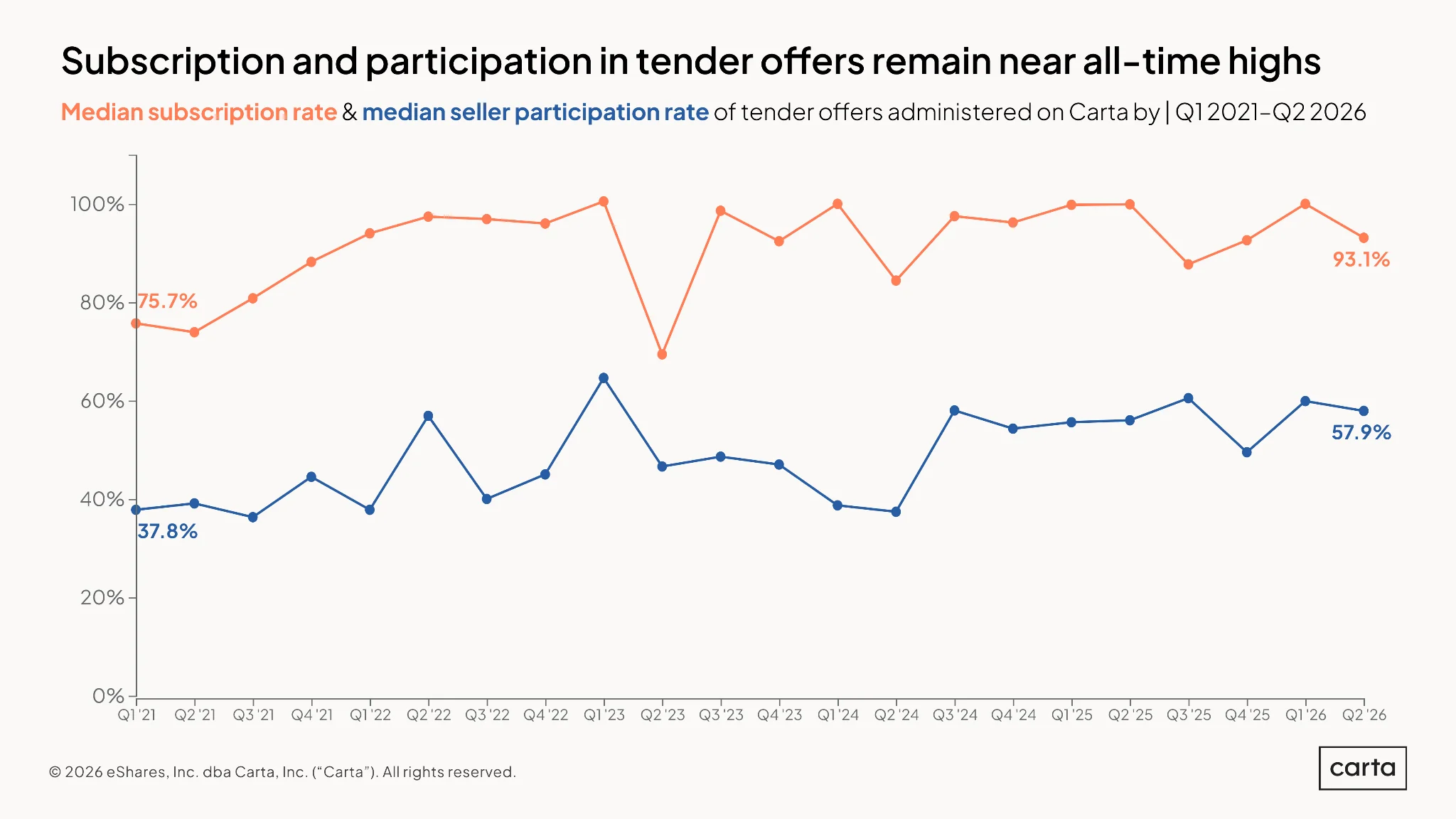
The median subscription rate in tenders administered on Carta during Q2 2026 was 93.1%, while the median seller participation rate was 57.9%. Both of those figures were down slightly from Q1, but both are also in line with the typical rates seen in the past two years.
On a longer timeline, though, both median subscription rate and median participation rate are trending up, with the participation rate having risen by more than 20 percentage points since Q1 2021. The skyrocketing valuations seen by startups near the top of the market in recent quarters could, for some eligible sellers, make participating in a tender even more attractive.
“A lot of eligible sellers are willing to take chips off the table,” Lawson says. “Obviously, some companies have been on a tear, and in these high performing companies, we’re increasingly seeing sellers look to us for structured solutions, allowing them to keep future upside.”
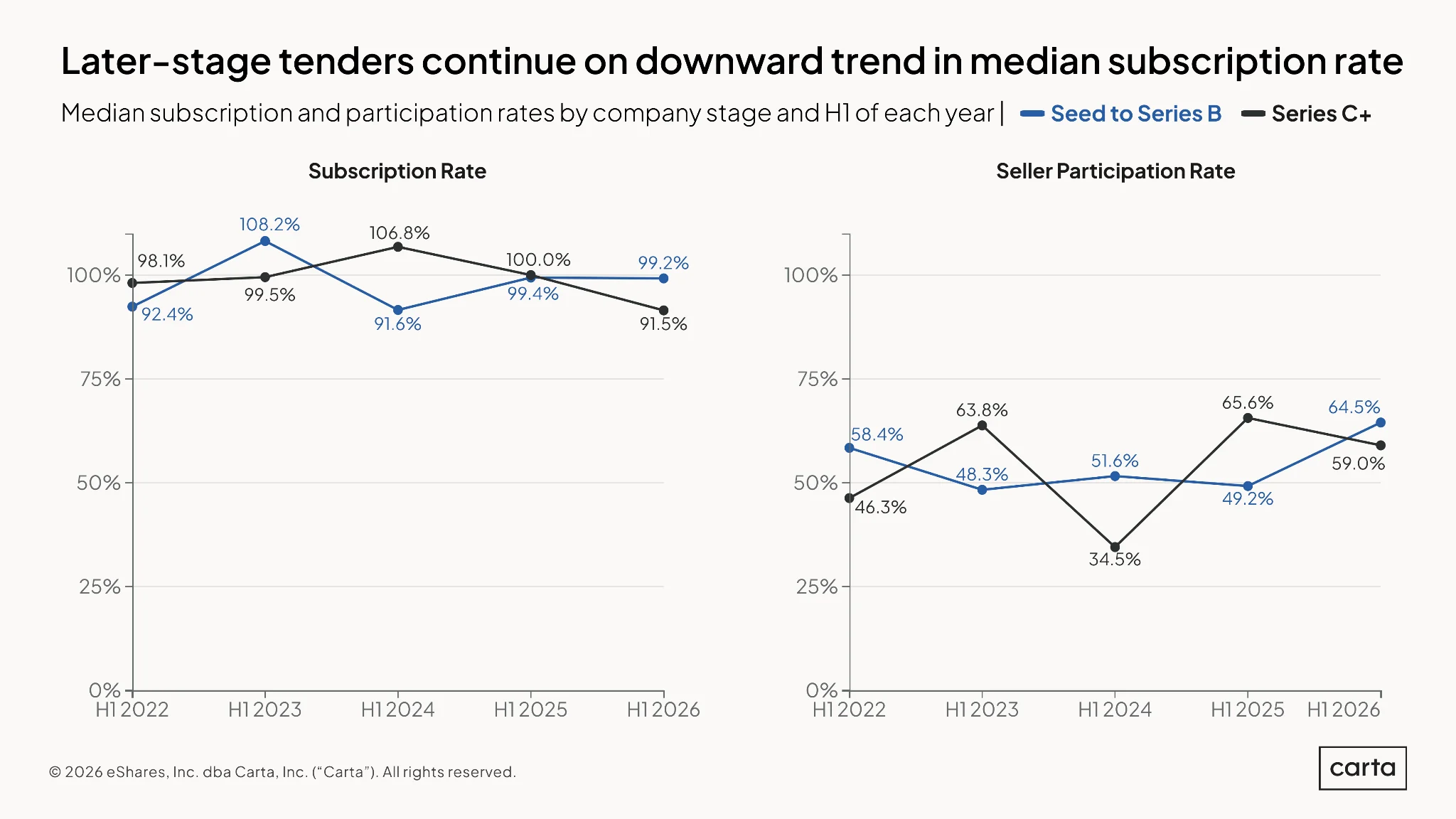
Compared to two years ago, the median subscription rate among companies at Series C and beyond has declined, while median subscription rate for earlier-stage deals has been on the rise. Again, this echoes a similar dynamic unfolding in the primary fundraising market, where a new cohort of AI-native early-stage startups have in recent years begun to generate enormous investor interest.
This similarity makes sense, as the population of buyers in tender offers often overlaps with the population of investors in primary funding rounds, both for any particular company and across the market at large.
“It translates quite closely to the type of investors you see in primary financings,” Lawson says of the investor base for tenders. “You see larger growth investing groups, institutions, large asset managers, hedge funds coming in at later stages. You’re seeing a lot of activity from family offices and high-net-worth individuals as well who want in on these tenders.”
Who participates in tender offers
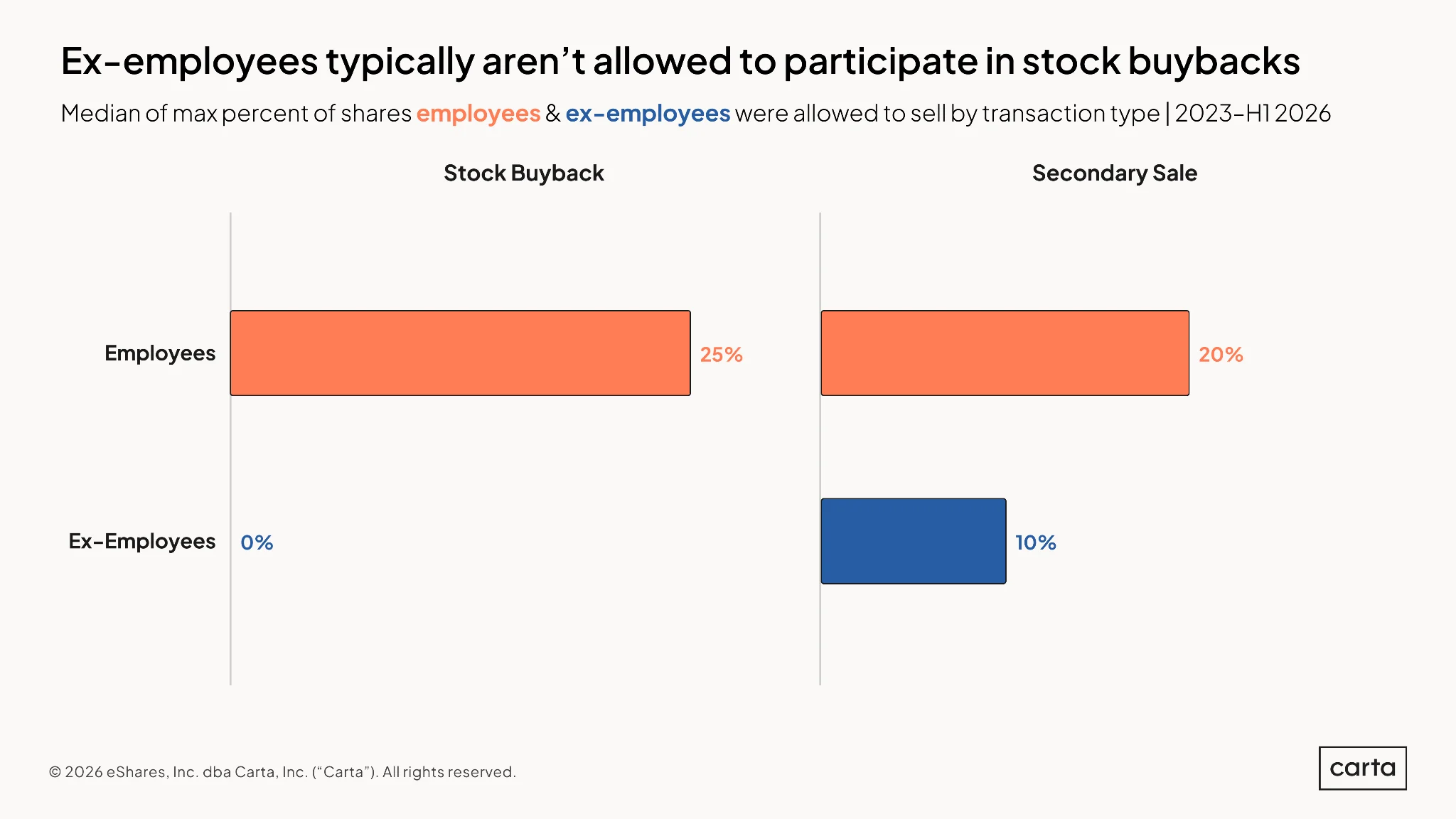
Tender offers can be structured in multiple ways. In a stock buyback, the company itself provides liquidity by directly acquiring shares from their current owners, similar to how buybacks work in the public markets. In a secondary sale, an outside buyer acquires shares from current shareholders.
The base of eligible sellers in a tender can vary depending on the structure of the offering. The median percentage of current employees who are deemed eligible to sell is larger in buybacks than in secondary sales. But stock buybacks also tend to be more restrictive with ex-employees: In the median tender administered on Carta over the past three and a half years, no ex-employees have been eligible to participate.
How tender offers are priced
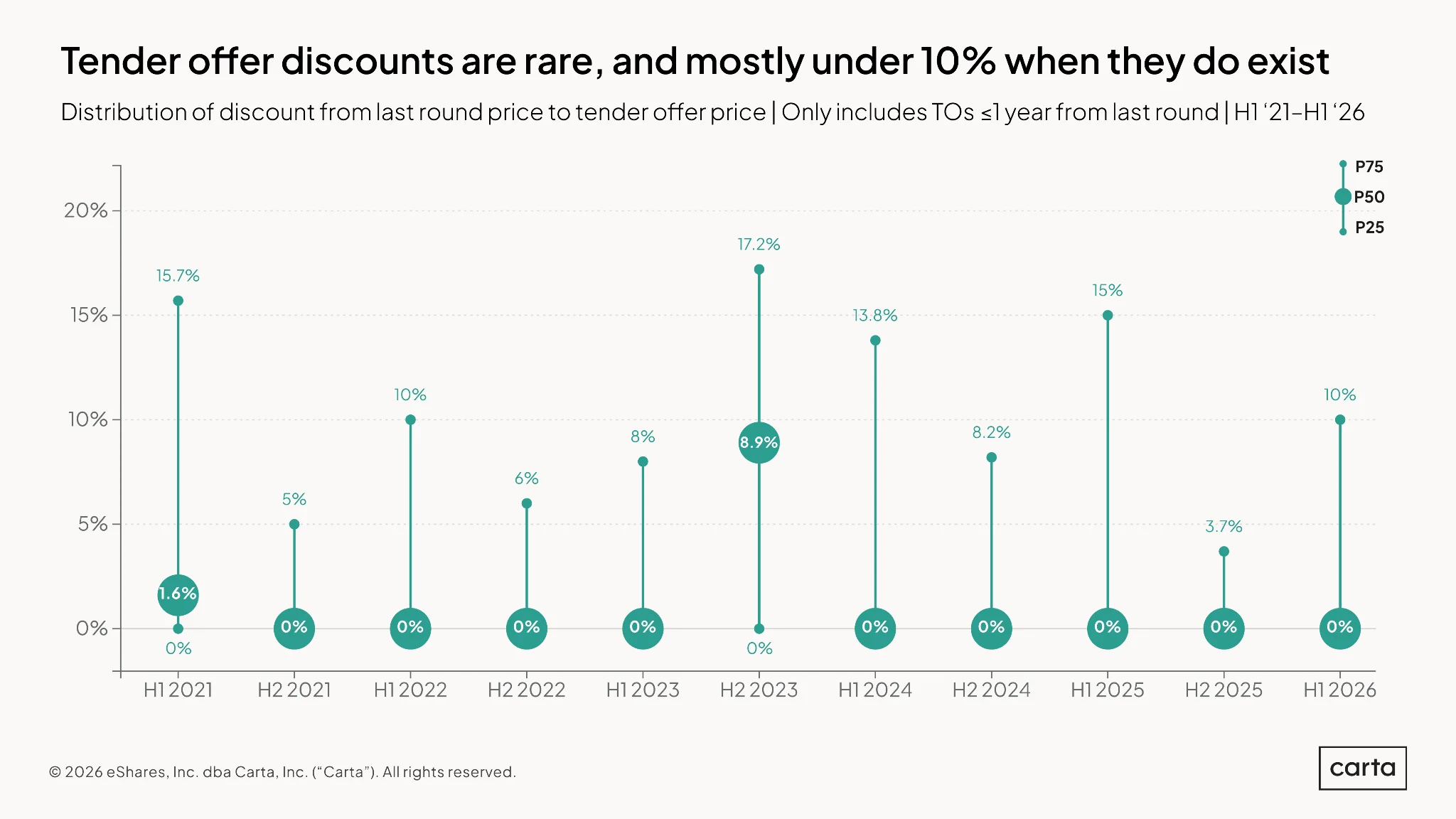
Discounts among tender offers in the current market are uncommon, with most pricings landing at or above the valuations companies achieved in their most recent primary round. It’s a common strategy for startups to conduct a tender in close succession after a primary round, which allows the company to set its valuation by a true market mechanism.
Among tenders that were at least a year after a primary round, the median discount rate has now been at 0% in each of the last five semiannual periods. In H1 2026, the 25th percentile for discount rate was also 0%, while the 75th percentile rose to 10%. In other words, at least a quarter of these tenders included a double-digit discount.
Subscribe to the Data Minute newsletter


DISCLOSURE: This communication is on behalf of eShares, Inc. dba Carta, Inc. ("Carta"). This communication is for informational purposes only, and contains general information only. Carta is not, by means of this communication, rendering accounting, business, financial, investment, legal, tax, or other professional advice or services. This publication is not a substitute for such professional advice or services nor should it be used as a basis for any decision or action that may affect your business or interests. Before making any decision or taking any action that may affect your business or interests, you should consult a qualified professional advisor. This communication is not intended as a recommendation, offer or solicitation for the purchase or sale of any security. Carta does not assume any liability for reliance on the information provided herein. This post contains links to articles or other information that may be contained on third-party websites. The inclusion of any hyperlink is not and does not imply any endorsement, approval, investigation, or verification by Carta, and Carta does not endorse or accept responsibility for the content, or the use, of such third-party websites. Carta assumes no liability for any inaccuracies, errors or omissions in or from any data or other information provided on such third-party websites. © 2026 eShares, Inc. dba Carta, Inc. All rights reserved. Reproduction prohibited.