Based on the latest valuations of their underlying assets, most venture capital funds from the past decade tracked on Carta have generated positive value. But the vast majority of that positive value is still concentrated in on-paper returns that have yet to be realized through exits.
The TVPI is there. The DPI is not.
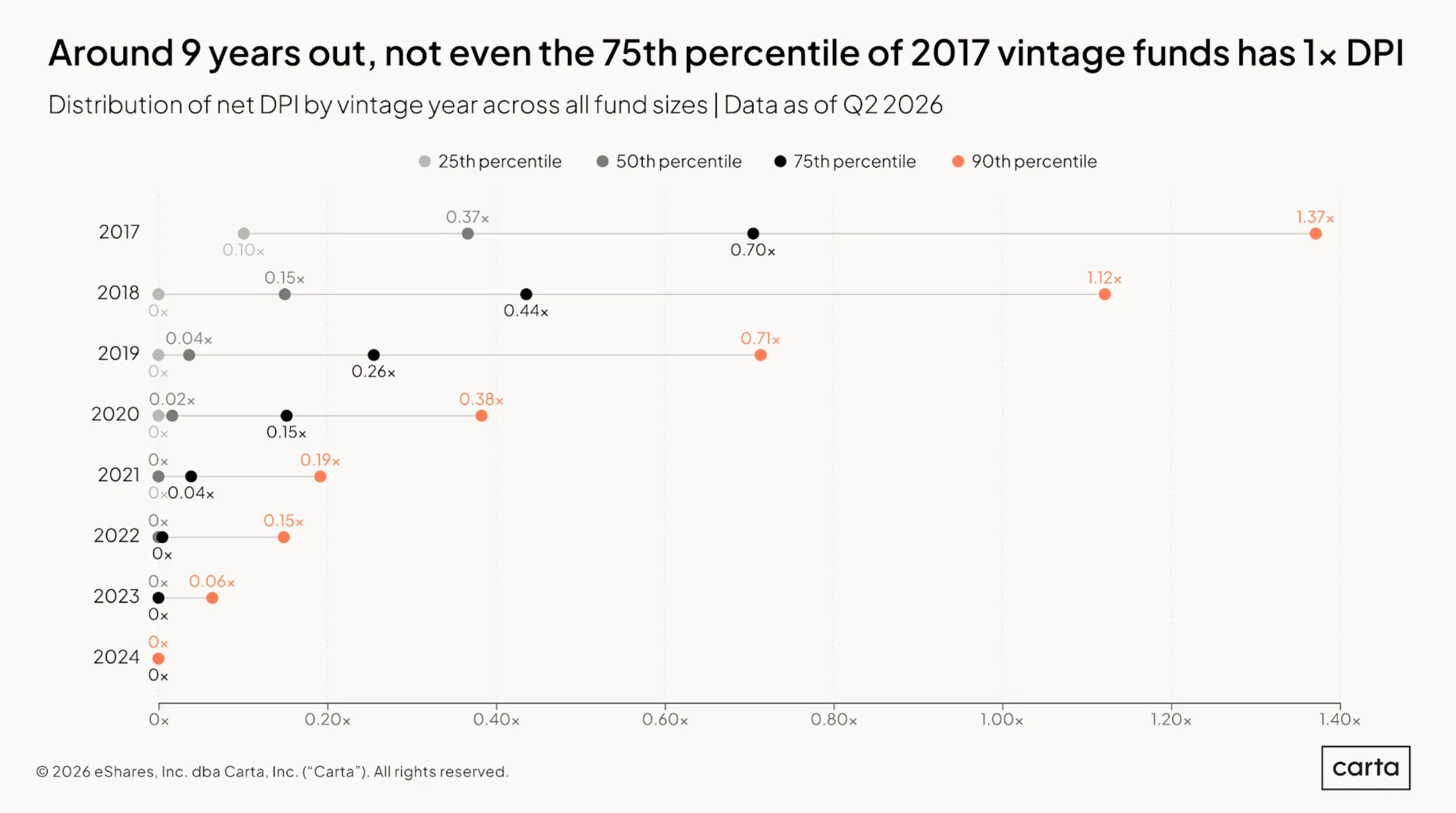
Many of these vehicles are relatively early in their lifespans, with plenty of time left to convert theoretical gains into cash that can be returned to LPs. But for vintages from the late 2010s and early 2020s, concerns are mounting that these on-paper gains will never be realized at anything close to the scale that current fund performance metrics might suggest.
“If you have these older funds, low DPI is extremely concerning,” says Anthony Georgiades, general partner at venture firm Innovating Capital. “For a fund that’s approaching a decade, it raises a lot of hard questions.”
$104 billion in unrealized gains
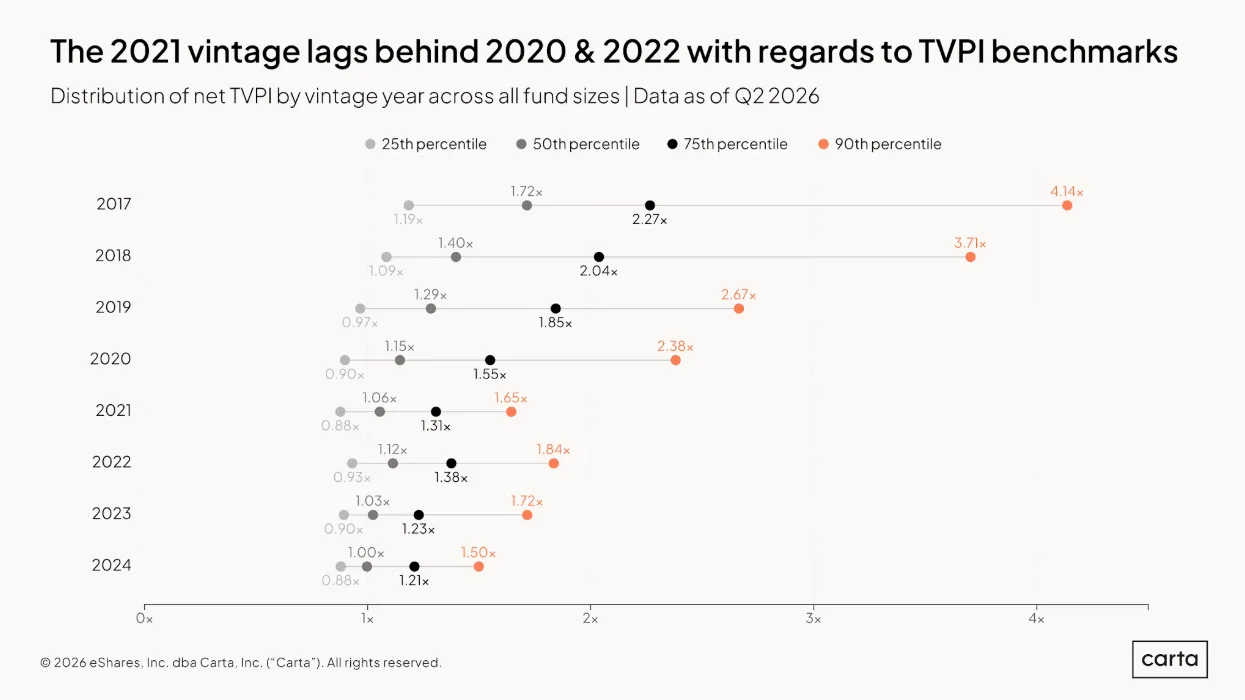
At the midpoint of this year, every VC fund vintage from 2017 through 2023 had a median TVPI of at least 1x, according to Carta’s latest Fund Performance Report. For top-performing funds, TVPI figures rise much higher, particularly for vintages from the late 2010s. At the upper end of the market, many of these gains have been driven by skyrocketing valuations among private AI companies.
For almost every fund, however, most of these gains are still unrealized. In other words, they’re theoretical.
Among 2017 funds, for instance—the most mature vintage in this sample—realized gains account for just 18.6% of total value within the median fund. Even at the 90th percentile, a threshold that only the most successful funds clear, DPI accounts for just 58.4% of a fund’s reported TVPI.
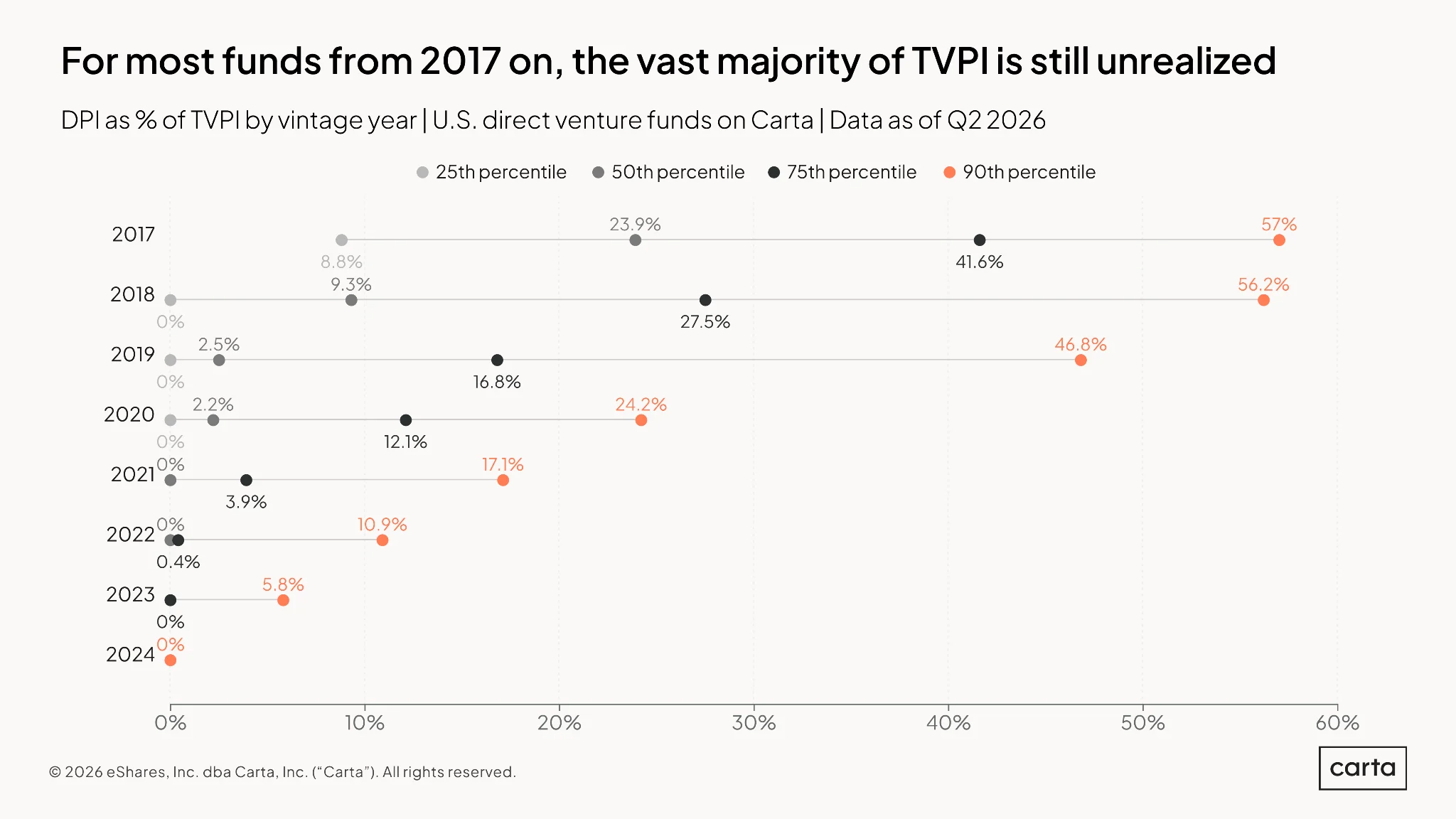
In other vintages, realized returns are even rarer. For the median vehicle from 2019, DPI accounts for less than 1% of total fund value. For funds from the 2020s, a huge majority have produced barely any DPI at all.
Across this whole sample of more than 2,000 funds across eight different vintages, those unrealized gains add up. Combined, the VC funds analyzed here are currently sitting on more than $104 billion in unrealized value.
Historically, LPs have had faith that the TVPI figures reported by their GPs will eventually convert into DPI. They’ve been willing to take fund managers at their word. But the climate is shifting, and skepticism is mounting.
“The expectation is that [TVPI] will convert 100%. That’s what investors generally think and believe. But obviously, that has not necessarily happened, which has caused a lot of pushback and issues in the market,” Georgiades says. “You have a lot of funds right now that are not even going to return above 1x. You’re going to see a massive dropoff in TVPI from where it stands today to when it’s fully harvested.”
How we got here
The value of a venture fund, of course, depends on the value of its underlying portfolio companies. One of the reasons for this growing skepticism around TVPI is a belief that many of these portfolio companies may be seriously overvalued.
“I think a lot of that TVPI is fake,” says Steve Brotman, founder and managing partner at Alpha Partners. “If you had VCs go in and grade other VCs on what they felt like the real valuations of those companies were, that would be pretty interesting.”
In some cases, current valuations are still pegged to funding rounds that occurred in the era of near-zero interest rates, which came to an abrupt end in the middle of 2022. For other portfolio companies, the inflection point may instead be the public launch of ChatGPT in November of that same year. Both of these events have helped lead to widespread resets in venture-backed valuations: Investors discounted future cash flows more heavily, and revenue projections grew less rosy.
Most venture funds adjust their portfolio valuations once a quarter, in part to account for such macroeconomic changes. But the inability of these funds to realize exits at their current marks suggests these internal reassessments of portfolio-company value have not kept pace with the prices outside investors are willing to pay.
“Just because an asset doesn’t trade doesn’t mean there’s not a real value to it,” Brotman says.
When the bid-ask spread between buyers and sellers widens, exits are less likely to take place. This is exactly what’s happened in the past few years, as exit activity across the VC ecosystem entered a multi-year chill that has only this year begun to show signs of thawing. And when fewer exits take place, fewer returns are realized, continuing this unvirtuous cycle.
What comes next
For a select few funds, upcoming IPOs from major frontier labs and other emerging AI powerhouses may be enough to offset any worries about returns across the rest of their portfolios. But most VC vehicles don’t have these sorts of mega-listings waiting in the wings.
This leaves firms and their portfolio companies to face difficult questions. When an exit fails to materialize at the price you expected, what comes next?
Some companies are biting the bullet and completing exits at lower valuations, often via acquihires or other types of inorganic consolidation, Georgiades says. Others are raising new capital through heavily structured securities, with the idea of kicking the can down the road until a better offer might materialize. As a result, Georgiades expects the lifespans for some of these recent VC funds to extend well into their second decade, far longer than their LPs planned.
In other cases, the options are even less attractive.
“Some of these companies are going to run out of money and have to go out of business,” Brotman says.
A potential reckoning for TVPI
For GPs, this widening gap between current TVPIs and expected DPIs has implications beyond their current funds.
Traditionally, metrics from a manager’s active vehicles are one of the main proofpoints used by firms when pitching their next vehicle to LPs. But today, because of these fears of inflated marks, LP attitudes are shifting.
“Investors want to have an idea of where things are going and how things are performing on paper,” Georgiades says. “But I think what’s happened is that people are placing a lot less weight on the internal marks to market and are more strictly focused on asking, ‘When do I get my money back?’”
LPs are partners of their GPs, not opponents. They want everything to work out. As such, they’re typically willing to give fund managers some degree of grace when it comes to converting on-paper gains into realized returns.
But that patience isn’t endless.
“Smart LPs can see the writing on the wall,” Brotman says.
Subscribe to the Data Minute newsletter

DISCLOSURE: This communication is on behalf of eShares, Inc. dba Carta, Inc. ("Carta"). This communication is for informational purposes only, and contains general information only. Carta is not, by means of this communication, rendering accounting, business, financial, investment, legal, tax, or other professional advice or services. This publication is not a substitute for such professional advice or services nor should it be used as a basis for any decision or action that may affect your business or interests. Before making any decision or taking any action that may affect your business or interests, you should consult a qualified professional advisor. This communication is not intended as a recommendation, offer or solicitation for the purchase or sale of any security. Carta does not assume any liability for reliance on the information provided herein. This post contains links to articles or other information that may be contained on third-party websites. The inclusion of any hyperlink is not and does not imply any endorsement, approval, investigation, or verification by Carta, and Carta does not endorse or accept responsibility for the content, or the use, of such third-party websites. Carta assumes no liability for any inaccuracies, errors or omissions in or from any data or other information provided on such third-party websites. © 2026 eShares, Inc. dba Carta, Inc. All rights reserved. Reproduction prohibited.