- The best CRM for private equity in 2026
- Why private equity CRM adoption fails (and what success looks like in 2026)
- Why a purpose-built CRM for private equity is an important investment in 2026
- Trends shaping private equity CRM software in 2026
- 1. Agentic AI workflows are becoming a competitive advantage—and your CRM is the bottleneck
- 2. LP expectations for transparency and self-service
- 3. AI notetaking has broken the manual logging bottleneck, but created a new one
- 4. Non-technical customization and reporting are now table stakes
- 5. Email and calendar sync is now the baseline for relationship intelligence
- What to look for in a private equity CRM
- Deal flow
- Relationship management
- LP/Investor relations
- Reporting and analytics
- Note taking
- AI/integrations
- Security, data privacy, and access controls
- Criteria: How we evaluate the best CRM for private equity firms
- Top private equity CRM and platform solutions (2026)
- Carta CRM: End-to-end platform for private equity
- Carta alternatives
- Private equity CRM comparison table
- How to choose the best private equity CRM for your firm (a simple decision-making path)
- When to choose an integrated platform vs. a standalone CRM
- Why Carta is a strong foundation for private equity relationship management
- Built for fund CFOs and deal teams, not just one or the other
- The network effect of a connected private capital ecosystem
- From fund formation to wind-down in one platform
- Frequently asked questions about private equity CRM software
For private equity firms, the customer relationship management platform is the central hub for deal flow management, investor relations and market intelligence. The best private equity CRM software for 2026 depends entirely on your firm’s primary challenge: Are you looking to automate deal flow tracking, get better visibility into investment banker relationships, or help the IR team close the next fund?
The answers to these questions will dictate which solution or module is best suited for your fund.
Why private equity CRM adoption fails (and what success looks like in 2026)
Most PE CRMs fail for a simple reason: They create more work for the deal team. When a CRM requires constant manual data entry or has a clunky interface, associates and partners stop using it. The data becomes incomplete, unreliable, and ultimately untrustworthy as a single source of truth.
This may have real consequences for your firm. Poor CRM data leads to missed follow-ups with promising deal targets, confusion over who owns key investor relationships, and frantic, last-minute scrambles to prepare for Monday deal flow review meetings.
Common signals that your current CRM or process is failing include:
Senior investors don't log new deals or meeting notes
The active deal pipeline lives in a shared Excel file or in personal notebooks
Critical relationship context is lost when a team member leaves the firm
Why a purpose-built CRM for private equity is an important investment in 2026
PE is structurally different from every other industry that uses a CRM. Most businesses have customers, invoices, support tickets, and revenue pipelines. Their CRM problems are about managing volume—thousands of leads, renewals, and service requests flowing through a predictable funnel. Salesforce, HubSpot, and their competitors were built for exactly that world.
PE firms have none of those things. There are no customers, no invoices, and no recurring revenue. Instead, you have limited partners (LP) with complex commitment structures, a deal pipeline driven by relationship quality rather than inbound volume, and a competitive advantage that is almost entirely determined by who you know and how fast you can move. The workflows that matter (like tracking banker coverage, running a deal process, and managing LP communications across a fund close) don't exist in the generic CRM playbook.
This is why shoehorning a horizontal CRM into a PE context consistently fails. The firm ends up building elaborate workarounds: custom fields to approximate deal stages, manual exports to generate LP reports, or separate spreadsheets to track which MD owns which banking relationship. The CRM becomes a data entry burden rather than a productivity multiplier, and the deal team, rationally, stops using it.
A purpose-built PE CRM platform is built by people who understand that a contact at a bulge-bracket bank is not the same as a contact at an LP, a portco, or a target company—and that conflating them creates noise. They know that a deal stage maps to specific diligence activities, IC memo timelines, and document workflows. They know that fundraising cadence is driven by fund close mechanics, not a sales quota.
The firms that get the most out of their CRM in 2026 will be the ones who bought the right CRM for how PE actually works.

Trends shaping private equity CRM software in 2026
1. Agentic AI workflows are becoming a competitive advantage—and your CRM is the bottleneck
Claude Code, OpenAI Codex, and similar agentic tools have moved well beyond developer productivity. Front-office PE professionals are using them today to parse CIMs, draft IC memos, cross-reference deal targets against portfolio criteria, and build bespoke research workflows. Tasks that previously took days now take hours.
The problem is that the most valuable data in a PE firm lives inside the CRM: bankers, deal history, LP commitments, and notes from hundreds of management meetings. If your AI tools can't reach that data, you're leaving the most important context on the table.
This is driving a specific architectural requirement in 2026: CRM platforms need to expose their data through MCP (Model Context Protocol), Connector or Plugin tooling that allows third-party LLMs to query and act on CRM data natively. The firms moving fastest are those whose CRM already has an MCP layer, allowing Claude or GPT to answer questions like, “Which bankers covered healthcare buyouts last year, and which ones did we have breakfast with?” without anyone exporting a spreadsheet.
Some modern CRMs—including newer entrants like Attio—have moved quickly to build out MCP and Claude integrations, which resonates with technical deal teams building custom workflows. But AI-native architecture and fund-native architecture are different things. A CRM that connects Claude to contacts, companies, and custom pipeline fields is genuinely useful. A CRM that connects Claude to LP commitments, capital call history, IRR, and fund performance data is useful in a fundamentally different way—one that maps directly to the questions partners and IR teams are actually asking. The distinction matters more as AI workflows move from productivity tools to front-office decision support.
The gap between CRMs that have built this infrastructure and those that haven’t is widening quickly.
2. LP expectations for transparency and self-service
LPs are no longer satisfied with quarterly PDF reports delivered via email. They expect on-demand, self-service access to their investment information through a secure LP portal. A CRM disconnected from your fund administration platform may create delays and manual work as teams scramble to reconcile data from different systems for fundraising and quarterly reports.
A modern PE CRM addresses this by connecting directly to an LP portal and other investor relations tools. This integration ensures that when an LP has a question, your team can respond quickly with accurate, up-to-date information drawn from a single source of truth. Providing LPs a single login to view capital account statements, download subscription documents, and access tax forms like Schedule K-1s (which report each partner's share of income, deductions, and credits) can contribute to a stronger investor experience and improved fundraising outcomes.
3. AI notetaking has broken the manual logging bottleneck, but created a new one
For years, PE resisted AI notetaking. Notes lived in email threads, Notion docs, and personal notebooks. That resistance has largely collapsed. Tools like Granola, combined with native transcription features in Zoom and Teams, mean that most deal calls and LP meetings are now automatically transcribed.
This solves one problem and creates another. The transcription exists, but it needs to land in the right place in the CRM, tagged to the right contact, deal, and fund, and surfaced to the right people on the team. A meeting with a healthcare banker should automatically link to all relevant deal targets in that sector. An LP call transcript should attach to their investor record, not sit in a folder nobody checks.
CRMs that can ingest, classify, and route notetaking output (rather than treating it as an attachment) will be meaningfully more useful than those that can’t.

4. Non-technical customization and reporting are now table stakes
AI has fundamentally changed what a non-technical user can build. Associates and IR professionals now expect to create custom dashboards, build deal flow reports, and modify data structures without filing a support ticket or waiting for a developer.
For PE specifically, this matters because every firm's data model is slightly different. One firm tracks deal sourcing by banker tier and geography; another by sector and proprietary versus process. A CRM that forces you into a rigid schema will always require workarounds. Platforms that allow flexible object structures (custom fields, relationship types, pipeline stages) and pair that with AI-assisted report building will get significantly higher adoption across the firm.
5. Email and calendar sync is now the baseline for relationship intelligence
If your CRM isn't automatically capturing communication activity from Gmail and Outlook and mapping it to contacts, deals, and companies, you're starting behind.
What matters in 2026 is what the platform does with that data. The strongest platforms surface relationship signals: Who on the team has the warmest relationship with a given banker? Which portco CEO hasn't been contacted in six months? Which LP went cold after the last fund close? This kind of intelligence, extracted passively from email and calendar data without any manual logging, is what finally makes a CRM useful to a deal team.
What to look for in a private equity CRM
When evaluating PE CRM software, organize your questions around your firm's core workflows. This approach helps you move beyond generic feature lists to understand how a platform will perform in the real world.
Ihar Valodzin, director of product management for Carta CRM, walks through the three agentic form factors now emerging across firms.
Deal flow
Configurable pipeline stages (From sourcing to IC to close)
Deal source attribution (banker, proprietary, network)
Automatic activity capture from email and calendar
Document management (CIMs, teasers, NDAs)
IC memo workflow/deal notes
Sector/geography/criteria tagging
Relationship management
Contact hierarchy (From individual to firm to coverage area)
Relationship strength signals from email activity
Who on the team knows whom
Interaction history across the whole firm (not just one person's inbox)
Portco contact management and relationship tracking
Board seat/observer tracking
LP/Investor relations
Fundraising pipeline tracking by fund
Communication history and preferences
Bulk email and campaign management (fund updates, capital call notices, quarterly letters, event invites)
Segmentation by fund, commitment size, geography, or custom criteria
Email open/click tracking and engagement analytics
Capital call and distribution notices (or handoff to fund admin)
Reporting and analytics
Deal flow funnel reports (volume, conversion, time in stage)
Sourcing attribution (which bankers generate the best deals)
LP relationship health and engagement
Custom dashboards without needing a developer
Note taking
An embedded, full-featured note editor built into the CRM (not a link to Notion or a free-text field)
AI notetaker support: Ingest transcripts from Granola, Zoom, Teams and auto-attach to the right contact/deal
Inline tagging: Mention a company, contact, or deal directly from the note and navigate straight to the record
Notes searchable across the firm so institutional knowledge doesn't walk out the door
AI/integrations
Email and calendar sync (Gmail/Outlook)
AI notetaking ingestion (Granola, Zoom, etc.)
MCP/API access for agentic workflows
Integration with fund admin and closings workflows
Security, data privacy, and access controls
Granular, role-based access controls to ensure that GPs, associates, LPs, and external auditors can only view the data relevant to their roles
Here are some sample questions you can ask vendors on how their platforms address these specific workflows:
How are you charging for AI capabilities and MCP access?
How do you ensure your deal and IR teams adopt this platform consistently?
How does your platform integrate with your fund accounting system?
Who can use this platform? Is this just for deal or investor teams?
Can you demonstrate the LP experience in the investor portal?
How do you handle automatic enrichment and updates of contacts and deal entities?
How are you ensuring that the day-to-day interactions are captured in the CRM so you don’t lose any important context.
What is the typical implementation timeline for a firm of our size and complexity?
How does the system automate the capture of emails and meetings related to a deal?
What standard security protocols, such as two-factor authentication and data encryption, does your platform use to ensure our firm’s and investors’ data is protected?
With these requirements in mind, here's how the leading platforms stack up in 2026.
Criteria: How we evaluate the best CRM for private equity firms
A PE CRM is only valuable if your deal team uses it consistently. Low adoption renders even the most powerful software useless, turning it into an expensive, empty database. Therefore, any evaluation must start with features that drive adoption before considering the broader needs of the firm.
When assessing your options, use the following criteria to build a practical rubric.
User adoption and usability: The interface must be intuitive, with fast logging features that minimize friction for busy dealmakers.
Automated data capture: Look for native integration capabilities with email and calendars to automatically log interactions and enrich contact profiles without manual effort.
Relationship intelligence: The system should provide firm-wide visibility into who knows whom, mapping the strength of relationships across your network to surface warm introduction paths.
Pipeline flexibility: PE deal flow is non-linear. The CRM must accommodate custom fields and flexible stages that reflect how your firm actually sources, evaluates, and closes deals.
Reporting and permissions: The platform needs to provide customizable dashboards for pipeline health, as well as role-based access controls and audit trails to protect sensitive information.
Seamless integration or native linkage to fund operations: Assess how well the CRM connects to your systems for fund accounting, valuations, and LP reporting to eliminate manual data transfers.
Implementation and migration support: The vendor should offer a clear process for migrating your existing data from spreadsheets or legacy CRMs with dedicated support.
Top private equity CRM and platform solutions (2026)
The PE CRM market is divided between integrated platforms that manage the full fund lifecycle and point solutions that focus primarily on front-office activities like deal sourcing and relationship management.
Carta CRM: End-to-end platform for private equity
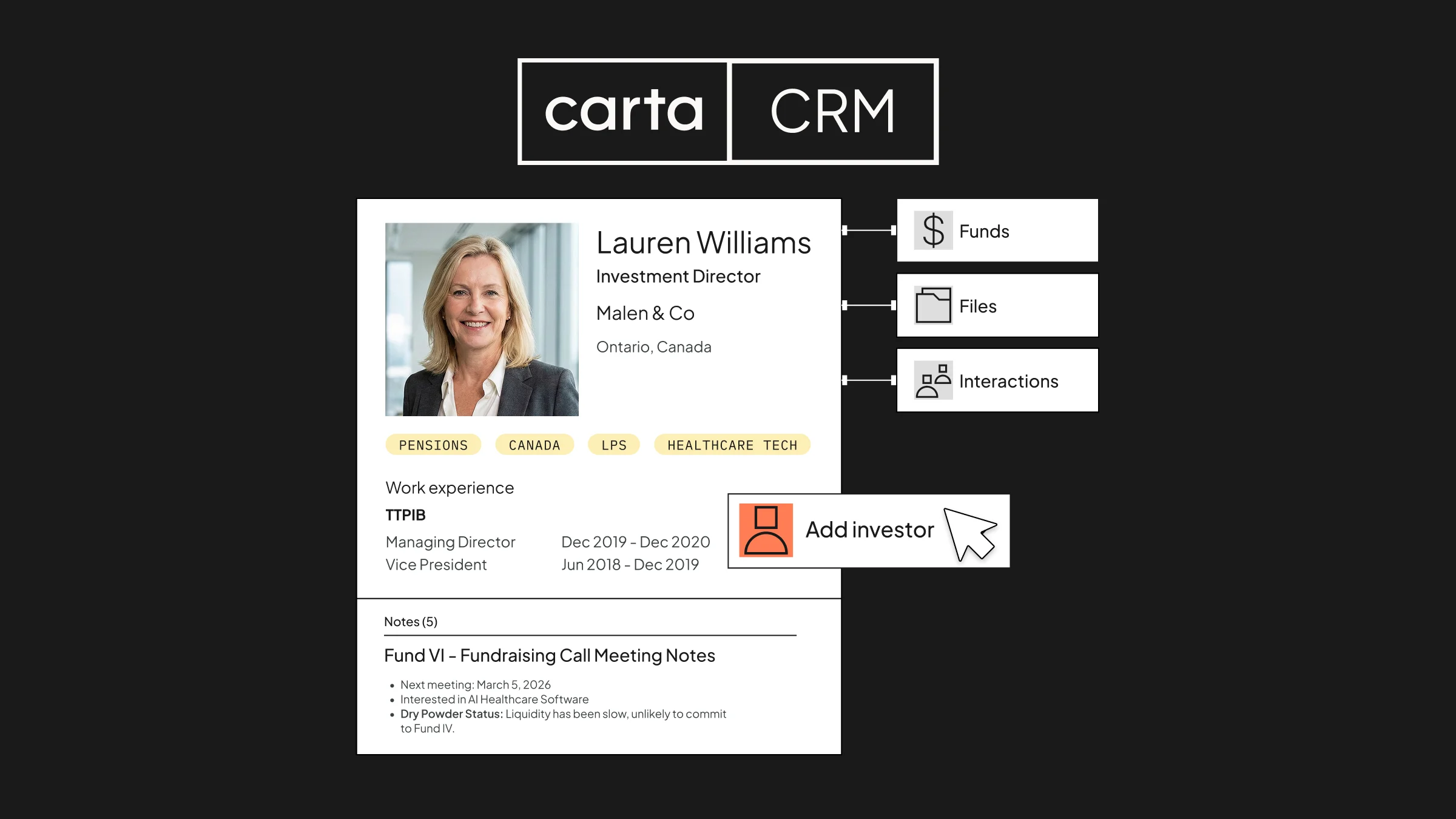
Carta CRM is a modern, front office-first platform, built from the ground up by investors and for investors. It covers the full deal team surface area: pipeline management, banker and advisor tracking, LP and fundraising workflows, embedded note-taking with AI notetaker support, and automatic contact and company enrichment that runs in the background without anyone on your team touching it. The platform is built LLM-first, meaning AI isn't a feature layer sitting on top of a legacy database. Instead, deal teams can surface relationship context, draft outreach, and run agentic workflows directly against their CRM data in ways that older platforms simply weren't designed to support. Carta currently supports 650 private equity firms with portfolio companies and 2,500 PE-backed companies, with $380 billion in total portfolio equity value and 120,000+ LPs served.
The Carta CRM suite consists of two specialized products built on a unified, LLM-native architecture that serves as the single source of truth for your firm. Deal CRM is built specifically for deal teams to automate deal flow tracking, proprietary sourcing, and execution workflows. LP CRM is designed for investor relations teams and senior partners to manage the fundraising flywheel, bridging the gap between relationship intelligence and live fund performance data from the Carta ERP.
Key features
Deal pipeline management: Configurable stages from sourcing to close, with deal source attribution and automatic activity capture from email and calendar
Banker and advisor relationship tracking: Full interaction history across the firm, relationship strength signals, and coverage mapping so you always know who owns which relationship
LP and fundraising management: Multi-level investor hierarchy, fundraising pipeline by fund, bulk email and campaign tools for LP communications
Embedded note-taking: Full-featured note editor with AI notetaker ingestion, inline company and contact tagging, and firm-wide search across all notes
Automatic data enrichment: Contacts, companies, and deals are continuously enriched in the background; headcount, funding history, and firmographics stay current without manual input
AI and agentic workflow integration: LLM-native architecture with MCP tooling, allowing deal teams to query and act on CRM data directly through Claude, GPT, or custom agentic workflows
Deep integrations with Carta’s fund admin, cap table, and closings modules
Strengths
Modern UI: Clean, fast, and designed for daily use by investors
AI and LLM integration built into the core product, not added as an afterthought
Automatic contact and company enrichment: Data stays current without manual input
Built by PE practitioners: The data model and workflows reflect how funds actually operate
Limitations
Newer to market than incumbents like DealCloud or Affinity: Some third-party ecosystem integrations are still being added
Better suited to large cap, mid-market and emerging funds
Ideal for: Emerging and established PE firms seeking a modern, easy-to-use CRM platform that is AI native.

Carta alternatives
If your priority is primarily sourcing and relationship intelligence, or you want a highly configurable front-office CRM, consider these alternatives.
Affinity
Affinity is a relationship intelligence platform designed to help VC deal teams automate data capture and map their firm's network. It syncs with email and calendars to automatically create and enrich contacts, helping teams find the warmest introduction path to a target company. However, Affinity is primarily a front-office tool focused on client-facing activities like deal sourcing and pipeline management; its product documentation does not include back-office functions or internal operations like fund accounting, capital call automation, or full-featured LP reporting functionality.
Key features
Automated contact and activity data capture from inboxes and calendars
Relationship intelligence scoring and network mapping
Customizable deal pipeline management
Integrations with third-party data providers
Strengths
Good for venture capital and VC-like PE investors
Strong network visualization helps teams find the best path into a company
Quick to implement and generally intuitive for deal teams to use
Limitations
Lacks some PE-specific workflows (investment banker/advisor management, AI-based company research)
Lacks native fund administration integration, requiring separate systems for back-office operations
Ideal for: Deal teams at VC firms and VC-like PE firms that prioritize proprietary deal sourcing and automated network building.
Attio
Attio is a modern, AI-native CRM built for go to market teams of start-ups and scale-up companies. Founded in 2019 and backed by approximately $124 million in total funding—including a Series B led by GV in August 2025—Attio has positioned itself as a developer-friendly alternative to legacy CRMs, with native integrations for Claude, Gumloop, and other AI tooling via its open API and MCP server. The platform competes primarily on price and ease of setup.
The core limitation in a PE context is structural: Attio is a general-purpose CRM that does not cater to the industry specific needs of private equity funds. There is no native fund data model, no LP portal, and no fund administration layer. Teams that adopt Attio alongside a fund admin system will find themselves maintaining two separate data sources and bridging the gap manually.
Key features
Configurable, flexible data model for go to market / sales organisations
Native AI integrations with Claude and Gumloop via MCP and open API
Email and calendar sync for automatic contact and activity capture
Developer-first platform for building custom automation workflows
Strengths
Low price point makes it accessible for budget-conscious teams
Modern, fast UI with minimal setup—goes live quickly without a lengthy implementation project
Strong developer extensibility for teams building custom AI workflows
Genuine AI integration depth: for technical teams using Claude or Gumloop, the API surface is flexible
Limitations
Pure CRM only—no fund administration, LP portal, or valuations; firms require a separate system for all fund operations
No native fund data model: LP commitments, IRR, TVPI, and capital call context must be manually built and maintained
“Blank canvas” flexibility requires ongoing data maintenance
Ideal for: Early-stage companies looking to build out their go-to-market motion and track prospective customers, or very small VC firms that need a simple spreadsheet-like CRM with Gmail sync.
DealCloud (Intapp)
DealCloud is a highly configurable CRM platform built for the capital markets, including PE. It serves as a central hub for deal and relationship management, allowing firms to tailor pipelines, reports, and workflows to their specific processes. While powerful for front- and middle-office activities like fundraising and investor relations, firms using DealCloud typically require separate, integrated systems for back-office fund administration and accounting.
Key features
Highly customizable pipeline and workflow management
Configurable tools for managing intermediary coverage and business development
Integrated compliance and risk management features
Advanced reporting and analytics capabilities
Strengths
Extremely flexible and can be tailored to a firm’s specific processes
Scales to support complex, global organizations with multiple fund strategies
Provides a centralized platform for managing deals, relationships, and compliance
Limitations
Independent implementation consultants note deployments can extend from six months to two years
Requires significant internal or external resources to manage and maintain
AI capabilities are often an additional, costly upsell
Total cost of ownership can be higher when accounting for migration, per-seat fees, and additional charges for AI
Ideal for: Large enterprise and multi-strategy PE firms that need a deeply customized platform and have the resources to support a complex implementation
Dynamo Software
Dynamo, founded in 1998, offers a broad, end-to-end platform for alternative asset managers that includes modules for CRM, deal management, portfolio monitoring, and an investor portal. The system can also integrate fund accounting, making it a potential all-in-one solution. However, this breadth can come with complexity; user reviews sometimes note that the platform has a steep learning curve that may require significant training during implementation.
Key features
Portfolio monitoring
Investor portal
CRM
Optional fund accounting modules
Strengths
Broad platform that can cover the full investment lifecycle for various asset classes
Limitations
User reviews emphasize a steep learning curve and potential implementation complexity
AI features are proprietary and siloed, lacking integration with leading third-party LLMs like OpenAI, Anthropic, or Microsoft, which can create additional administrative work rather than streamlining workflows
Ideal for: Alternative asset management firms seeking a platform to unify front-to-back-office investment operations, including CRM, deal management, portfolio monitoring, and fund accounting
folk CRM
folk CRM is a relationship-focused platform designed to help private equity teams manage deal sourcing, intermediary relationships, and investment pipelines. It centralizes contacts, companies, emails, meetings, and notes while automatically enriching records with relevant data. Teams can track interactions with founders, bankers, advisors, co-investors, and LPs in one place. However, folk remains a front-office CRM rather than a fund administration platform, so firms still need separate tools for fund accounting, capital calls, compliance, and detailed LP reporting.
Key features
Contact and company enrichment with automated data capture
Flexible pipelines for deals, intermediaries, investors, and portfolio companies
Email and calendar synchronization with complete interaction histories
AI-powered research, meeting summaries, personalized messages, and recommended next actions
Strengths
Easy to configure around different private equity workflows
Centralized relationship context supports warmer introductions and better follow-ups
Quick to implement without dedicated CRM administrators
Limitations
Lacks native fund accounting, capital call, and compliance workflows
Less suited to large firms requiring complex enterprise permissions and reporting
Ideal for: Private equity teams that need a flexible, easy-to-use CRM for relationship management, deal sourcing, and pipeline tracking.
Salesforce (with PE customization)
Salesforce is the world's leading generic CRM, offering immense flexibility to be customized for any industry, including PE. Using the Salesforce platform, firms can build custom objects and workflows for deal management and investor relations. This flexibility comes at a cost, as a proper PE implementation is not an out-of-the-box solution and can take many months and significant consulting support to build, integrate, and maintain.
Key features
Very customizable platform
Reporting and dashboard capabilities
Large ecosystem of third-party apps and integration partners
Strong security and compliance features
Scalable architecture for growing firms
Strengths
Ultimate flexibility to build a system that perfectly matches your firm's process
Can be adapted to manage any relationship-driven workflow
A vast pool of administrative and development talent is available
Limitations
Requires extensive, costly customization to function as a PE-specific CRM
Firms implementing Salesforce for PE typically require extensive customization and dedicated training programs, increasing the risk of low adoption
Total cost of ownership is high when factoring in development, administration, and third-party tools
Ideal for: Large firms with dedicated internal IT resources and highly unique process requirements that cannot be met by off-the-shelf CRM solutions.
Private equity CRM comparison table
To make this easier to scan, here is a quick comparison across the most common PE CRM decision-making factors.
Provider | Best for | Key features | Strengths | Limitations |
Carta CRM | Tech-forward PE funds looking for an AI-native CRM | Deal flow, relationship intelligence, investor relations, integrations with Carta ERP | AI-native, deep PE workflows, modern interface, easy to use | Nascent API integrations with 3rd party data providers |
Affinity | VC-like growth PE funds with an outbound sourcing motion | Automated data capture, network mapping, pipeline management, email/calendar sync | Relationship intelligence, automatic data capture | Does not include fund accounting, capital call workflows, or a full-featured LP portal |
Attio | Small VC/PE teams wanting a lightweight, AI-native CRM for deal flow | Configurable deal pipeline, AI integrations (Claude, Gumloop), email/calendar sync, developer-friendly API and MCP | Modern UI, low price point, fast setup, strong AI extensibility for technical teams | No fund admin, LP portal, or valuations; fund-specific data (LP commitments, IRR, TVPI) must be manually built and maintained |
DealCloud (Intapp) | Large enterprise and multi-strategy PE firms | Customizable pipelines, deal and relationship tracking, fundraising and IR modules | Highly flexible and purpose-built for complex workflows | Requires separate systems for back-office fund accounting and administration; total cost may be prohibitive |
Dynamo Software | All-in-one asset management | CRM, portfolio monitoring, investor portal, and optional fund accounting modules | Broad platform that can cover the full investment lifecycle for various asset classes | User reviews note a steep learning curve and potential implementation complexity; AI tools are proprietary, without current access to best-in-class integrations |
folk | PE teams needing a flexible CRM for relationship management, deal sourcing, and pipeline tracking | Contact and company enrichment, flexible pipelines, email/calendar sync, and AI-powered research and meeting summaries | Simple configuration, centralized relationship context for follow-ups, and quick implementation | Lacks native fund accounting, capital call, and compliance workflows; less suited to firms with complex reporting or permission requirements |
Salesforce | Funds looking for complex legacy workflows | Highly extensible platform with a vast ecosystem of apps and implementation partners | Nearly infinite flexibility to build a solution tailored to a firm’s unique processes | Requires significant time, budget, and technical resources to customize and maintain for PE |

How to choose the best private equity CRM for your firm (a simple decision-making path)
Follow this process to convert your evaluation into a final decision. This path will help you succinctly re-answer the primary question of which CRM is truly best for your firm.
Define your primary workflow. Is your biggest pain point proprietary deal sourcing, or is it the operational drag from disconnected fundraising and fund administration systems? Be honest about the problem you are trying to solve.
Map your required integrations. List the systems your CRM must connect with. This includes email (Outlook/Gmail), data providers (PitchBook/Grata), and, most importantly, your fund administration and LP portal solutions.
Run a pilot with a small user group. Select five to 10 users from your deal team, investor relations (IR), and operations to test the top two contenders. Real-world usage is the only way to validate a vendor's claims.
Validate the reporting outputs. Ask your pilot team to generate the reports they need for investment committee meetings and LP updates. If they can't do it easily without exporting to Excel, it's a major red flag.
Finally, remember that successful implementation requires more than just good software. A clear change management plan, with designated internal stakeholders and a focus on automation to ensure adoption, is just as important as the platform you choose.
When to choose an integrated platform vs. a standalone CRM
The decision between a standalone CRM and an integrated platform comes down to your firm's scale, complexity, and long-term operational goals. Understanding the tipping point where the benefits of an integrated system outweigh the simplicity of a standalone tool is key.
A standalone CRM is often sufficient for smaller teams with a straightforward pipeline. If your reporting requirements are simple and your finance stack is already well-established and separate, a dedicated tool for the deal team can work effectively. The primary focus is on organizing front-office activities without disrupting existing back-office processes.
However, an integrated platform becomes essential as your firm scales. If you find that quarterly reporting is a painful, manual process, or that your deal and finance teams are constantly reconciling numbers, you have likely outgrown a standalone CRM. An integrated platform is designed to solve these specific pain points by creating a single, reliable data source for the entire firm.
Consider choosing an integrated platform if you need:
One source of truth from the first contact with a target through closing and investor reporting
Fewer spreadsheets and fewer manual handoffs between the deal team, finance team, and investor relations
Repeatable, auditable workflows for compliance, financial reporting, and capital events
The best next step is to shortlist the tools that align with your unique needs, request demos, and run a pilot program. A successful pilot should measure adoption directly by tracking metrics like the percentage of deals with complete notes and defined next steps after 30 days of use.

Why Carta is a strong foundation for private equity relationship management
Choosing an operational platform is a long-term commitment. Firms select Carta because the platform is built on a fundamentally different premise than traditional CRMs.
Built for fund CFOs and deal teams, not just one or the other
The PE software market has historically been split between front-office CRMs for dealmakers and back-office accounting tools for fund administrators. This creates the very data silos that modern platforms are meant to solve. Carta bridges this gap with a unified platform where deal teams, investor relations, and fund finance all work from the same data, eliminating the friction and risk of manual reconciliation during capital calls, audits, and LP reporting.
The network effect of a connected private capital ecosystem
Carta serves as the technology infrastructure for the private capital markets. Carta is also used by more than 2,500 PE-backed portfolio companies for cap table management and over 120,000 LPs to manage their investments, creating network effects that reduce administrative burdens. This translates into smoother document management, fewer data re-entries, and connected data flows between a fund and its portfolio companies.
From fund formation to wind-down in one platform
Carta is designed to support your firm across the entire fund lifecycle. Carta's services begin with fund formation and LP onboarding and extend through day-to-day operations, reporting, tax, and audit, all the way to a fund's eventual wind-down. This comprehensive approach allows your firm to scale by adding new funds and investment vehicles without adding new, fragmented software tools for each one.
Choosing an integrated platform involves a strategic tradeoff.
What you gain: A single source of truth results in faster responses to LP inquiries, fewer painful data reconciliations, and cleaner, quicker audits.
What you give up: You may have less granular flexibility than you would by stitching together multiple best-of-breed point solutions. While an integrated platform may carry a higher initial investment, the total cost of ownership for a fragmented stack—which requires managing multiple subscriptions, integrations, and manual reconciliation workflows—is often higher overall.

Frequently asked questions about private equity CRM software
What is a private equity CRM?
A PE CRM is a specialized software system used to track and manage relationships, deals, and interactions across the entire investment lifecycle—from initial sourcing through exit. Unlike a generic sales CRM, it is purpose-built to manage a long-cycle deal pipeline, complex LP relationships, and fund-specific compliance requirements. It helps firms manage their deal pipeline, investor communications, and portfolio monitoring in one central place.
How is a private equity CRM different from fund administration software?
A CRM is a front-office tool focused on deal sourcing and relationship management, while fund administration software is a back-office system for accounting, compliance, and reporting. Some modern platforms, like Carta, unify both functions to create a single, integrated system for the entire firm.
What are the biggest signs your current CRM is failing?
The most significant signs of a failing CRM are low user adoption and a lack of trust in the data. If your deal team still relies on spreadsheets and you can't get a clear view of your pipeline without manual follow-ups, your CRM is not providing value.
How does AI actually save time in a PE CRM?
AI saves time by automating administrative tasks that deal teams typically perform manually. Practical examples include automatically capturing contact information from email signatures, summarizing meeting notes, and generating reminders for follow-up actions.
Can a new CRM integrate with Outlook or Gmail and migrate my data?
Most modern CRMs offer native integrations with Outlook and Gmail to automatically sync emails and calendar events. Vendors typically provide support for migrating data from existing systems, but the level of support and ease of migration can vary.
Why not just use Salesforce for private equity?
While Salesforce is a powerful CRM, it typically requires significant customization to fit the specific workflows of PE. Generic CRMs struggle with the non-linear nature of deal management and lack the specific features for fund operations, which can lead to poor adoption and an incomplete solution.
How is a private equity CRM different from Salesforce or HubSpot?
Unlike generic CRMs like Salesforce or HubSpot, developers purpose-built PE CRMs with features for managing deal flow, LP relationships, and fund-specific workflows that often require extensive and costly customization on a general-purpose platform.
What features should a PE CRM have that generic tools lack?
A PE CRM should include specific features like pipeline management tailored to investment stages, LP relationship management for tracking commitments, integration with fund administration systems, and compliance tools for regulations like the Investment Advisers Act.
What is a deal flow CRM, and how is it different from an investment CRM?
Industry professionals often use the terms deal flow CRM and investment CRM interchangeably to describe a system for managing the entire investment lifecycle, including sourcing and due diligence, closing, and portfolio monitoring, as distinct from a generic sales CRM.
How does a PE CRM support LP relationship management and fundraising?
A PE CRM acts as a fundraising CRM by centralizing all LP data, tracking commitments and side-letter terms, logging all communications, and managing the fundraising pipeline, which provides the investor relations team with a single source of truth.
How does CRM integrate with fund administration and an LP portal?
A tightly integrated CRM syncs deal and investor data with the fund administration platform, automating workflows like capital calls and distributions, and populating the LP portal with accurate, real-time information without manual reconciliation.
Why do PE deal teams resist using CRM tools?
Deal teams often resist CRMs because they perceive them as time-consuming administrative tools that require constant manual data entry, which distracts from their primary focus on sourcing deals and building relationships.
What compliance and security standards should you require (SOC 2 Type II, audit trail)?
You should require a CRM provider to have a System and Organization Controls 2 Type II (SOC 2 Type II) certification, and provide immutable audit trails for all data changes.
How long does it take to implement a private equity CRM?
Implementation can take anywhere from a few weeks for a straightforward, ready-to-use CRM solution to many months for a highly customized enterprise platform, depending on data migration complexity, number of users, and integration requirements.
Can a PE CRM replace a fund administration platform?
No, a standalone PE CRM cannot replace a fund administration platform, as it lacks the specialized accounting, valuation, and reporting capabilities that fund managers need to manage a fund's back-office operations. An integrated platform like Carta combines both functions into a single system.
What is the difference between a PE CRM and fund administration software?
A PE CRM traditionally focuses on front-office activities like deal sourcing and investor relationship management. Fund administration software handles back-office operations like fund accounting, capital calls, and financial reporting. Integrated platforms like Carta bridge both, connecting front-office activities to the back-office system of record.
Why do generic CRMs fail for private equity firms?
Generic CRMs typically fail because they lack the specific data structures and workflows required for fund management. They require heavy, expensive customization to handle concepts like fund structures, LP commitments, and compliance processes like KYC/AML checks.
How does a PE CRM integrate with fund accounting?
A strong integration connects the CRM to the fund's general ledger, allowing data to flow directly between the two systems. This ensures that LP commitments and deal information captured in the CRM are automatically reflected in the fund's financial records, eliminating manual reconciliation.
What compliance requirements should a PE CRM support?
A PE CRM should support core compliance needs by providing workflows for KYC and AML checks, maintaining a complete and immutable audit trail for all transactions, and enabling granular, role-based access permissions.
How long does private equity CRM implementation typically take?
Implementation time varies based on a firm's size, the complexity of its data, and the number of integrations required. A simple, out-of-the-box CRM might take a few weeks, while a highly customized, enterprise-wide implementation can take six months or more.
Can a private equity CRM handle multiple funds with different LP rosters simultaneously?
Yes, a purpose-built PE CRM should allow you to segment data by fund, ensuring that LP information, communications, and reporting are kept separate and confidential for each vehicle. It should also provide a firm-level, roll-up view for partners.
How does an LP portal differ from a standard investor update email?
An LP portal provides LPs with secure, on-demand, self-service access to their documents and performance data. This replaces the manual process of fulfilling one-off requests and sending periodic updates via email attachments.
What should fund CFOs prioritize when evaluating private equity CRM options?
Traditional CRMs are designed to track linear sales pipelines. For a fund, the CRM must map complex financial networks, adhere to strict regulatory guidelines, and bridge the gap between front-office fundraising and back-office fund accounting.
Is Carta only for venture capital firms, or does it serve private equity firms too?
While Carta started in VC, the platform is built to serve the entire private capital ecosystem, including PE. Carta supports PE firms with a full suite of services, including fund administration, portfolio valuations, LP reporting, and managing complex fund structures.

DISCLOSURE: This communication is on behalf of eShares, Inc. dba Carta, Inc. ("Carta"). This communication is for informational purposes only, and contains general information only. Carta is not, by means of this communication, rendering accounting, business, financial, investment, legal, tax, or other professional advice or services. This publication is not a substitute for such professional advice or services nor should it be used as a basis for any decision or action that may affect your business or interests. Before making any decision or taking any action that may affect your business or interests, you should consult a qualified professional advisor. This communication is not intended as a recommendation, offer or solicitation for the purchase or sale of any security. Carta does not assume any liability for reliance on the information provided herein. This post contains links to articles or other information that may be contained on third-party websites. The inclusion of any hyperlink is not and does not imply any endorsement, approval, investigation, or verification by Carta, and Carta does not endorse or accept responsibility for the content, or the use, of such third-party websites. Carta assumes no liability for any inaccuracies, errors or omissions in or from any data or other information provided on such third-party websites. © 2026 eShares, Inc. dba Carta, Inc. All rights reserved. Reproduction prohibited.