
- How treating new VC firms more like startups could help address the emerging manager paradox
- Why smaller funds tend to outperform
- Why don’t LPs back more emerging funds?
- Potential solutions to the emerging manager paradox
- Idea no. 1: Standardized back-office support
- Idea no. 2: Formation-stage capital solutions
- Idea no. 3: Follow-on fund infrastructure
- Idea no. 4: Standardized evaluation and underwriting
- A starting point, not a solution
- Subscribe to the Data Minute newsletter
It’s one of the enduring paradoxes of venture capital: The very best fund performance in the VC ecosystem tends to come from smaller funds raised by emerging managers. Yet despite this track record of success, those emerging managers often still struggle to raise capital from institutional LPs.
Rather than the small, emerging funds, it’s typically large funds raised by established VC firms that dominate the fundraising landscape.
Investors on both sides of the table should be incentivized to close this gap. Emerging managers want to raise more capital and eventually grow into established firms. LPs want better returns. But the existence of these complementary aims has not been enough to drive a change in the fundraising market.
Why does this emerging manager paradox persist? And what might be done to address it? There’s likely no single perfect answer. But many of the possibilities center around a similar theme: To make the VC ecosystem work better for everyone involved, it might help to treat emerging managers a little bit more like startups.
Why smaller funds tend to outperform
Research into venture performance consistently finds that emerging managers are one of the primary drivers of value in the VC ecosystem. This truth holds for venture funds tracked on Carta. For each fund vintage from 2017 through 2022, the 90th percentile for net TVPI is higher among funds between $1 million and $10 million in size than it is for funds larger than $100 million.
In some cases, the difference is vast. In the 2019 vintage, for instance, the 90th percentile of TVPI for funds between $1 million and $10 million is 4.91x, compared to just 1.92x for funds with more than $100 million in assets.
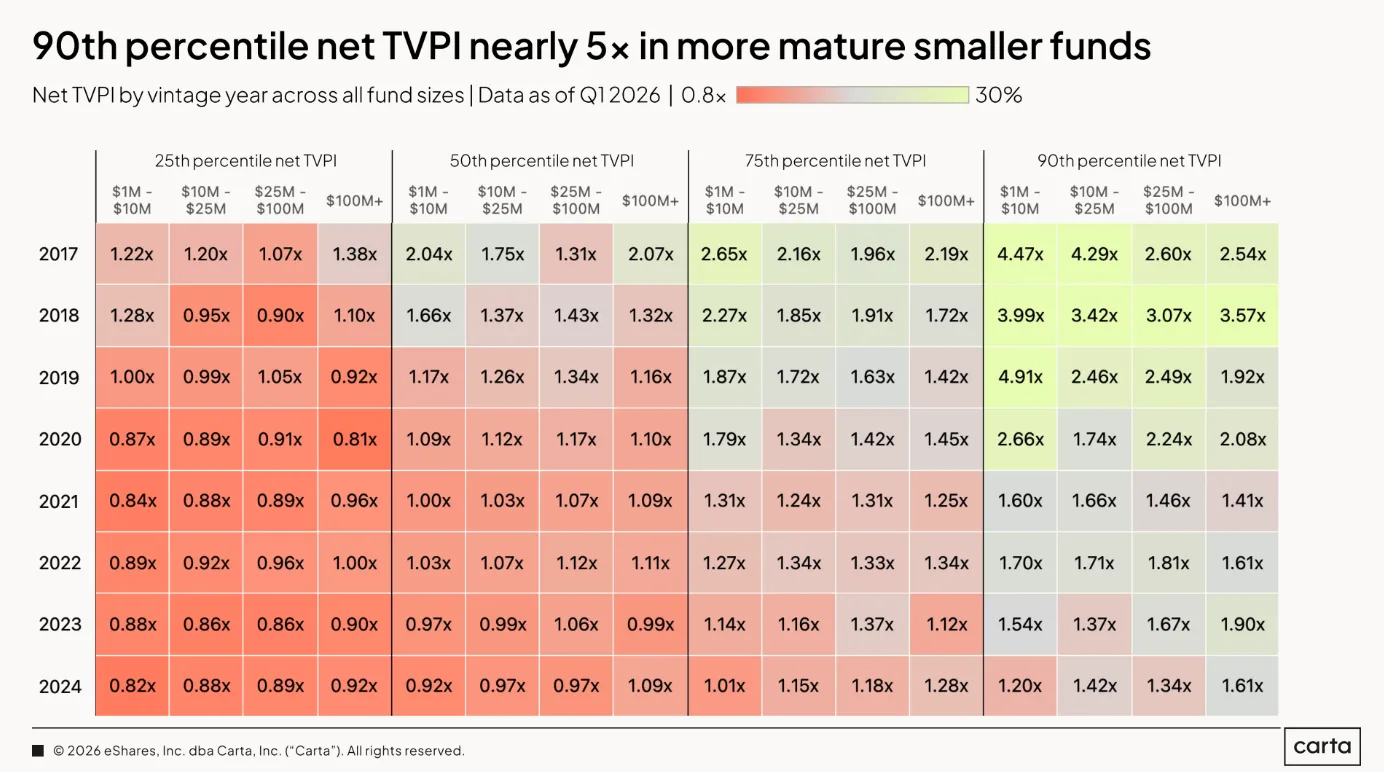
Conventional wisdom attributes this outperformance to multiple factors. One is simple math: Smaller funds need to produce less overall exit value than larger funds to achieve the same multiple. For example, there are far more opportunities in the market for a $10 million fund to realize a $10 million return and reach a 2x multiple than there are for a $500 million fund to achieve a $500 million return.
“As venture funds grow, the return profile changes materially. Larger funds require much larger outcomes to generate the same multiples,” says Aaron Dubin, a partner at the VC firm Team8, who authored a recent report examining some of the causes and potential solutions to the emerging manager paradox.
Another reason for this trend of outperformance is tied to the sorts of people who often become emerging managers. In Dubin’s findings, the typical emerging manager is a former operator who, as a VC, is now investing in the area in which they used to work. These sorts of individuals are often true technical experts with deep personal networks and comprehensive knowledge of the space in which they operate. For an investor, this combination can be potent—and difficult to replicate.
“When you’re small and you’re focused, you tend to be specialized in a particular domain, in a particular geography,” Dubin says. “You also tend to be at the point in your career where you’re closest to what you were doing before that created some kind of edge for you.”
Combine this investor edge with a friendly math equation, and outperformance can follow.
Why don’t LPs back more emerging funds?
There are also multiple factors contributing to the overall reticence among LPs to invest in emerging managers.
One of these is a mismatch in institutional capacity. Large, institutional LPs often manage tens or hundreds of billions of dollars, and they must follow strict mandates about how that capital is deployed. Investors hoping to receive an allocation from these LPs must meet specific requirements around how that capital is managed, how their back offices operate, and how performance is reported back to LPs. In many cases, emerging managers simply lack the capacity to meet these demands.
In other cases, LPs might only invest in funds with established track records of performance. This sort of mandate is designed to ensure that an LP’s money only goes to qualified, experienced stewards of capital—but it can eliminate some of the best-performing funds in the market from even being considered for an allocation.
“The big LPs, they have governance policies, they have mandates that require their investments to have infrastructure and a track record,” Dubin says. “They look for these institutional signals at times when, [for emerging managers], a lot of those signals don’t exist yet.”
The current state of the market is exacerbating these issues. Over the past several years, VC-backed exits have been few and far between. This means VC funds have been returning relatively little capital to their LPs. With no returns being generated, those LPs have relatively little capital to turn around and commit to new funds.
As of the end of Q1 2026, more than half of all VC funds on Carta in every vintage from 2019 on had yet to return a single dollar to their LPs, as measured by DPI.
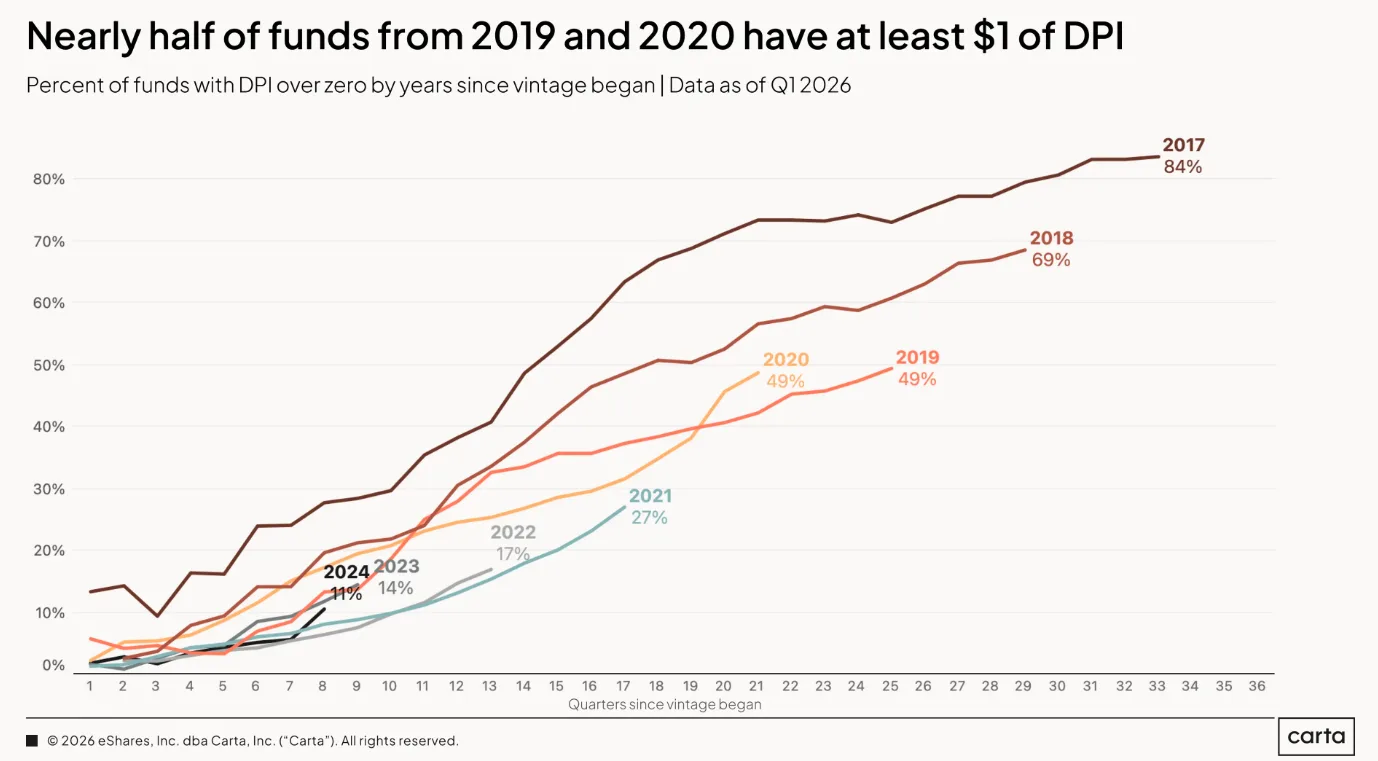
With less capital at their disposal, many LPs are choosing to play it safe and invest in the largest, most established funds in the market, rather than taking a chance on emerging funds that might present a wider range of possible outcomes. In Q1, just six of the industry’s largest VC fund managers combined to raise more than 75% of all newly committed capital.
“Companies are staying private longer, and that’s creating a DPI desert,” Dubin says. “If LPs aren’t getting DPI, their budgets to reinvest are limited. And so with whatever limited dollars they have, there can be a tendency to allocate to what they perceive as safer investments. And in today’s market, that often means mega-funds. They have the brand, they have the scale, they have the infrastructure.”
Potential solutions to the emerging manager paradox
In Dubin’s perspective, this desire among LPs to minimize risk is entirely rational. But it may still be limiting the upside of their portfolio performance. And it is certainly limiting the ability of new fund managers to emerge and grow, which could have negative long-term consequences for the venture ecosystem.
After speaking with dozens of GPs and LPs about the paradox, he arrived at four ideas that could help better align the incentives of emerging managers and institutional LPs. Most of them would have to be implemented by LPs themselves, or by other larger, established players in the VC space. None of them will eliminate the paradox entirely. In some cases, even if implemented, the impact might be marginal. No matter what processes are put in place, some emerging funds are just too small to matter for certain LPs—a $5 million first fund is quite different from a $75 million debut.
But Dubin believes there are genuine opportunities to reshape the VC ecosystem in a way that could benefit everyone involved. And these opportunities are based around a single idea, one that has also been informed by Dubin’s work in Team8’s VC foundry, which works with first-time investors trying to get their debut funds off the ground.
“Emerging funds are a lot like startups,” Dubin says.
Idea no. 1: Standardized back-office support
One of the biggest obstacles for LPs investing in emerging managers is the lack of established infrastructure those managers possess. A new fund manager wants to spend most of their time raising capital and sourcing deals, not setting up IT systems and compliance processes. But for LPs, those sorts of back-office functions are often prerequisites for writing a check.
For a potential solution to this issue, Dubin looks to the world of multi-manager hedge funds, also called pod shops. These funds typically function as platforms where one firm employs multiple distinct teams (called pods) led by separate fund managers who are all pursuing their own strategies. The overarching firm provides back-office support and other logistics, while the pods focus on managing and deploying capital.
“It happened in the hedge fund world decades ago, and more recently has moved into the PE world,” Dubin says of this model. “But it hasn’t really made its way into venture yet.”
This sort of model could be applied to VC in various ways. A major LP or fund-of-funds could stake several different emerging managers, treating them each as a separate pod. A company could offer outsourced back-office services to emerging managers, similar to the way fractional CFOs help fulfill back-office functions at many startups.
In the startup world, a founder must wear many hats that require many different skills. They might be better at some of those skills than others. Outsourced and fractional services for startups allow founders to focus on the highest-leverage tasks—building a product, selling to customers, finding a team—and minimize the distraction presented by smaller operational aspects.
The same is true for emerging managers. It would likely be in the best interest of all involved—both emerging managers and their LPs—if fund managers were able to spend more time on sourcing, underwriting, and fundraising, and less time on back-office chores. And with more back-office support, emerging managers would be more likely to meet the stringency of many LP mandates.
Idea no. 2: Formation-stage capital solutions
Every VC fund has setup costs. For an emerging fund operating on a shoestring budget, these costs can be particularly onerous.
Usually, a fund’s limited partner agreement (LPA) has a line item for the reimbursement of setup costs, which go toward things like paying lawyers and marketing the fund to investors. But this reimbursement might not happen for multiple years, leaving managers to pay the up-front cost—often hundreds of thousands of dollars—out of pocket.
In some cases, this is a financial hardship that must be navigated, such as by forgoing a salary or dipping into the manager’s personal savings. In others, it’s an insurmountable obstacle that prevents would-be managers from raising a fund at all.
“You almost need existing personal wealth to afford to get a fund off the ground,” Dubin says. “The economics of small funds may not support meaningful salaries or a broader team.”
Companies, of course, also have certain set-up costs. In some cases, the founder or founders pay these out of pocket. But other options exist. Many incubators or accelerator programs help cover the costs incurred when forming a startup. In other instances, some of the earliest capital that a startup raises from VCs or angel investors will go toward setup costs. In both cases, there’s some outside third party (such as an accelerator or an investor) who is willing to cover some of the cost of forming a company in exchange for financial upside as the company grows.
Dubin envisions a similar mechanism for emerging managers. A strategic LP, a fund-of-funds, or even an outside venture fund could help cover the setup costs for an emerging fund in exchange for a share of the upside the fund could create in the future. The emerging fund wouldn’t necessarily have to hand over part of their carry, in the same way that startups don’t trade part of their profits for VC fundraising—being an anchor LP in a promising young fund could be compensation enough. And outside investors could stake several different funds through this process, hedging their risk in the same way VC investors stake several different startups.
For the outside investors, this would be akin to buying an option on an emerging manager and any future funds they might raise. For some LPs or other investors, this scenario still might be too risky. But Dubin believes it’s an untapped opportunity that, for the right type of backer, would hold clear appeal.
“If we’re talking about a couple hundred thousand dollars, that’s a bet some LPs may be willing to make for a foot in the door,” Dubin says. “You’re saying to the emerging manager, ‘I believe in you enough to take the risk and help you get things going.’”
Idea no. 3: Follow-on fund infrastructure
All VC fund managers want to be able to continue to invest in the successful startups they back. The pro rata right that typically comes with investing in a startup can be one of an emerging manager’s most valuable possessions. But for funds operating on a tight budget, exercising that right can be easier said than done.
There are three primary mechanisms through which these follow-on investments usually occur. The manager might set aside some portion of their fund’s capital to use for follow-ons. The manager might raise a sidecar follow-on fund or a similarly structured opportunities fund. Or the manager might simply wait until they raise a new flagship fund and continue to invest in future rounds out of their primary fund.
There are a few problems with this status quo. For a first-time manager, raising a follow-on fund so close after your initial fund can be difficult, time-consuming, and distracting. Setting aside capital from the current fund for follow-on rounds creates a risk of the manager having to pick winners too quickly—it might be a better use of that initial pool of capital to instead keep writing new checks and get more bites at the proverbial apple. And if you wait until raising a new flagship fund to pursue follow-on deals, the opportunity to invest in top portfolio companies at the most favorable terms may already have passed.
Dubin proposes a different approach, one that would once again involve a friendly third party entering the equation to provide both financial and operational support to emerging managers.
That third party would raise a new pool of capital from LPs. An emerging manager would transfer their pro rata rights to this new fund in exchange for a share of the carry. And the new fund—call it a pro rata fund—would then deploy its capital in follow-on rounds with existing portfolio companies.
Depending on the fee structure of this new type of vehicle, the emerging manager might see limited financial downside. Dubin says that the standard VC follow-on fund has a 1-and-10 fee structure, rather than the 2-and-20 structure that predominates in typical venture funds. If this new pro rata fund operated with a 2-and-20 structure, it could split those fees evenly with the emerging manager, and the emerging manager would see the same profit they would have recorded from a typical follow-on fund.
Pro rata rights tend to roll over from one fund to the next. If an emerging manager fails to exercise those rights in an early portfolio company that goes on to huge success, it might miss out on serious profits down the line. This proposal would allow those managers to retain their pro rata rights into the future without having to raise a separate follow-on fund on their own, and without setting aside reserves from their primary fund.
This is essentially a proposed twist on the traditional fund-of-funds model, wherein a GP invests in many different VC funds with the goal of diversifying their exposure. It’s another way in which investors could underwrite the early-stage development of emerging managers and place a bet that those emerging managers could drive significant value in the future, in much the same way that VCs underwrite the early-stage development of young startups.
“Pro rata rights can be incredibly valuable, but smaller managers often don’t have the capital to fully exercise them,” Dubin says. “Across many managers, those rights may collectively represent a meaningful and often overlooked source of investment access.”
Idea no. 4: Standardized evaluation and underwriting
Institutional LPs conduct a detailed diligence process before allocating to a new fund. This process can take six months or more to complete, and even then, an investment is not assured. Different LPs might all have their own diligence workflows, with requests for the same sort of information presented in slightly different ways.
For emerging managers, completing these diligence processes can be a huge time commitment. It’s another aspect of getting a new VC fund off the ground that requires managers to direct their attention away from the highest-value parts of their jobs—namely, sourcing new investments and writing checks.
In Dubin’s view, it’s also another area in which treating emerging managers more like startups could pay dividends.
For young companies, negotiating deal terms with new investors can be a major distraction from the parts of the job that will ultimately drive value to those same investors. Both sides are incentivized to streamline the process. In response, Y Combinator several years ago popularized a one-size-fits-all framework for SAFE investments in early-stage startups. Instead of going back and forth for weeks about specific questions or terms, companies and investors can work from a standardized document that’s designed to expedite the fundraising process.
The due diligence process for emerging managers could be similarly ripe for disruption. Dubin acknowledges that different LPs have different diligence needs, and that coordinating various players and industry groups across the private markets could be a challenge. But he sees this as a clear chance for LPs to make life easier on emerging managers, to the ultimate benefit of the entire VC ecosystem.
“We need a more streamlined set of diligence requirements that is emerging-manager friendly, while still addressing the needs of institutional LPs,” Dubin says. “There’s already been some progress towards standardization, but there’s an opportunity to take it one step further.”
A starting point, not a solution
The emerging manager paradox has been an established fact of the VC ecosystem for more than a decade. It’s entirely possible that there’s no simple way to solve it, or perhaps no way to solve it at all. Perhaps the desire among LPs for established track records and limiting risk simply outweigh the desire to maximize returns, no matter what new structures or mechanisms might be introduced.
But Dubin believes a different type of ecosystem is possible, one in which a better alignment of incentives between LPs and GPs could allow emerging managers to thrive. He thinks this alternative would be superior for everyone involved in the private market—and that a little experimentation about it could be achieved is very much worthwhile.
“You have to start somewhere,” Dubin says. “There’s this whole chicken-and-egg problem: emerging managers typically need a track record to attract capital, but they need capital to build a track record. Once you crack that, I think you can pull it off.”
Subscribe to the Data Minute newsletter

DISCLOSURE: This communication is on behalf of eShares, Inc. dba Carta, Inc. ("Carta"). This communication is for informational purposes only, and contains general information only. Carta is not, by means of this communication, rendering accounting, business, financial, investment, legal, tax, or other professional advice or services. This publication is not a substitute for such professional advice or services nor should it be used as a basis for any decision or action that may affect your business or interests. Before making any decision or taking any action that may affect your business or interests, you should consult a qualified professional advisor. This communication is not intended as a recommendation, offer or solicitation for the purchase or sale of any security. Carta does not assume any liability for reliance on the information provided herein. © 2026 Carta. All rights reserved. Reproduction prohibited.