Introduction
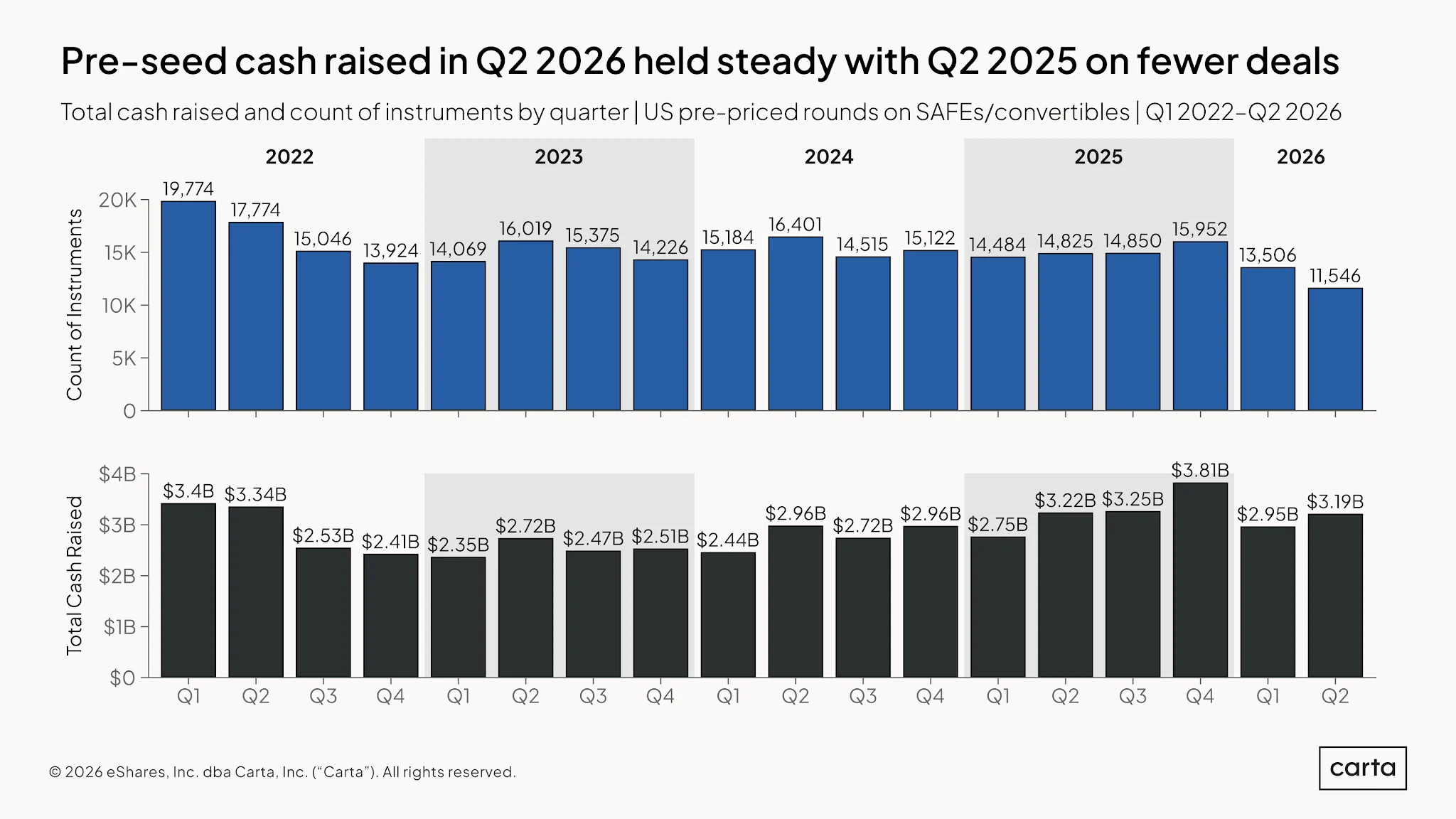
Over the past year, there has been a concentration of capital in the pre-seed market, with similar sums of cash going into noticeably fewer deals. As of this publication, U.S.-based startups on Carta raised $3.19 billion across more than 11,500 pre-seed instruments (i.e., SAFEs and convertible notes) in Q2 2026. Last year’s Q2, on the other hand, saw $3.22 billion invested across 14,825 instruments.
The concentration of capital is illustrated by the rise in average instrument size, calculated by dividing the total dollars invested by the count of instruments. In Q2 2026, the average instrument size came out to $276,000, representing a 27% year-over-year increase from Q2 2025 and a record high over the past four-plus years.
The final pre-seed investment volume for Q2 2026 will be revised upward as more data is entered into our system. But 2026 is already slightly ahead of 2025 in terms of total pre-seed cash invested during the first half of the year.
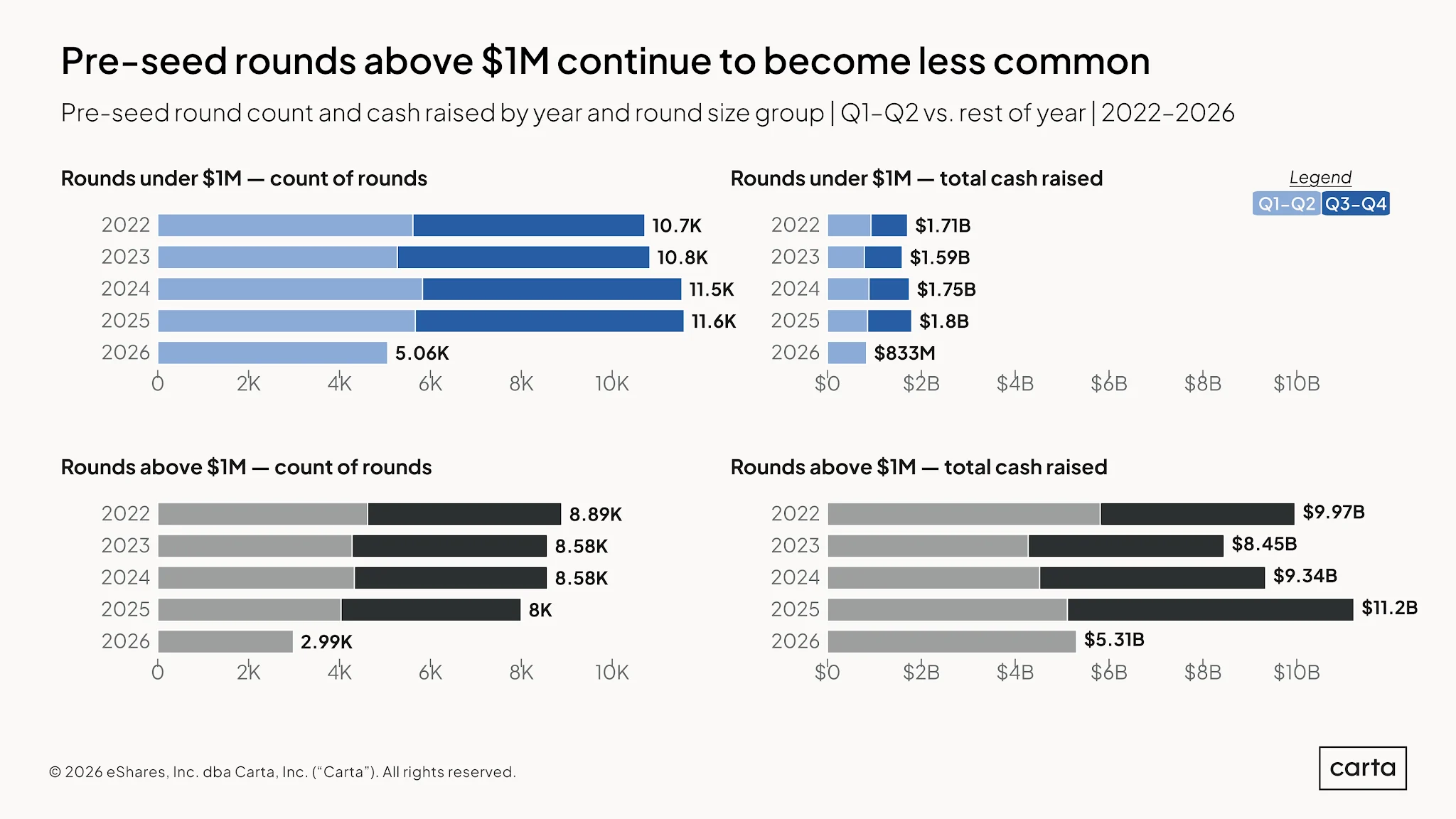
Even with the increase in average check size, few pre-seed deals exceed $2.5 million. The ones that do typically involve ten or more instruments stacked together. At the 90th percentile, valuation caps on SAFEs larger than $2.5 million can reach a shocking $100 million. This trend is largely tied to investor enthusiasm for AI companies, which have captured half of all pre-seed dollars so far this year.
Top 3 findings for Q2 2026
The average size of pre-seed SAFEs/notes reached a new high. As larger amounts of capital go towards fewer companies, the venture capital industry’s big early-stage bets are getting increasingly concentrated. More dollars invested on fewer instruments pushed up the average instrument size in Q2 to a record high of $276,000.
The AI hype continued, but is perhaps plateauing. The share of pre-seed dollars invested into AI startups is holding near 50%. AI companies captured 49% of all pre-seed dollars in H1 2026, essentially matching 2025's full-year figure of 50%. While there has been a noticeable increase in AI’s share since 2021, the past six months did not see a continued rise.
Texas overtook New York, and the Austin metro ranked third in the nation. Startups based in Texas took in 9% of pre-seed investment in the U.S. in Q2, second only to California. New York fell to third in the state rankings. In terms of metro areas, the top three in Q2 were the Bay Area, New York City, and Austin.
Key trends
Download the full report
Submit the form below to access the full report, including charts on salary, equity, hiring trends, and company composition across stages and sectors.

DISCLOSURE: This communication is on behalf of eShares, Inc. dba Carta, Inc. ("Carta"). This communication is for informational purposes only, and contains general information only. Carta is not, by means of this communication, rendering accounting, business, financial, investment, legal, tax, or other professional advice or services. This publication is not a substitute for such professional advice or services nor should it be used as a basis for any decision or action that may affect your business or interests. Before making any decision or taking any action that may affect your business or interests, you should consult a qualified professional advisor. This communication is not intended as a recommendation, offer or solicitation for the purchase or sale of any security. Carta does not assume any liability for reliance on the information provided herein. © 2026 Carta. All rights reserved. Reproduction prohibited.