Executive summary
IRR and TVPI are two of the most closely watched metrics for measuring venture capital fund performance.
For the top-performing funds raised in the late 2010s, these two statistics currently tell two very different stories.
Among the 2017, 2018, and 2019 VC vintages, the 90th percentiles for IRR have all trended down over the past two years. In the 2017 vintage, for instance, the current 90th percentile IRR sits at 25.7% as of the end of Q2 2026, down from 28.7% two years prior. Top-decile IRRs for the 2018 and 2019 vintages have experienced similarly gradual declines.
As measured by TVPI, however, VC fund returns at the 90th percentile are skyrocketing. For the 2017 vintage, the current top-decile figure is 4.14x, up from 3.31x two years ago. For the 2018 vintage, the 90th percentile for TVPI has climbed from 2.96x to 3.71x over that span.
IRRs are sinking for the best funds from these vintages, while TVPIs are soaring. What does this difference reveal?
IRR and TVPI are both ways to assess the overall performance of a fund. But they approach the problem from two different angles. IRR is tied closely to the timelines on which returns are generated. The same returns produced more quickly result in higher marks. TVPI, on the other hand, is time neutral. A 3x return is a 3x return, no matter how long it took to produce.
This divergence of IRR and TVPI, then, tells us something worthwhile about the current market. Yes, VC funds from the late 2010s are still gaining significant value, bolstered in some cases by the huge gains produced by sought-after AI startups. But the timeline on which these gains are being achieved is perhaps longer than expected. And in many cases, those gains are still on paper, not realized into distributions.
From the perspective of LPs, the best outcome from a VC fund investment is for the fund to produce strong returns as quickly as possible. The top funds from the late 2010s are succeeding in the first half of that equation. As for the second half? The clock is still ticking.
Q2 highlights
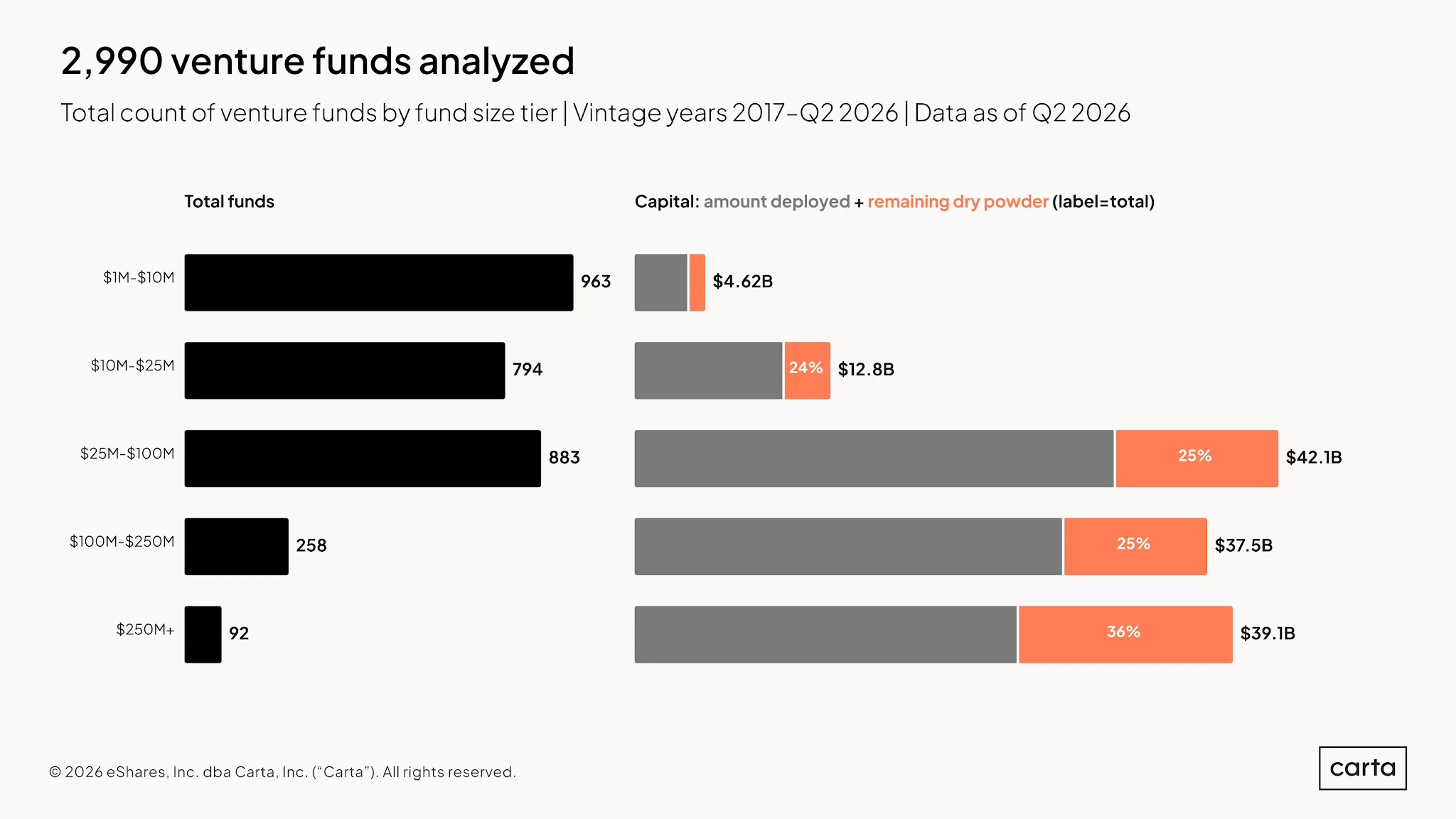
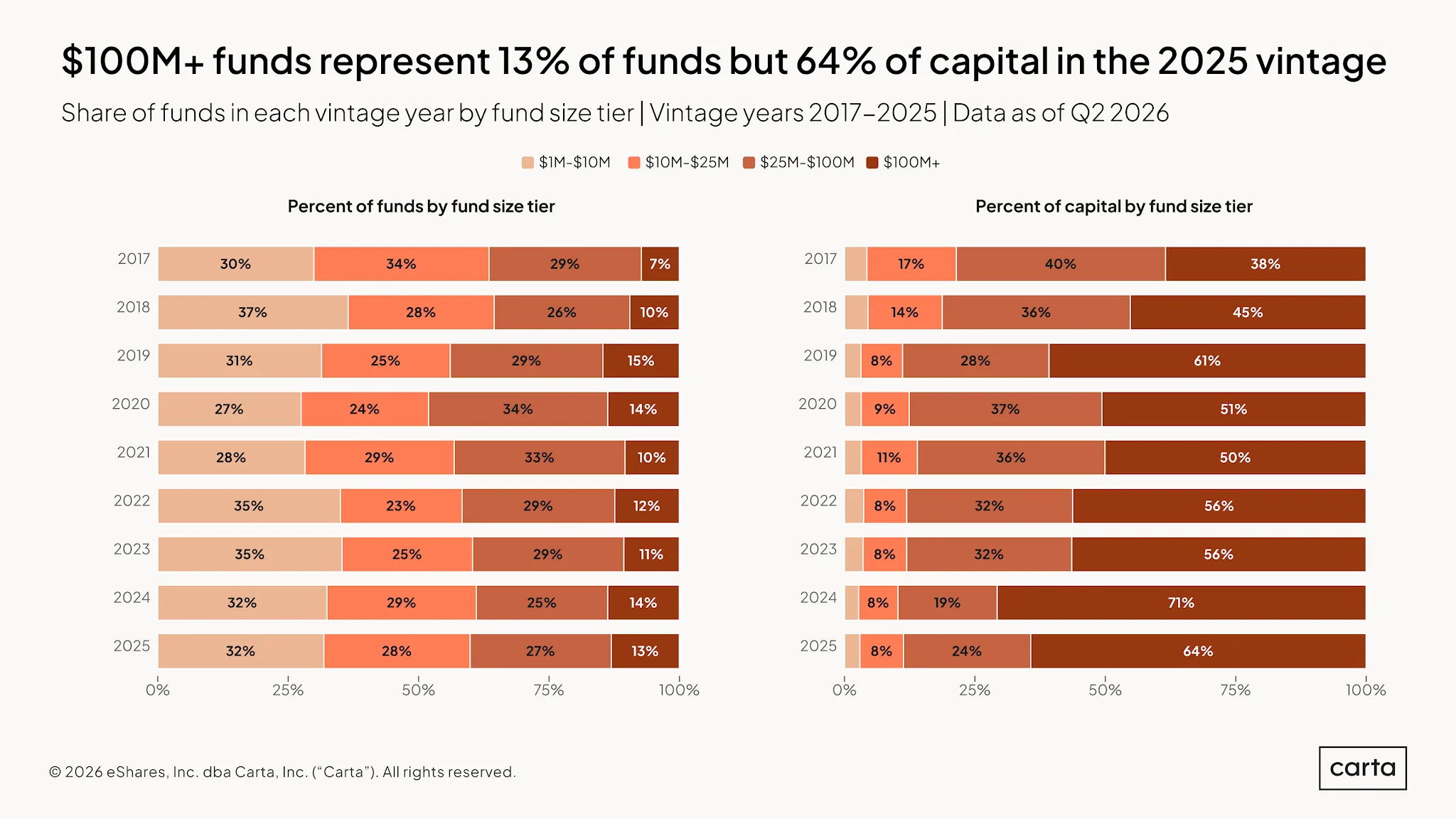
A flight to megafunds: In 2025, 64% of all capital raised by VC funds on Carta was concentrated in funds with more than $100 million in assets under management. This figure has been rising steadily for much of the past decade: Back in 2017, just 38% of capital went to $100 million-plus funds. In their allocation decisions, LPs today are choosing to place their capital in bigger baskets.
New funds rely on fewer LPs: As these large VC funds have grown more common, the typical number of LPs contributing to each fund has declined. In the first half of 2026, the median fund between $100 million and $250 million had 44 different LPs; in 2025, the median fund of that size had 59 LPs. Over the past four years, median LP count for these nine-figure funds is down 45%.
Liquidity timelines continue to lengthen: The percentage of recent funds that have begun to generate at least some DPI is growing. But the scale of those returns still leaves much to be desired. For the 2017 vintage, median DPI sits at 0.37x. That median DPI is 0.15x for 2018 funds, and 0.04x for 2019 funds. As these vehicles approach a decade since inception, concrete returns for the typical fund remain difficult to find.
Fund details
Read the full report
Submit the form below to access the full report and receive a copy in your inbox, including charts on IRR, TVPI, and DPI.


DISCLOSURE: This communication is on behalf of eShares, Inc. dba Carta, Inc. ("Carta"). This communication is for informational purposes only, and contains general information only. Carta is not, by means of this communication, rendering accounting, business, financial, investment, legal, tax, or other professional advice or services. This publication is not a substitute for such professional advice or services nor should it be used as a basis for any decision or action that may affect your business or interests. Before making any decision or taking any action that may affect your business or interests, you should consult a qualified professional advisor. This communication is not intended as a recommendation, offer or solicitation for the purchase or sale of any security. Carta does not assume any liability for reliance on the information provided herein. © 2026 Carta. All rights reserved. Reproduction prohibited.