- Carta discusses future of American capital, while policymakers debate future of regulation for prediction markets, crypto, and frontier AI
- Topline
- SEC Commissioner Peirce makes the case for regulatory restraint
- Carta participates in U.S. Chamber’s Capital Markets Summit: The Future of American Capital
- Frontier AI governance debate heats up
- Other AI policy news
- CFTC proposes federal framework for prediction markets
- Crypto market structure hits snags on its way to the floor
- Quick hits
- Sign up below to receive Carta's Policy Weekly Brief
Topline
Peirce’s parting wisdom on the future of SEC regulation
Carta Policy participates in U.S. Chamber’s Capital Markets Summit: The Future of American Capital
Frontier AI oversight debate takes shape
CFTC proposes federal framework for prediction markets
Lack of clarity on path forward for crypto market structure
Quick hits
SEC Commissioner Peirce makes the case for regulatory restraint
In one of her final speeches as an SEC Commissioner (an absolute must-read), Hester Peirce offered a parting regulatory philosophy and roadmap for the agency’s next chapter. Speaking at the U.S. Chamber’s Capital Markets Summit, Peirce argued that U.S. capital markets work best when the government acts as a referee, not a market participant. Enforce sensible rules fairly, but resist the temptation to steer capital, impose merit-based judgments, or stretch old statutes to reach new policy objectives beyond the agency’s core investor-protection and capital-formation mandates.
For private markets, Peirce pointed to the proposed Form PF rollbacks as an example of correcting a private fund reporting regime that had grown beyond its original purpose. She also flagged the investment adviser pay-to-play rule, questioning whether restrictions that can limit an adviser’s ability to receive compensation after certain political contributions are constitutionally sound or within the SEC’s proper remit. This matters for private fund advisers raising from public pensions and other government LPs, where political contribution compliance can affect fundraising and investor relationships. Peirce also criticized expansive uses of Section 206(4) of the Advisers Act, including negligence-based theories, reinforcing a broader message that prophylactic adviser rules should be tied more clearly to fraud, investor harm, and congressional authorization.
Why it matters: Peirce’s speech offers a roadmap for where the SEC may continue to unwind or narrow private-market regulation under Chairman Atkins. Form PF rollbacks are already underway, but Peirce’s comments suggest the next wave could focus on adviser rules that impose broad compliance burdens without a clear showing of fraud, investor harm, or congressional authorization. For private fund advisers, that could mean a more favorable posture on reporting, fundraising, enforcement remedies, and political contribution compliance—especially for firms raising from public pensions.
Carta participates in U.S. Chamber’s Capital Markets Summit: The Future of American Capital
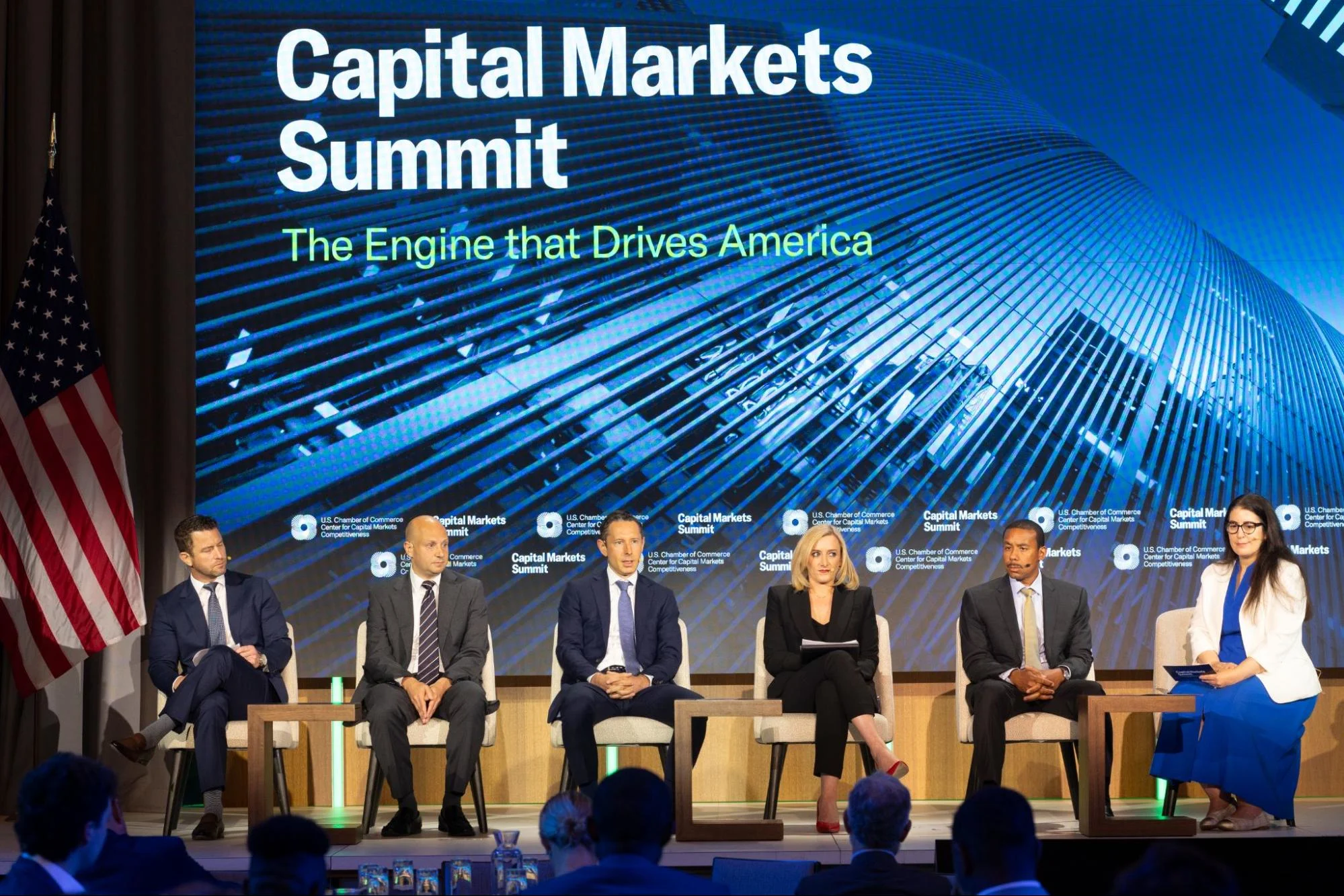
On Tuesday, Carta’s Head of Policy Holli Heiles Pandol joined policymakers and market participants for a discussion on the future of American capital at the U.S. Chamber of Commerce Capital Markets Summit. The panel focused on why companies are staying private longer, what that means for investors and employees, and how policy can reduce the regulatory frictions associated with going—and staying—public.
Key takeaways:
The cost of being public has continued to rise. Public companies face greater regulatory complexity, compliance expense, and litigation exposure, while quarterly reporting pressures can punish management teams for investing through longer-term growth cycles. Private markets, by contrast, often give companies more flexibility to scale before entering the public markets.
Private capital has also matured as an alternative. Secondary transactions, tender offers, and other liquidity tools now provide meaningful opportunities for employees and early investors without requiring an IPO. For many companies, going public remains an important aspiration, but it is no longer the only path to scale.
The policy environment is beginning to respond. The SEC is taking steps to meaningfully address barriers for companies to go—and stay—public. There is growing momentum behind reforms that would make the public markets more attractive, including extended disclosure accommodations, a new IPO on-ramp, and reforms that would shield smaller public companies from accelerated filer status as they transition into life as public companies.
Companies raise capital on a continuum, and policy should support them at every stage of that journey, including formation and growth in the private markets, liquidity, employee ownership, and, when the time is right, a successful transition to the public markets. As access to private markets expands and innovation continues to reshape how companies finance growth, the traditional distinction between public and private markets will continue to blur.


Frontier AI governance debate heats up
Frontier labs are pushing beyond the voluntary framework laid out in Trump's June 2 executive order to mandatory federal AI testing. OpenAI released a governance blueprint calling for the Center for AI Standards and Innovation (CAISI) to become the federal government’s lead AI safety institution and, once it has sufficient capacity, to require the most capable frontier models to undergo pre-release evaluation. Anthropic went further, urging Congress to mandate catastrophic-risk testing, independent evaluations, public risk reporting, and binding government authority to block dangerous deployments. The two proposals differ in tone and enforcement teeth—OpenAI explicitly opposes giving regulators authority to block releases; Anthropic is asking for exactly that—but both point in the same direction. Frontier labs are no longer asking the government to stay out of the way, but are pushing for a federal safety framework that can keep pace with model capabilities.
That is putting preemption back at the center of the congressional AI debate. The bipartisan House proposal—the Great American AI Act—would create a federal AI framework and temporarily preempt certain state laws governing AI development, while preserving room for states to regulate many downstream uses. In the Senate, the path is more fluid. Sen. Marsha Blackburn is reportedly negotiating with the White House on an AI preemption package that could be paired with KOSA, NO FAKES, age verification, and other child-safety and creator-rights measures. But the politics remain difficult. State lawmakers, consumer groups, and some Republicans have resisted broad preemption, while Anthropic is arguing that Congress should not displace state frontier AI laws unless it enacts a federal regime at least as strong as the leading state frameworks.
Why it matters: The center of gravity in AI policy is shifting from whether Washington should regulate frontier models to what kind of federal standard should replace the emerging state patchwork. For companies building or deploying advanced AI, the key questions are no longer just compliance with today’s voluntary commitments; they are whether Congress creates a national testing regime, who runs it, whether it has teeth, and how much room states retain to regulate safety, consumer protection, child harms, data centers, and workforce impacts. A sweeping AI package before the midterms remains unlikely, but the policy architecture is coming into focus: mandatory testing is gaining traction, preemption is the bargaining chip, and frontier AI governance is becoming a live legislative fight.
Other AI policy news
Unlikely allies: Sen. Bernie Sanders is pushing an American AI sovereign wealth fund concept that would give the public an ownership stake in major AI companies through a 50% equity tax. President Trump has also said the U.S. could take equity stakes in leading AI companies so Americans can share in the upside, with active discussions reportedly underway with OpenAI. The scale and mechanisms between the proposals differ sharply, but the convergence signals growing consensus on the left and right that AI wealth and power is becoming too concentrated and too dependent on public inputs to be left to the private sector.
Mythos goes mainstream. Anthropic launched Claude Fable 5, the first broadly available version of its Mythos-class model, with stronger capabilities and new safeguards for high-risk use cases. Some cybersecurity, biology, and chemistry requests are routed to Opus 4.8 when flagged, and Anthropic initially disclosed that some frontier AI development requests could be limited through hidden interventions without user notice. After pushback, the company reversed course and said flagged requests will visibly fall back to Opus 4.8 or be refused with an explanation. The quick correction matters, but the episode highlights a new diligence category for enterprise AI adoption: output integrity. As firms use AI for legal review, investment analysis, valuation work, portfolio monitoring, and software development, they need to know when a model is being rerouted, constrained, or modified by vendor policy.
Mythos-class models also require 30-day retention of prompts and outputs for trust and safety purposes, including on third-party platforms, and existing zero data retention arrangements for other Claude models do not automatically apply.
CFTC proposes federal framework for prediction markets
The Commodity Futures Trading Commission (CFTC) proposed its first substantive regulatory framework for prediction markets, moving from one-off disputes over event contracts toward a more formal case-by-case review process. The proposal would give the agency meaningful gatekeeping authority over contracts it determines are contrary to the public interest or unusually susceptible to manipulation, rather than imposing categorical bans across broad subject areas. It also marks a shift from a model where regulated platforms can generally list new contracts through the CFTC’s self-certification process unless the agency intervenes.
The framework takes particular aim at contracts tied to war, assassinations, terrorism, military events, and other high-stakes markets that regulators claim pose significant risks, including the leakage of classified national security information and the creation of perverse real-world incentives. The proposal comes as prediction markets are becoming a more visible input in politics, sports, media, and investor sentiment. Platforms like Kalshi and Polymarket have helped make real-time event pricing part of the policy conversation, but the market’s rapid growth has also exposed gaps in the regulatory perimeter and raised hard questions about where federal derivatives regulation ends and gambling, election, and national security concerns begin.
Why it matters: Prediction markets are quickly becoming a signal that investors, policymakers, journalists, and market participants rely on to understand real-time expectations, and they have expanded rapidly with minimal federal oversight. But the same features that make these markets useful—binary outcomes, rapid trading, and information aggregation—also make them vulnerable to manipulation, insider trading, national security concerns, and political backlash. A case-by-case review framework gives the CFTC meaningful gatekeeping authority without shutting down the category, but it also places significant discretion in the agency to define what is and isn’t in the public interest. The sports-contract provisions could also tee up a broader fight with state gaming regulators and tribes, who have argued that some prediction markets are being used to route around state gambling regimes under the banner of federal derivatives regulation. For fund managers and investors who have come to rely on prediction market pricing as a policy signal, the rules being written now will determine how much of that signal survives federal scrutiny.
Crypto market structure hits snags on its way to the floor
The CLARITY Act cleared the Senate Banking Committee last month with bipartisan support, but the path to passage is getting narrower and more complicated. Democrats are pressing for stronger ethics guardrails to address senior officials’ crypto conflicts, including an enforceable mechanism if the Justice Department fails to act. Republicans have raised constitutional and political concerns with that approach and floated narrower alternatives, which Democrats view as insufficient. Law-enforcement groups are also pressing concerns around Section 604, the Blockchain Regulatory Certainty Act, which would protect certain noncustodial software developers from liability for third-party misuse unless they intended to facilitate illicit activity. A stablecoin compromise helped the bill advance through committee, but banks continue to argue there is too much room for deposit-like incentives.
And these disputes are just within the Banking Committee’s portion. The Senate still has to integrate the CFTC-focused provisions that passed the Agriculture Committee on a party-line vote before leadership can assemble a floor-ready package.
Why it matters: The CLARITY Act remains the most viable vehicle for comprehensive crypto market structure legislation—and it has momentum—but its path depends on holding together a fragile bipartisan coalition to reach 60 votes. The Democrats most likely to support the bill have made it clear their votes depend on stronger ethics language, which isn’t there yet. If negotiators can resolve ethics enforcement, Section 604, stablecoin yield, and the Banking–Agriculture integration quickly, a pre-August floor vote remains possible. But the odds are slipping. Post-election, the bill’s prospects become much less likely, particularly if control of either chamber shifts. (Kalshi currently has 25% odds for market structure legislation becoming law before August, and ~40% this Congress)
Quick hits
SpaceX prices record-setting IPO at $1.8 trillion valuation. SpaceX priced its IPO this week at $135 per share, raising $75 billion and implying a roughly $1.77 trillion valuation—the largest public offering in history. The offering sold 555.6 million shares and was more than four times oversubscribed, with retail investors reportedly placing more than $100 billion in orders. At the IPO price, SpaceX’s market capitalization nearly equals the combined inflation-adjusted value of the 29 largest U.S. IPOs since 2000. But SpaceX is more than a landmark listing; it is a stress test for the next phase of private market exits. After years of companies staying private longer and accumulating enormous valuations outside the public markets, SpaceX will show whether public investors can absorb mega-cap listings built around long-duration growth stories, limited float, and concentrated founder control. Its performance will also shape the path for other expected frontier technology IPOs, including Anthropic and OpenAI, where valuations are likely to depend less on current earnings than on investor confidence in future market dominance.
Silicon Valley revolts against Newsom software tax plan. A coalition of 50 major technology companies is urging California lawmakers to reject Gov. Gavin Newsom’s proposed expansion of the state sales tax to digital software and his plan to permanently limit the state’s R&D tax credit. The companies argue the software tax would raise costs for widely used business tools like Microsoft Outlook and Slack, while a permanent R&D credit cut would weaken California’s competitiveness and push investment in AI, semiconductors, and other emerging technologies to other states. While the coalition opposes the software tax outright, it floated a compromise on R&D by temporarily extending the current 50% cap while allowing companies to recover the full credit value in future years. The fight highlights the growing tension between California’s near-term budget pressures and its long-term reliance on the innovation economy as a core driver of jobs, investment, and tax revenue. Lawmakers are expected to finalize the budget with Newsom by the end of June.
Trump nominates Jay Clayton as Director of National Intelligence: President Trump nominated the former SEC chairman and current U.S. Attorney for the Southern District of New York to serve as Director of National Intelligence (DNI), a move that could help ease congressional backlash over the interim appointment of Bill Pulte and reopen stalled talks over Section 702 of FISA. The House rejected a temporary extension after Democrats objected to Pulte’s acting DNI role, leaving the surveillance authority on track to lapse. Clayton’s nomination drew bipartisan praise, suggesting a path to confirmation. His background overseeing complex regulated markets and sophisticated private-sector actors could shape how the intelligence community approaches cyber risk, AI-enabled threats, and classified engagement with frontier technology companies, potentially favoring a more process-driven model built around risk review, confidential information-sharing, and coordination with industry rather than blunt regulations.
Citigroup launches tokenized private-company shares: Citi launched its venture to provide trade shares of private companies through its new tokenized depository receipt product, a structure it hopes other banks will take to in a push to improve transparent investor access and liquidity in the private sector. This product, which is initially only available to foreign investors but intended to be rolled out to their U.S. client base later, will allow clients’ private-company shares to sit alongside public equities in investor portfolios. The bank is already in discussions with large private companies to get involved as investor demand builds around IPO candidates like SpaceX and Anthropic, and as companies continue to take longer to go public. Tokenization is already moving beyond concept into capital markets plumbing. For private markets, the key question will be whether these structures can expand access while preserving issuer control, transfer restrictions, custody safeguards, and valuation discipline.
Sign up below to receive Carta's Policy Weekly Brief

DISCLOSURE: This communication is on behalf of eShares, Inc. dba Carta, Inc. ("Carta"). This communication is for informational purposes only, and contains general information only. Carta is not, by means of this communication, rendering accounting, business, financial, investment, legal, tax, or other professional advice or services. This publication is not a substitute for such professional advice or services nor should it be used as a basis for any decision or action that may affect your business or interests. Before making any decision or taking any action that may affect your business or interests, you should consult a qualified professional advisor. This communication is not intended as a recommendation, offer or solicitation for the purchase or sale of any security. Carta does not assume any liability for reliance on the information provided herein. © 2026 Carta. All rights reserved. Reproduction prohibited.