
- Restricted stock units (RSU): How they work, benefits, and taxes
- What is a restricted stock unit?
- RSUs vs. options
- How do RSUs work?
- RSU vesting schedules and conditions
- Single trigger vs. double trigger RSUs
- RSU settlement and delivery of shares
- Benefits and drawbacks of RSUs
- Benefits:
- Drawbacks:
- How are RSUs taxed?
- Tax withholding at vesting
- Capital gains tax
- RSU cost basis and tax forms
- RSU tax implications
- 83(b) elections and RSUs
- When can you sell your RSUs?
- Selling public company RSUs
- Selling private company RSUs
- What happens to RSUs when you leave a company?
- Making the most of your restricted stock units
- Frequently asked questions about restricted stock units
What is a restricted stock unit?
A restricted stock unit (RSU) is a form of equity that companies issue to employees and other service providers. An RSU is a promise from your employer to grant you shares of the company's stock (or the cash equivalent) on a future date, once you meet certain restrictions. Those restrictions usually take one of two forms: time-based vesting, where you stay at the company for a set period, or performance and milestone conditions, such as the company reaching an IPO. Meeting these restrictions is called vesting.
RSU grants are an alternative to stock options (like ISOs or NSOs), which give employees the chance to buy company shares at a set price. With RSUs, you don't have to pay anything to get the stock. You're only responsible for taxes when you receive the shares. Unlike with restricted stock awards (RSA), you won't acquire the shares underlying the RSUs until they vest.
You typically don't get to choose which type of stock award you receive; instead, what you receive depends on your role and the size, stage, and preferences of your company. RSUs are more commonly issued by larger, later-stage companies.
→ Learn more about the differences between RSAs and RSUs

RSUs vs. options
The core difference comes down to cost and downside. An RSU has value as long as the share price is above zero, and it costs you nothing to receive. A stock option only has value if the share price rises above your strike price (the set exercise price at which you can buy). If the price falls below that strike price, the option is "underwater" and effectively worthless, and you still have to pay to exercise it.
RSUs | Stock options | |
Cost to receive | Nothing | You pay the strike price to exercise |
Value if stock price drops | Retains value while above zero | Can go underwater and become worthless |
Want to go deeper on differences between RSUs and stock options? Read our guide or download the free calculator below to compare the possible payout from an option grant vs. RSU grant.
→ Learn more about the differences between RSUs and stock options

How do RSUs work?
Your employer issues a grant for a set number of units. Those units vest as you meet the conditions in your agreement, then they settle, converting into real shares or cash. At that point you become a shareholder. Vesting drives the whole timeline, so it's worth understanding before you dig into the fine print.
RSU vesting schedules and conditions
Vesting is the process of earning your granted units over time or by hitting specific goals. Your RSU vesting schedule spells out when your units convert from a promise into something you can eventually own. Until units vest, the shares are not yet yours.
Vesting conditions within your RSU agreement may include any of the following:
Time-based (e.g., you must stay at the company for a certain amount of time)
Milestone-based (e.g., your company must IPO or be acquired, or you have to complete a performance milestone or project)
A combination of the two
In most cases, RSUs follow a four-year schedule with a one-year cliff. You vest nothing for the first 12 months. At the one-year mark, 25% of the grant vests all at once. The remaining 75% then vests in smaller increments, monthly or quarterly, over the following three years. Schedules vary by company, so check your own agreement for the exact terms.
That structure is intentional. By spreading your grant across multiple years, companies give employees a financial reason to stay. Leaving before your shares vest means leaving that value behind, which is why RSU vesting schedules are one of the primary tools companies use for employee retention.
Single trigger vs. double trigger RSUs
Single-trigger RSUs vest on one condition, typically time. Double-trigger RSUs require two conditions before settlement: usually a time-based requirement plus a liquidity event such as an IPO or acquisition.
Private companies commonly use double-trigger RSUs. If units settled on time alone, you could owe taxes on shares you cannot yet sell to cover the bill. The second trigger delays settlement until there is a market for the shares. Some double-trigger grants add a "must be present to win" condition, meaning you need to still be employed when the liquidity event happens. Read your agreement closely, because leaving before that second trigger can mean walking away from units you thought you had earned.
→ Learn more about single-trigger vs. double-trigger RSUs
RSU settlement and delivery of shares
After an RSU vests, it must be settled. Settlement is the actual conversion of the RSU into shares. Sometimes vesting and settlement occur at the same time. Other times the settlement date is separate, often for administrative reasons. A company might, for example, settle all RSUs that vested during a quarter on the same date.
Benefits and drawbacks of RSUs
RSUs are a popular form of equity, but they aren't the right fit for every situation.
Benefits:
No purchase cost. You don't pay anything to receive the shares.
Retaining value even when the stock dips. As long as the share price stays above zero, your RSUs are worth something.
The mechanics are simpler than options. There is no exercise decision and no strike price to track.
Drawbacks:
Taxed at vesting. You owe ordinary income tax on the value of the shares when they vest, whether or not you sell them.
Limited control over timing. Vesting periods are set by your agreement, so the tax event lands on schedule whether the timing works for you.
Private-company RSUs can be illiquid. You often can't sell until a liquidity event, such as an acquisition or IPO.
A large single-year tax bill is possible if a big block of shares vests at once.
How are RSUs taxed?
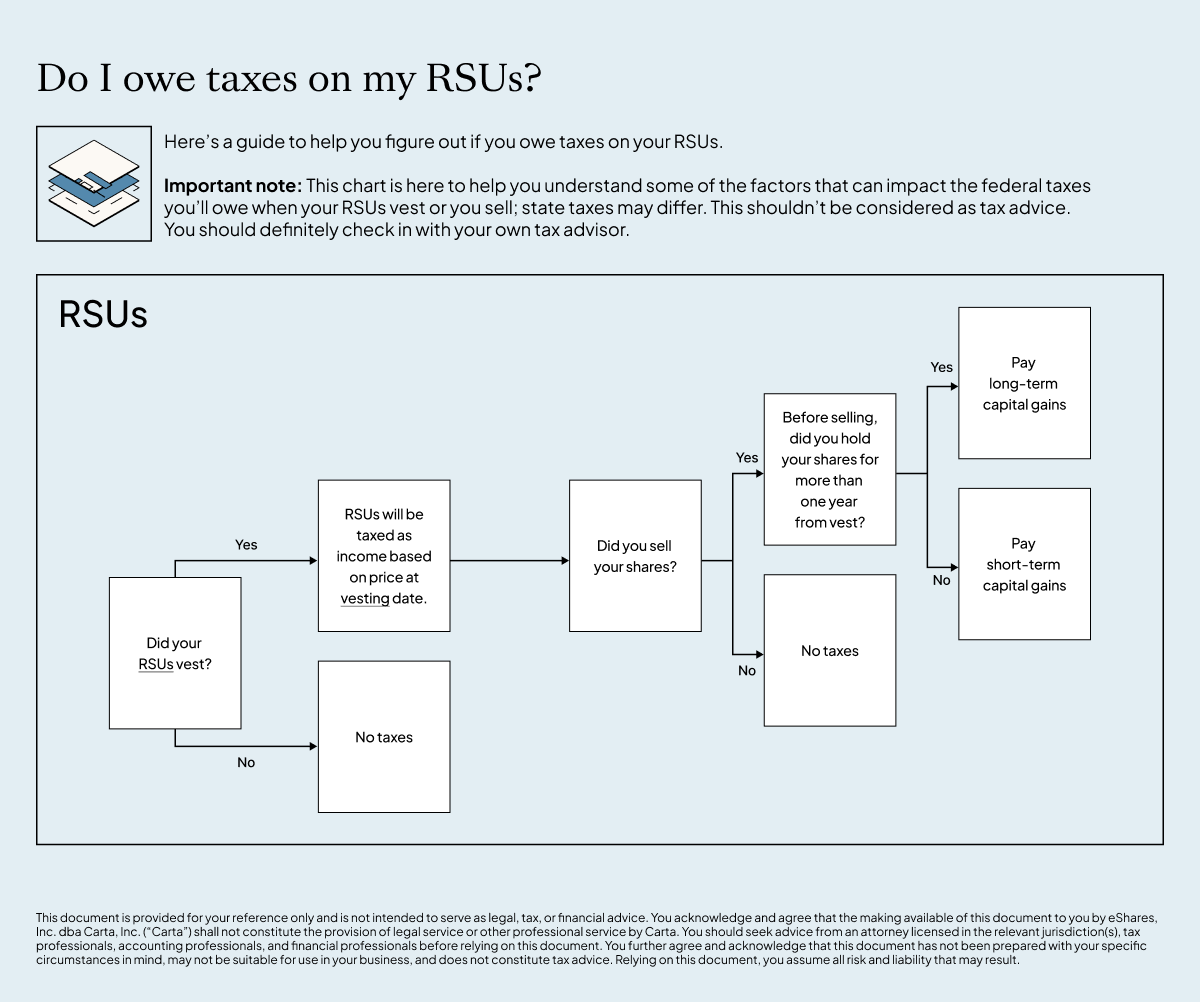
RSUs are not taxed when they are granted. They are taxed as ordinary income based on the fair market value (FMV) of the shares when you acquire them. This differs from how stock options are taxed. With ISOs, you sometimes don't pay taxes until you sell your shares. With NSOs, you pay taxes at exercise on the spread between the strike price and the fair market value, and again at sale if the shares have appreciated further.
Tax withholding at vesting
Your RSU shares are initially taxed as supplemental income. According to IRS Publication 15 (Circular E), employers are required to withhold 22% for federal income taxes on the first $1 million in supplemental income for employees, and 37% of any amount exceeding $1 million.
You may end up owing more depending on your effective tax rate. If it's higher than 22% for the year you vest your shares, you'll owe more than your employer has withheld. Social Security, Medicare, and state income taxes also apply.
That gap is why some people owe a balance at filing time. The vested value shows up as taxable income on your W-2, and you reconcile what was withheld against what you actually owe.
Sell-to-cover
Your company may allow you to sell a portion of your vested shares to cover the tax obligation your employer must withhold. This approach is called “sell-to-cover.” Typically, you'll hold the remaining shares, though sometimes you can choose whether to hold the remaining shares or sell them right away.
Capital gains tax
When you sell RSUs, you may also need to pay capital gains tax. Once your shares settle, the FMV at vesting becomes your cost basis, the baseline value used to measure gain or loss later. If you sell the shares for more than that basis, the difference is a capital gain. If you sell for less, it is a capital loss.
The holding period determines how any gain is treated. Sell soon after settlement and the gain is short-term, taxed at ordinary income rates. Hold the share for a over a year before sale, and the gain becomes long-term, which is taxed at a lower rate. One thing to watch: your basis is the already-taxed vesting value, so you’re only taxed on the growth after vesting, not on the same value twice.
RSU cost basis and tax forms
If you report a cost basis of zero at sale time, you can end up taxed twice on the same value: once as wage income at vesting, and again as a capital gain when you sell.
RSU income shows up in your W-2 wages for the year the shares vest. When you later sell, your brokerage reports the sale, and it's your responsibility to make sure the cost basis on that form matches the FMV at vesting. A mismatch is one of the more common ways RSU holders overpay at tax time, so it's worth reviewing both forms before you file.
RSU tax implications
Action | Tax implication |
Your company gives you an RSU grant. | No immediate tax implication. |
Your RSUs vest and are settled. | You'll owe ordinary income tax on the FMV of your shares at the time of settlement. |
Your RSUs are settled and you sell the shares immediately at the FMV. | You'll owe ordinary income tax on the FMV of the shares you acquired and no capital gains tax on the sale of the shares (because the sale price was the same as your tax basis). |
You sell your shares within one year of receiving them. | If you sell at a price higher than the FMV of your shares at vesting, you'll also likely owe short-term capital gains tax on the difference. |
You sell your shares after holding them for more than a year. | If you sell at a price higher than the FMV of your shares at vesting, you'll also likely owe long-term capital gains tax on the difference. |
83(b) elections and RSUs
A common question is whether you can file an 83(b) election on your RSUs to lock in a lower tax basis before the stock appreciates. For standard RSUs, the answer is no.
An 83(b) election lets you pay taxes on restricted property at its grant value rather than its (presumably higher) vesting value. It works for RSAs because shares transfer to you at grant. With RSUs, no shares transfer at the grant date—you hold a promise, not property—so there is nothing to elect on. By the time shares actually transfer at settlement, they vest immediately, leaving no restricted period for an 83(b) to change.
When can you sell your RSUs?
Depending on your financial situation or your confidence in your company's future, you may want to sell RSUs to access liquidity. A few factors are worth weighing:
Your company's trading policy: Some companies restrict when and how you can sell, so check your policy first.
Your view on the stock: If you think the price will keep rising, holding longer gives it room to grow.
Your cash needs: Selling is a direct way to access cash when you need it.
Tax timing: Shares held longer than a year qualify for long-term capital gains rates. If you're close to that threshold, waiting can reduce your bill.
Portfolio concentration: A heavy concentration in one stock carries more risk. Selling some shares to invest elsewhere is a reasonable way to rebalance.
Selling public company RSUs
If your company is public, you can usually sell the shares you receive from your RSUs as soon as you meet the vesting criteria and receive your shares, as long as you comply with your company's trading policy.
Selling private company RSUs
If your company is private, you'll need to wait for a liquidity event, such as an acquisition, IPO, or tender offer, before you can sell your shares. If your company approves it, you can also find a third-party buyer directly.
What happens to RSUs when you leave a company?
In most cases, you keep your fully vested shares when you leave. Unvested shares are typically forfeited, whether you resign or are laid off.
If your RSUs have vested but not yet settled before your last day, you'll still receive those shares when settlement occurs. For double-trigger RSUs, check whether your grant includes a "must be present to win" condition, which would require you to still be employed when the liquidity event happens.
Your RSU agreement should also indicate if and when unvested double-trigger RSUs expire, since it is possible for time-vested shares to lapse before the milestone condition is ever met.
Making the most of your restricted stock units
Read your RSU agreement before your next vesting date. Know your schedule, your triggers, and what happens to unvested shares if you leave. Then map out the tax impact in advance, since withholding often falls short of what you'll actually owe. To get help thinking through your specific grant, speak with an equity and tax expert.
If you are a founder granting these awards, RSUs also show up on your cap table, where accurate equity management keeps ownership records clean for everyone. Carta helps founders and employees make informed equity decisions.
Request a demo of Carta’s equity management platform today.

Frequently asked questions about restricted stock units
Does one RSU equal one share?
Yes. One RSU converts to one share of company stock at settlement, though some plans offer a cash equivalent instead.
Why are RSUs taxed so high?
RSU value at vesting is treated as ordinary wage income, so it is taxed at the same rates as your salary rather than at lower capital gains rates. Employers withhold at the 22% supplemental rate per IRS Publication 15, which may be below your actual effective rate, and Social Security, Medicare, and state taxes apply on top of that.
Can you cash out restricted stock units?
At a public company, you can generally sell your shares once they vest, subject to your employer's trading policy. If your company is still private, you usually have to wait for a liquidity event, such as an acquisition or IPO, before you can turn RSUs into cash.
Are restricted stock units good?
RSUs are a valuable form of compensation that hold value as long as the stock is worth something, making them less risky than options that can expire worthless. The tradeoff is that you won't know their exact value until your shares vest and settle.
More questions about RSUs?
Carta offers equity advisory services to employees of participating companies. Founders and leadership teams that want to help employees make informed decisions about their equity ownership can reach out for a demo.


DISCLOSURE: This communication is on behalf of eShares, Inc. dba Carta, Inc. ("Carta"). This communication is for informational purposes only, and contains general information only. Carta is not, by means of this communication, rendering accounting, business, financial, investment, legal, tax, or other professional advice or services. This publication is not a substitute for such professional advice or services nor should it be used as a basis for any decision or action that may affect your business or interests. Before making any decision or taking any action that may affect your business or interests, you should consult a qualified professional advisor. This communication is not intended as a recommendation, offer or solicitation for the purchase or sale of any security. Carta does not assume any liability for reliance on the information provided herein. © 2026 Carta. All rights reserved. Reproduction prohibited.