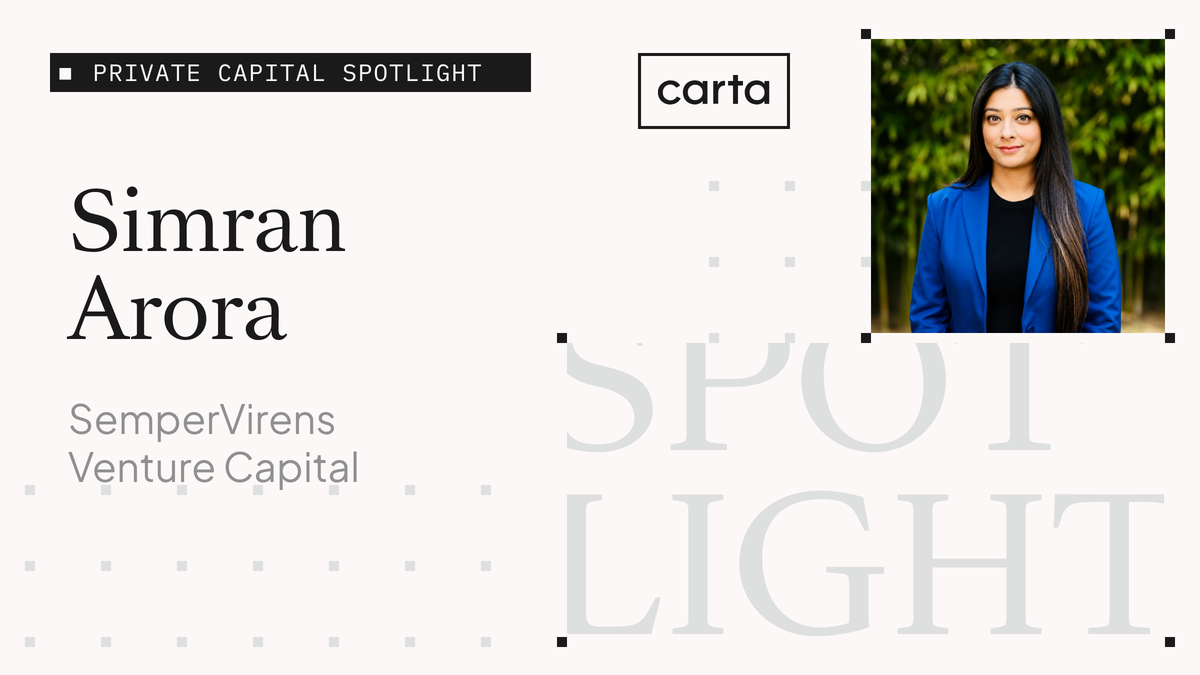
Simran Arora is the director of finance at SemperVirens Venture Capital, a multi-stage venture capital firm based in San Francisco backing AI-native software companies that reshape how people access healthcare, work, and financial services—categories that scale through enterprise buyers such as employers, health plans/systems, HCM platforms, carriers, and financial institutions. In her role, she oversees fund accounting, fund operations, capital planning, treasury management, and portfolio analytics across the firm's multiple funds.
We sat down with Simran to talk about her path from audit work in India and Canada to venture capital in the U.S., what the finance function actually looks like inside an early-stage VC firm, and why ownership percentages matter just as much as which companies you back.
CARTA: Tell us about your career path. You started in accounting. What drew you to that, and how did you end up where you are today?
SIMRAN ARORA: My journey into finance really began at a young age. Growing up in India, my father was a chartered accountant, and he gave me my very first lesson in accounting—introducing me to the basics of how financial statements worked and how numbers told a story of a business. I didn't truly appreciate how foundational that was at the time, but I think it sparked an early familiarity and comfort with finance.
I started my professional career with Deloitte in India, in audit, working with asset managers, real estate funds, and emerging growth companies. That gave me a strong technical foundation in financial reporting, but it also sparked my curiosity about how capital actually flows through funds and how investment decisions get made.
I later moved to Canada and joined KPMG, where I continued building on that foundation—working with asset managers and some of the largest public real estate investment trusts KPMG had as clients.
After about three years, I wanted to move from auditing investment firms to operating within one. That's when I joined Brookfield Asset Management, where I led finance and operations for one of their largest private infrastructure funds. That gave me firsthand exposure to liquidity management, valuations, and LP reporting—a much deeper appreciation for the discipline it takes to run a large-scale investment platform.
Then I got married and moved to the United States, which was my transition into venture. I joined Khosla Ventures, where I got deeper into fund dynamics, ownership, and capital deployment. It was a faster-moving environment, and it reinforced my interest in being closer to the strategic side of the work. After three years there, I joined SemperVirens, where I am today.
You've described your role at SemperVirens as spanning a lot of ground. What does the day-to-day actually look like?
It's hard to describe a typical day because my work spans a lot of different areas. A large part of it is managing liquidity and capital planning across the funds, as well as the management company accounting. Ensuring that we're deploying capital efficiently while maintaining operational flexibility. A large part of my day-to-day is working with banks, working with Carta as our fund administrator, ensuring money is moving at the right time and pace.
I also spend time analyzing portfolio and fund performance, supporting reporting to both partners and LPs, and improving internal models and dashboards that help us understand our current holdings, our ownership, our exposure. I actively work on portfolio analytics—reviewing financial KPIs and metrics from portfolio companies, which helps inform our reserve allocation and follow-on strategy.
And then there's a bigger mandate underneath all of that: scalability. We're launching two new funds this year, and I'm a one-person finance and ops team. So a significant piece of my focus is building the infrastructure that will allow us to scale as the firm grows, while staying lean. That means automating manual workflows and making the firm more institutionalized over time.
That sounds very different from an audit role. How has the nature of the work shifted?
When I was an auditor, it was more execution-focused. Now, it’s much more strategic. Finance sits at the intersection of so many different things: fundraising, platform, investments. I sit in investment committee meetings. I'm the centralized source of truth that people rely on for accurate reporting and for decision-making—things like ownership math, exit scenarios, whether an investment is going to return the fund, whether we have enough dollars to make a given investment, what the reserve strategy should look like. It's gotten much more strategic. I think of FinOps not as a support function, but as a critical part of building and scaling an investment platform.
You've worked across India, Canada, and now the United States, working in a highly regulated, technical field across three different countries. What has that experience taught you? What advice would you give someone navigating a similar path?
It's been pivotal. Adapting to a new country at a young age was a defining experience for me. It’s difficult, but it taught me resilience, independence, and how to navigate unfamiliar environments. Those experiences have shaped how I approach challenges and given me confidence to pursue opportunities outside my comfort zone.
My advice would be: Put yourself in uncomfortable positions and take risks early, because it will only make you a more well-rounded professional. It's not going to be smooth sailing—it never is—but if you keep pushing boundaries, you'll also find what keeps you motivated and start to discover your niche.
I'd also say: be patient with your growth. I spent a lot of years in one place early on, really honing my technical skills, and that was necessary. In a regulated industry you can't get by on fluff—you need to know your technicals. Consistent skill-building, taking ownership, and learning from the people around you matter a lot more than trying to move fast before you're ready.
Were there specific people who helped you along the way?
I've had mentors throughout my career, and they've each played a different role at different stages. Early on in audit and asset management, they helped shape my technical rigor and taught me to think critically about financial structures. At KPMG, Jason Gaiotto, a partner in the real estate funds practice in Canada, was a go-to for me. He really pushed me to expand my thinking beyond execution and develop a more strategic perspective—helping me understand what to look for when you're analyzing a business or a specific transaction, and building confidence in my decision-making.
Transitioning to venture finance was different. The industry is smaller and the function tends to be lean, which means you often have to navigate new challenges independently. That's made mentorship especially valuable. Here at SemperVirens, I've made a conscious effort to learn from the partners I work with closely. Allison Baum Gates, a General Partner at the firm, has encouraged me to take ownership and think beyond the immediate task—to see FinOps as a critical part of building and scaling an investment platform, not just a support function. And Colin Tobias, also a General Partner, has given me a deeper insight into portfolio construction and fund strategy—how ownership, reserves, pacing, and capital deployment decisions will ultimately shape long-term outcomes.
You mentioned portfolio construction specifically. What have you learned about that in your time in venture?
One of the biggest lessons I've learned is that a lot of fund outcomes are driven by decisions made early—around ownership targets, reserve strategy, fund size. It's not always about which investments you're making. Of course that's critical, but do you own the right percentage? Is your fund size appropriate for your sourcing strategy and the access you have? Portfolio construction really has an impact on the fund outcomes. Small differences in ownership or in your follow-on strategy can significantly change long-term returns.
The math can be counterintuitive. Owning 1% or less of a billion-dollar company might not meaningfully move the needle for your fund if your fund is too large, or if you owned too little. And in today's environment—with AI rounds that are enormous by historical standards—a fund can be making all the headlines for participating in a deal while taking a check size that's too small to matter to their returns.
Going into venture, I thought it was primarily about which companies you funded. Now I also think just as hard about how much of those companies you actually own, and whether the fund structure and strategy are set up to make that ownership meaningful.

DISCLOSURE: This communication is on behalf of eShares, Inc. dba Carta, Inc. ("Carta"). This communication is for informational purposes only, and contains general information only. Carta is not, by means of this communication, rendering accounting, business, financial, investment, legal, tax, or other professional advice or services. This publication is not a substitute for such professional advice or services nor should it be used as a basis for any decision or action that may affect your business or interests. Before making any decision or taking any action that may affect your business or interests, you should consult a qualified professional advisor. This communication is not intended as a recommendation, offer or solicitation for the purchase or sale of any security. Carta does not assume any liability for reliance on the information provided herein. © 2026 Carta. All rights reserved. Reproduction prohibited.