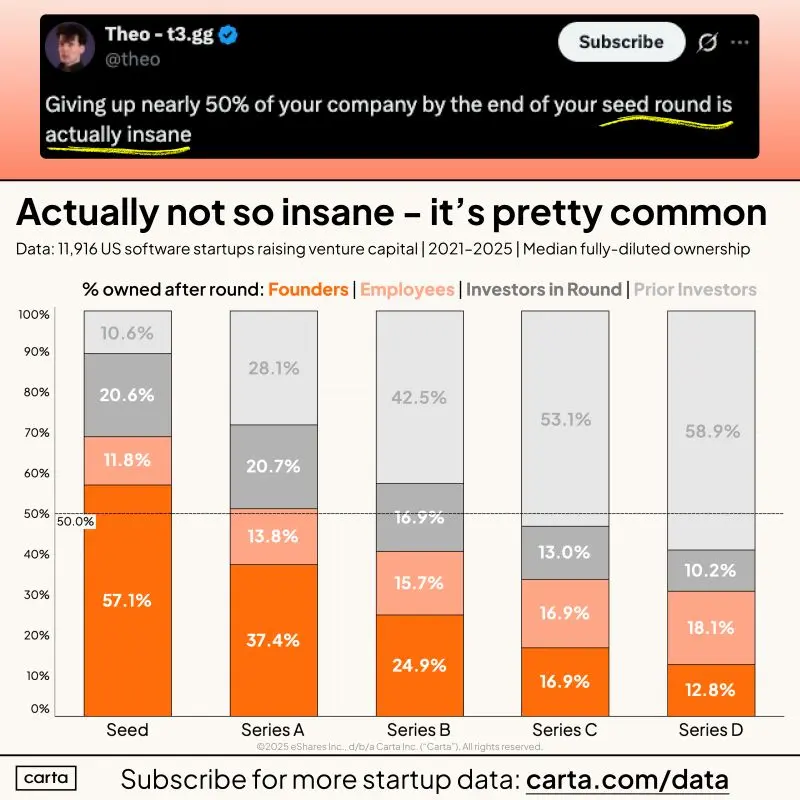
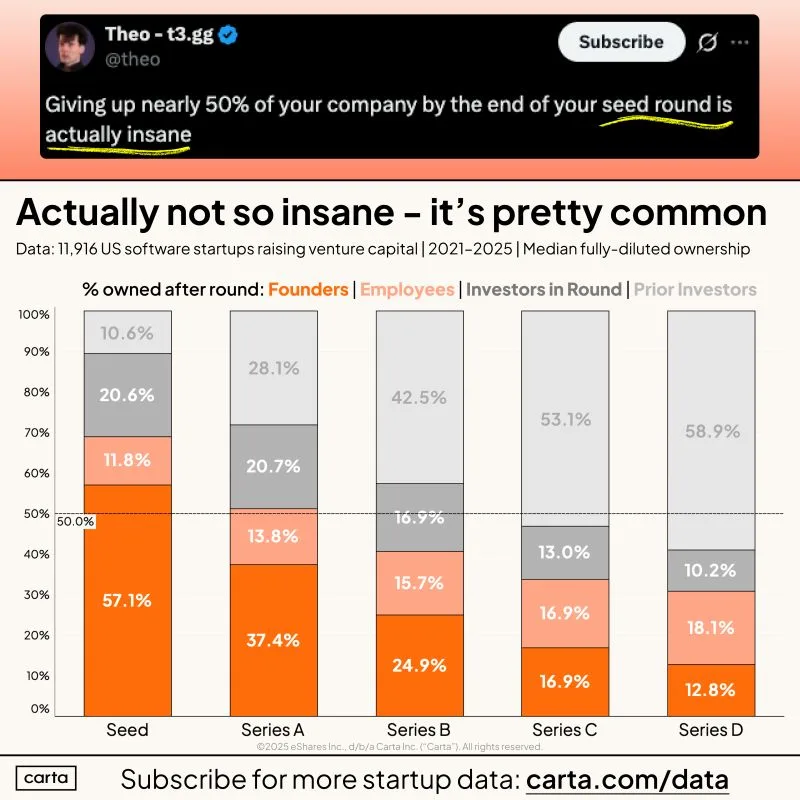
"Giving up nearly 50% of your company by the end of your seed round is actually insane"
Well, first off it's selling*, not giving up.
And second - no, not actually that crazy!
Let's do some actual math.
These days, the following path is pretty common:
Pre-seed on SAFEs: raise maybe $1.5 million and sell 10% of the company (actual dilution to be taken on in the first priced round of course).
Seed (on SAFEs or priced): raise another $3M-$4M, sell 20% of the company.
Option pool for employees: 10-12% of company equity.
Add it all up, and by the time the seed round is closed the founders own 58% or so.
Now, is this "good" or "bad"? Neither. It's the market. Back in the day (circa 2015-2018), raising $5M would be Series A money at least. Now venture is more professionalized, so the round sizes get bigger at earlier stages and so does the dilution.
These out-of-date assumptions contribute to founders feeling frustrated at the dilutive nature of VC. Most people also lump in the option pool with the founder ownership for some reason, making the true numbers look worse by comparison.
The other tagline you often hear is "founders should exit their Series A rounds with 50%+ of the company".
Just know that only about 1 in 4 founding teams actually pull that off.
So yeah - dilution is high! What can you do about it?
1. Don't raise VC (or raise less VC).
2. Negotiate better terms for your dilution (either by trading off in other key deal clauses or by being in such high demand from investors you get to dictate terms).
3. Get Zen about it 🙏
Note the data above is for software startups - deep tech businesses often face even steeper dilution in the early stages.
The more you know!
#startups #founders

DISCLOSURE: This communication is on behalf of eShares, Inc. dba Carta, Inc. ("Carta"). This communication is for informational purposes only, and contains general information only. Carta is not, by means of this communication, rendering accounting, business, financial, investment, legal, tax, or other professional advice or services. This publication is not a substitute for such professional advice or services nor should it be used as a basis for any decision or action that may affect your business or interests. Before making any decision or taking any action that may affect your business or interests, you should consult a qualified professional advisor. This communication is not intended as a recommendation, offer or solicitation for the purchase or sale of any security. Carta does not assume any liability for reliance on the information provided herein. © 2026 Carta. All rights reserved. Reproduction prohibited.