Will your cofounder leave? Definitely not 😇
But for those other founding teams...it's a real risk. Although perhaps the rate of cofounder breakups is declining slightly!
Here's the data:
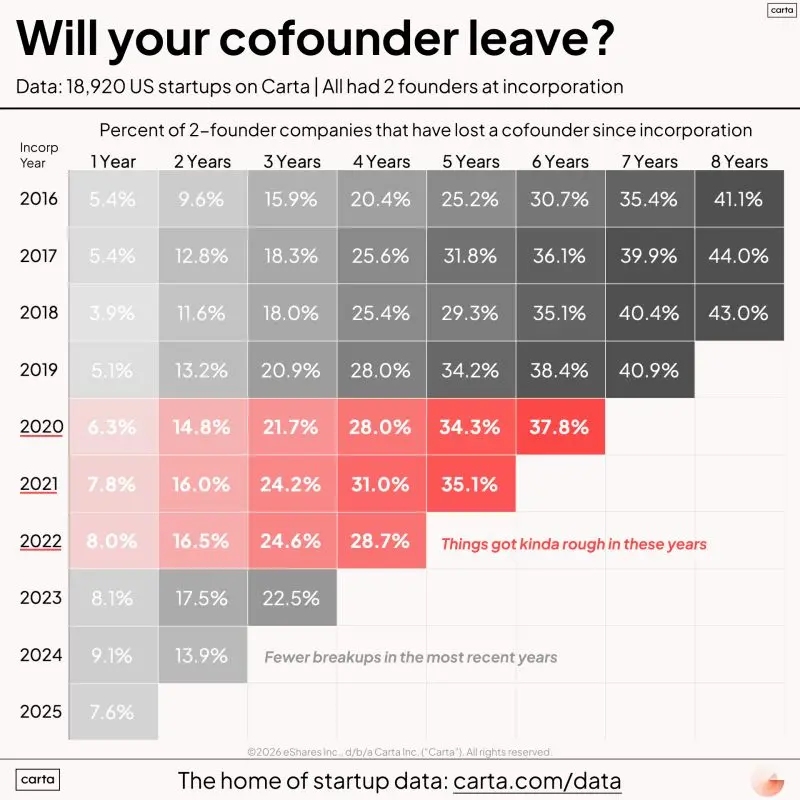
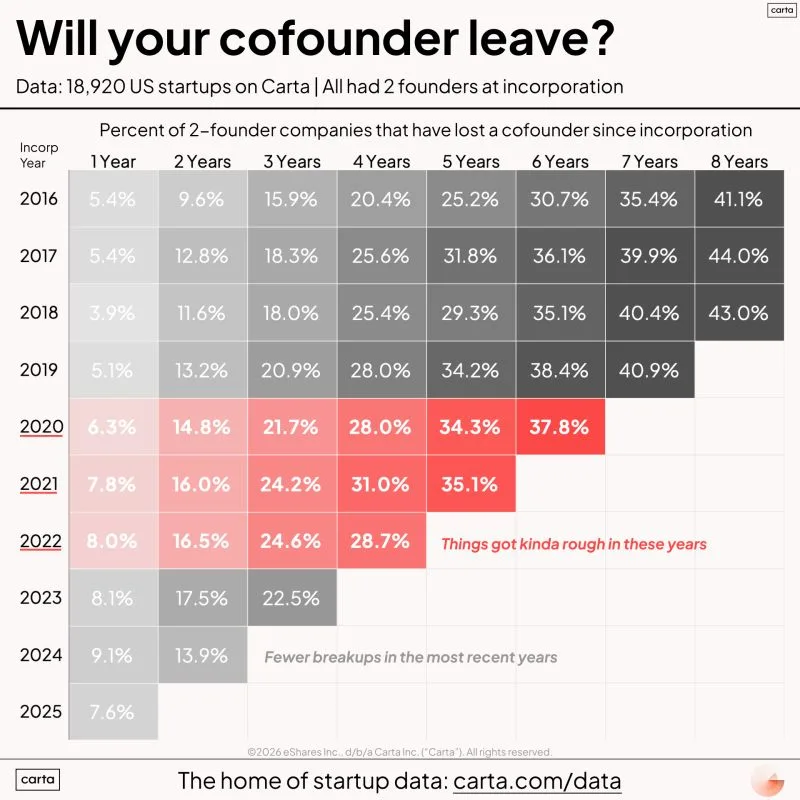
We looked at 18,920 startups that founded their companies between 2016-2025.
These companies had to have all the below:
a) been started in the US b) had 2 founders at the start b) raised at least some VC or angel cash (SAFEs or Notes count)
Each founding year vintage moves left to right—for example, in the 2017 cohort, 25.6% of companies had lost a cofounder by year 4.
𝗧𝗵𝗶𝗻𝗴𝘀 𝗧𝗼 𝗡𝗼𝘁𝗲
Cofounders left more often as the years progressed.
But the 2020-2022 period was the peak. Probably due to many factors (overvaluations, interest rate changes, startup funding flooded then sharply pulled, etc).
Typically founders have a 4-year vest on their shares. That means that about a quarter of founders will leave before their vest is complete (although it may be a higher if the vest didn't begin until the first VC round).
Every founder should have a vesting schedule on their equity. Absolute must-have. But the question of vesting schedule length has come up more frequently of late.
Should founder vesting start at 6 years given how long building a VC-backed business takes these days? Or should founders stick to the traditional 4-year vest?
No surprise that VCs would argue for the former but I think it can be a reasonable position. Founders can equally reasonably push back by saying if the VCs want us vested longer that should be a negotiating point during the deal. And of course there needs to be some way to acknowledge the actual dollars that many founders pour into their companies in the early days.
All of which brings us right back to the most crucial question in your company: who are you building it with?
PS: way more data on this cofounder dynamic and other questions in our Founder Ownership 2026 report - live now: https://lnkd.in/grPj33p7 🙏

DISCLOSURE: This communication is on behalf of eShares, Inc. dba Carta, Inc. ("Carta"). This communication is for informational purposes only, and contains general information only. Carta is not, by means of this communication, rendering accounting, business, financial, investment, legal, tax, or other professional advice or services. This publication is not a substitute for such professional advice or services nor should it be used as a basis for any decision or action that may affect your business or interests. Before making any decision or taking any action that may affect your business or interests, you should consult a qualified professional advisor. This communication is not intended as a recommendation, offer or solicitation for the purchase or sale of any security. Carta does not assume any liability for reliance on the information provided herein. © 2026 Carta. All rights reserved. Reproduction prohibited.