"Startup cofounders must split equity equally" OR "splitting equally sets the company up for failure".
Lots of strident opinions on this question but what does the data say?
Here are the findings from 9,000+ US founding teams using Carta, all incorporated in the past 2 years:
46% of 2-founder teams split equity 50/50 (so a slight majority of teams did not).
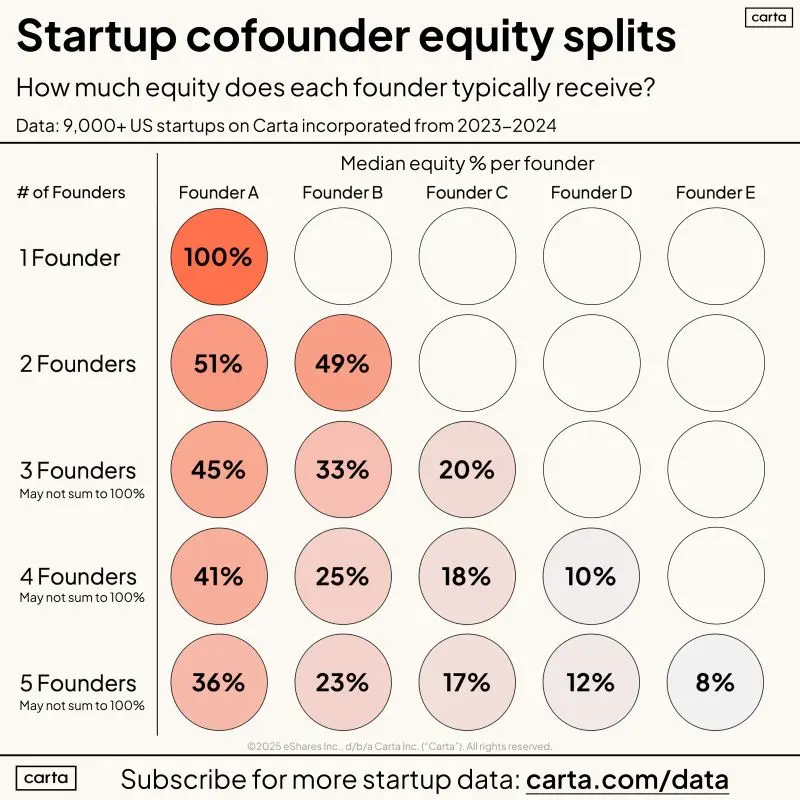
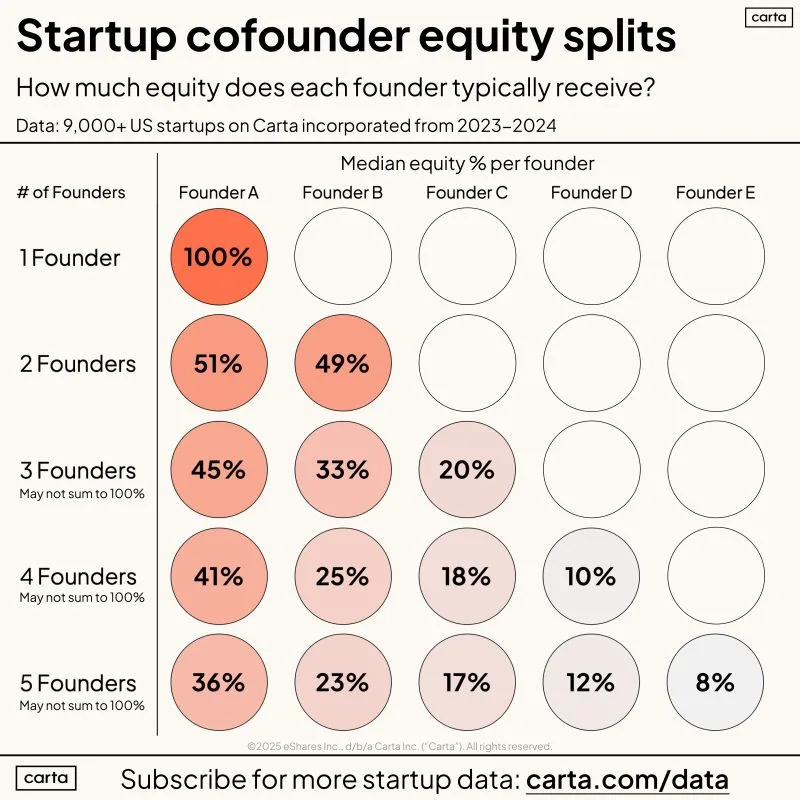
Median split for 2-founders teams was 51% to 49%.
Very few (less than 5%) of 2-founder teams split 80/20 or higher.
3-founder teams only split 33/33/33 about 20% of the time.
Median 3-founder split: 45% to 33% to 20%.
Only 1 in 10 4-founder teams split equally (25% each).
𝗦𝗼𝗺𝗲 𝗼𝗽𝗶𝗻𝗶𝗼𝗻𝘀:
1. Clearly you can split equally or unequally, many teams in both camps. Only problem is splitting a certain way without a deep conversation about it.
2. At the 4 year mark, there wasn't much difference in the "success ratio" between teams that split unequally vs those that split equally. They lost cofounders at a similar rate, they achieved funding rounds at similar rates, etc. Some minor gaps but nothing really stands out.
3. Teams, especially 2-founder teams, are increasingly choosing 50/50 as the default path. Only a third or so of 2-founder teams split equally in 2017 vs 45%+ today.
4. Vesting schedules (4-year minimum) are a critical piece of this — but the changes to the private lifecycle of startups have started conversations about extending these.
5. Will AI startup with lower capital costs and faster growth affect founder equity? Obviously these new builds may be less dilutive (both in funding and in lower employee counts) so founders could have bigger slices of pie over time.
6. Founding teams are waiting longer and longer to hire their first employee - so be ready to work just with your founding group for 1 or 2 or even 3 years.
7. The data seems to suggest solo founding is also on the rise over the last few years. No hard conversations needed in those cases!
Happy team building - and here’s more data on founders and the equity they own: https://lnkd.in/gGWpFpEm
#startups #founders

DISCLOSURE: This communication is on behalf of eShares, Inc. dba Carta, Inc. ("Carta"). This communication is for informational purposes only, and contains general information only. Carta is not, by means of this communication, rendering accounting, business, financial, investment, legal, tax, or other professional advice or services. This publication is not a substitute for such professional advice or services nor should it be used as a basis for any decision or action that may affect your business or interests. Before making any decision or taking any action that may affect your business or interests, you should consult a qualified professional advisor. This communication is not intended as a recommendation, offer or solicitation for the purchase or sale of any security. Carta does not assume any liability for reliance on the information provided herein. © 2026 Carta. All rights reserved. Reproduction prohibited.