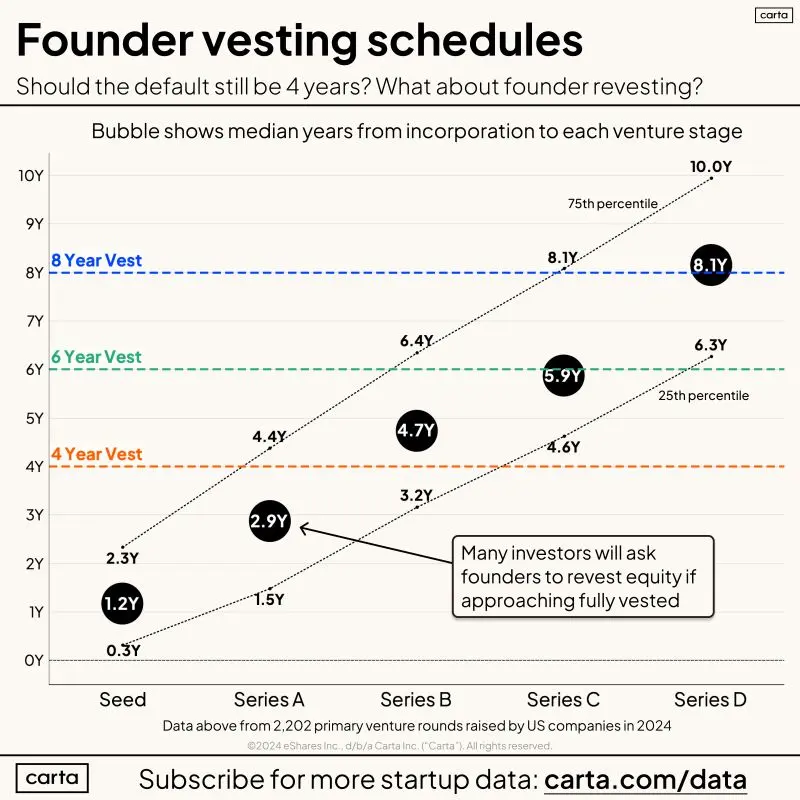
I now believe founder vesting should start at 6 years, not 4. Would hear arguments for 8 years.
Let's start with the obvious: 𝘆𝗲𝘀, 𝗲𝘃𝗲𝗿𝘆 𝗳𝗼𝘂𝗻𝗱𝗲𝗿 𝗻𝗲𝗲𝗱𝘀 𝗮 𝘃𝗲𝘀𝘁𝗶𝗻𝗴 𝘀𝗰𝗵𝗲𝗱𝘂𝗹𝗲.
It's very common for a founding team to split up at some point along the way in the first few years. If that departing founder walks away with a significant ownership stake (aka "dead equity") it will make future fundraising much more difficult, full stop.
So how long should this founder vesting schedule be?
A large majority of founders vest along a similar timeline to employees (4 year vest, though many founders do not have the 1-year cliff).
4 years into the company's life = a little beyond Series A, on median. Many companies will still be raising seed funding 4 years into the journey. Does it make sense for the founders to be fully vested when there's so much left to build?
IPOs happen 12-14 years into the lifespan of a company these days.
𝗣𝗿𝗼𝘀 𝗼𝗳 𝟲 𝘆𝗲𝗮𝗿 𝘃𝗲𝘀𝘁𝗶𝗻𝗴
Better aligned to the actual timeline towards IPO
Inherent reduction in dead equity if co-founders split along the way
Signal to investors around the seriousness of intent
𝗖𝗼𝗻𝘀 𝗼𝗳 𝟲 𝘆𝗲𝗮𝗿 𝘃𝗲𝘀𝘁𝗶𝗻𝗴
Doing anything just to signal to VCs is silly (I realize this isn't the only reason)
If things are going well, being asked to re-vest equity is a negotiation point that 6 year vesting just gives up
This is my company, damnit
𝗢𝘁𝗵𝗲𝗿 𝗖𝗼𝗻𝘀𝗶𝗱𝗲𝗿𝗮𝘁𝗶𝗼𝗻𝘀
What about founders who use their own money as startup capital? That money should probably buy preferred equity in the business just as any investor would, but that's tricky early on (does it set a valuation, etc). Not easy.
The analogy to an employee isn't a great one for founders. Yes, if an employee stays 4 years they should get their full allotment of equity (you could make a case for longer periods here too). Often a company will re-incentivize great employees with a new grant at 3 years in.
Common objection from founders : "How is a departed founders equity any more dead weight than an angel or Seed investor that no longer adds any value?" Just my thinking here, but a) the value from the investor is mostly the capital itself and b) the departed founder often owns a bigger slice of pie.
Some smart folks like Brayton Williams ⏻ and Brian Requarth influencing my thinking here.
What say you? Is this smart or am I becoming a shill for VCs? 😅
DISCLOSURE: This communication is on behalf of eShares, Inc. dba Carta, Inc. ("Carta"). This communication is for informational purposes only, and contains general information only. Carta is not, by means of this communication, rendering accounting, business, financial, investment, legal, tax, or other professional advice or services. This publication is not a substitute for such professional advice or services nor should it be used as a basis for any decision or action that may affect your business or interests. Before making any decision or taking any action that may affect your business or interests, you should consult a qualified professional advisor. This communication is not intended as a recommendation, offer or solicitation for the purchase or sale of any security. Carta does not assume any liability for reliance on the information provided herein. © 2026 Carta. All rights reserved. Reproduction prohibited.