A better way to think about post-money SAFEs.
Big shoutout to Chris Harvey for flagging this for me yesterday - go follow him right now before reading this whole post.
From Chris's post yesterday - 3 key points on SAFEs:
Discounts on a Pre-Money & Post-Money SAFE are identical in outcomes
Valuation Caps on Post-Money SAFEs FIX the Ownership % Sold in the Company
Calculating % in a Post-Money Safe is Simple: Investment Amount / Valuation Cap = X% sold at SAFE Conversion
So what does this mean?
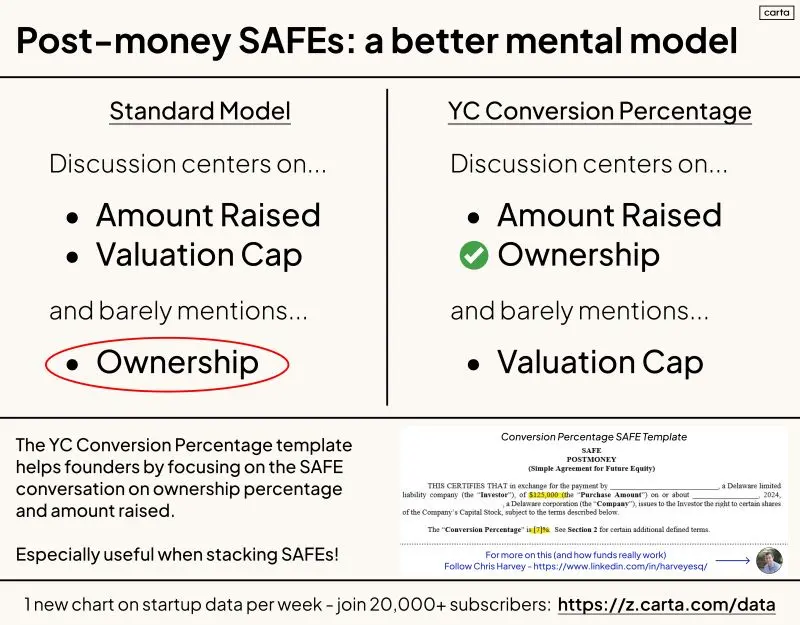
Right now, founders spend a ton of time trying to figure out their valuation cap. What if they spent that time discussing their dilution (in terms of ownership sold) instead?
It's the same math, just inverted. And it's how YC speaks to its founder cohorts about their SAFEs.
Y͟C͟ ͟M͟a͟t͟h͟
$125,000 for 7% of the company on one SAFE and an additional $375,000 on an uncapped second SAFE.
Implied valuation cap of about $1.7M (but that's never really discussed) on the first SAFE
𝗪𝗵𝘆 𝗶𝘀 𝗼𝘄𝗻𝗲𝗿𝘀𝗵𝗶𝗽 𝗮 𝗯𝗲𝘁𝘁𝗲𝗿 𝗺𝗲𝗻𝘁𝗮𝗹 𝗺𝗼𝗱𝗲𝗹 𝘁𝗵𝗮𝗻 𝘃𝗮𝗹𝘂𝗮𝘁𝗶𝗼𝗻 𝗰𝗮𝗽?
1. It focuses on the dilution for the founding team. Is the cash you're about to receive worth 3, 5, 7% of your company?
2. It REALLY helps when, as is common these days, founders begin "stacking" SAFE rounds. Instead of watching the valuation cap climb in various SAFE rounds and feeling great, founders could be wary of the ownership they give up and 𝘮𝘢𝘺 move to priced rounds earlier.
The truth about post-money SAFEs is that they are investor-friendly because they have anti-dilution built in. Every post-money SAFE investor is guaranteed their specific slice of ownership and basically nothing that happens in the first priced round will change that.
Love this as a framework for considering how valuable early investment is to your business.
#SAFEs #valuationcap #equity #founders #startups
Data from Carta out every week in our Data Minute newsletter - link in graphic to sign up!

DISCLOSURE: This communication is on behalf of eShares, Inc. dba Carta, Inc. ("Carta"). This communication is for informational purposes only, and contains general information only. Carta is not, by means of this communication, rendering accounting, business, financial, investment, legal, tax, or other professional advice or services. This publication is not a substitute for such professional advice or services nor should it be used as a basis for any decision or action that may affect your business or interests. Before making any decision or taking any action that may affect your business or interests, you should consult a qualified professional advisor. This communication is not intended as a recommendation, offer or solicitation for the purchase or sale of any security. Carta does not assume any liability for reliance on the information provided herein. © 2026 Carta. All rights reserved. Reproduction prohibited.