The hidden power of Y Combinator.
Why do the vast majority of pre-seed deals use the post-money SAFE?
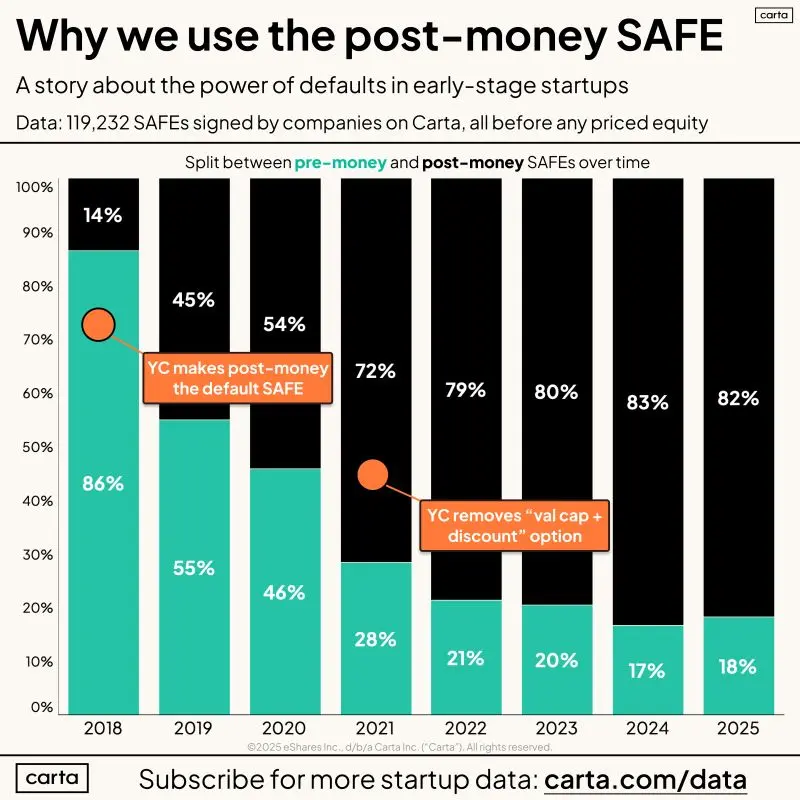
Back in 2018, founders were overwhelmingly using the pre-money version of the Simple Agreement for Future Equity, or SAFE (when they weren't using convertible notes, that is). But when YC introduced the post-money version on their website in late 2018, things changed quickly.
The post-money SAFE gobbled up market share and now 82% of all SAFEs are post-money. Data from nearly 120,000 signed SAFEs by companies using Carta.
Of course YC didn't just introduce the post-money and let founders choose, they removed the pre-money documents at the same time. One actor in the ecosystem removes a PDF from their website and viola, markets move.
𝗪𝗵𝘆 𝗽𝗼𝘀𝘁-𝗺𝗼𝗻𝗲𝘆?
1. Post-money is clearer. It is fairly simple to know how much of the company is bought and sold using a post-money SAFE (example: If you raise $1 million on a $10 million cap, you sold 10%)
2. Defaults matter a lot. Founders don't typically want to innovate on legal docs - they want to fundraise to build their companies. So if the YC website offers only the post-money version to download, they'll go with that.
Of course the whole world of SAFE fundraising has gotten messier over the past decade. Founders are raising much more capital on SAFEs before hitting priced equity (and doing so over multiple different valuation caps).
Inherent in the switch to post-money is a tilt towards investor friendliness. In a pre-money world, the SAFE investors would be diluted by any other SAFE investors that joined the cap table. Not so for post-money, where SAFE investors of all different caps and discounts are treated as one "round" in terms of dilution.
Trade-offs! Post-money SAFEs offer simplicity, clarity, and speed for founders, but they come with sweet anti-dilution characteristics for funders.
Coordination costs have also declined thanks to SAFEs (as founders close a deal with one investors without having to round up a whole group of them at once for a full round). Benefit: speed. Downside: kinda always fundraising.
𝗪𝗵𝗶𝘁𝗵𝗲𝗿 𝘁𝗵𝗲 𝗦𝗔𝗙𝗘?
In this AI world, does the SAFE need a re-examination?
What happens when a founder raises a seed round on SAFEs and then decides they don't want to raise priced equity...ever?
Lots of folks have issues (valid ones, frankly) with the current SAFE setup. But as we see from this example, changing defaults can sometimes require the buy-in of major actors.
Something to mull over 🤔
#startups #SAFEs #founders
DISCLOSURE: This communication is on behalf of eShares, Inc. dba Carta, Inc. ("Carta"). This communication is for informational purposes only, and contains general information only. Carta is not, by means of this communication, rendering accounting, business, financial, investment, legal, tax, or other professional advice or services. This publication is not a substitute for such professional advice or services nor should it be used as a basis for any decision or action that may affect your business or interests. Before making any decision or taking any action that may affect your business or interests, you should consult a qualified professional advisor. This communication is not intended as a recommendation, offer or solicitation for the purchase or sale of any security. Carta does not assume any liability for reliance on the information provided herein. © 2026 Carta. All rights reserved. Reproduction prohibited.