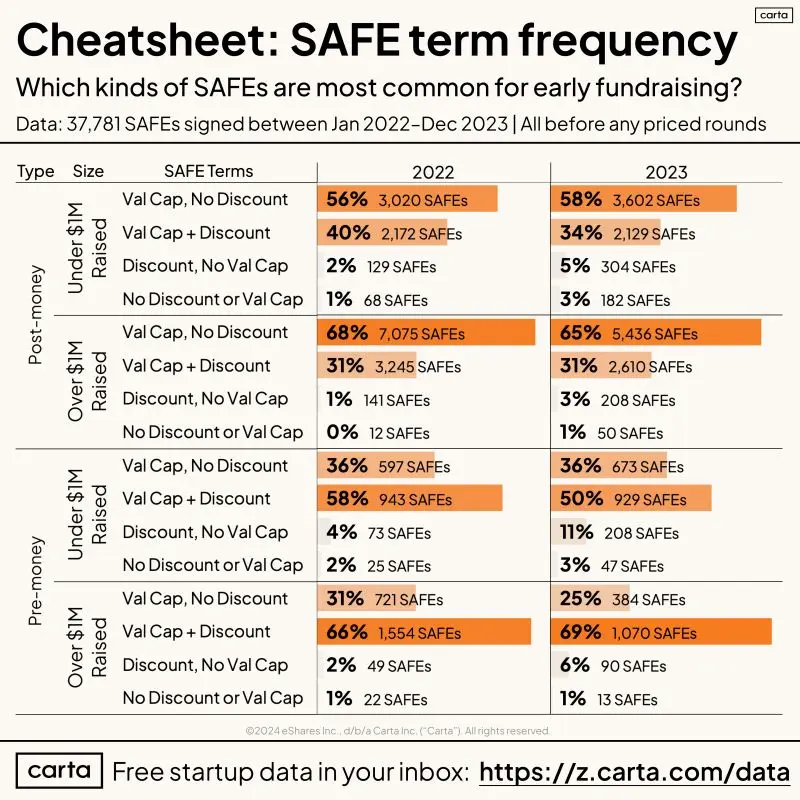
The complete breakdown on SAFEs - by type, terms, and round size.
All 37,000+ SAFEs in this analysis were signed before the company raised any priced funding. So "pre-seed", although some involved in hefty rounds that some would call seed rounds.
Overall, 80% of SAFEs over the past two years on Carta have been post-money. It's the default from YC these days, and although it is a little more investor friendly it's a great option.
𝗛𝗶𝗴𝗵𝗹𝗶𝗴𝗵𝘁𝘀: 𝗣𝗼𝘀𝘁-𝗠𝗼𝗻𝗲𝘆
Valuation cap with no discount is the most popular SAFE within the post-money tier.
Slight shift away from adding a discount alongside the val cap for smaller SAFE raises over the past year.
Basically nobody gets an uncapped, un-discounted SAFE
𝗣𝗿𝗲-𝗠𝗼𝗻𝗲𝘆
Far more people use the val cap + discount version, a departure from the post-money distributions. This pattern is even more pronounced with bigger SAFE rounds.
The big remaining question from my end: why aren't more SAFEs signed with only a discount and no valuation cap?
One of the original points in the argument for the SAFE is that it allows early angels and founders to avoid explicitly setting a valuation since that can be a fool's errand with such early companies.
Now, I know that often the cap is treated like a valuation in discussions. But kinda shocked that more people don't just lock in a 20-30% discount and call it a day. Perhaps it's not enough advantage for the angel investor, but there's a risk the next raise won't even hit the val cap!
Perhaps someone can educate me on the relative unpopularity of the discount :)
More data like this in this feed every few days and deeper dives in our Data Minute newsletter, which arrive promptly in your inbox every Thursday morning. Subscribe at the link in graphic.
And fundraise SAFE-ly!
#cartadata #SAFEs #founders #fundraising #preseed

DISCLOSURE: This communication is on behalf of eShares, Inc. dba Carta, Inc. ("Carta"). This communication is for informational purposes only, and contains general information only. Carta is not, by means of this communication, rendering accounting, business, financial, investment, legal, tax, or other professional advice or services. This publication is not a substitute for such professional advice or services nor should it be used as a basis for any decision or action that may affect your business or interests. Before making any decision or taking any action that may affect your business or interests, you should consult a qualified professional advisor. This communication is not intended as a recommendation, offer or solicitation for the purchase or sale of any security. Carta does not assume any liability for reliance on the information provided herein. © 2026 Carta. All rights reserved. Reproduction prohibited.