Why does it matter how fast founders go from Seed to Series A?
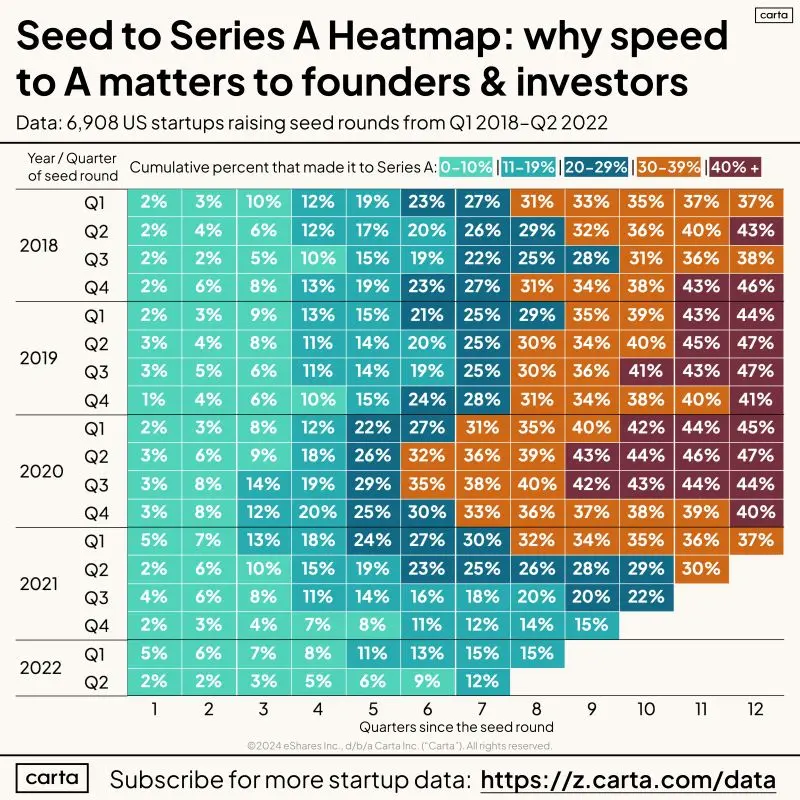
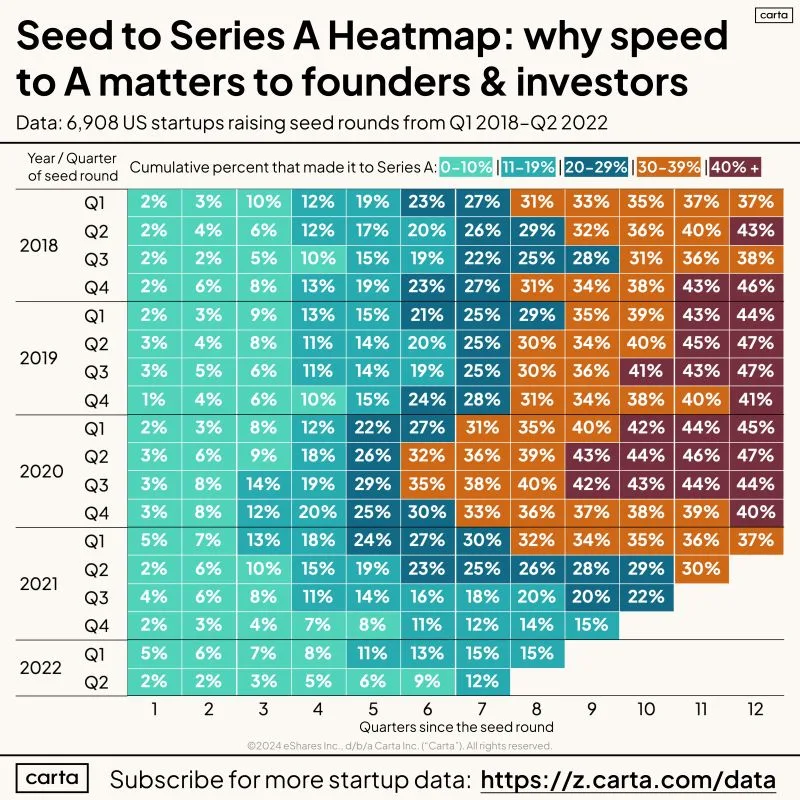
We sparked some interesting debate on Friday with a new trove of data on VC fund performance (if you missed it, check it out here: https://lnkd.in/g2N6tPU6). One of the highlight charts was this one below detailing what percent of seed-stage startups make it to Series A over time.
Percentages in the chart are cumulative for a single cohort of seed startups. So you read across each row. Take the top row—of the startups that raised their seed rounds in Q1 2018, 37% had made it to Series A in 12 quarters (or 3 years).
Basic Takeaway: a much higher share of seed startups made it to A within 2 years in the boom times than are making it in more recent cohorts. Probably unsurprising.
But why does this matter at all?
𝗢𝗻𝗲 𝗼𝗳 𝘁𝗵𝗲 𝗽𝗿𝗶𝗺𝗮𝗿𝘆 𝗿𝗲𝗮𝘀𝗼𝗻𝘀 𝗶𝘀 𝘁𝗵𝗶𝘀 𝗿𝗮𝘁𝗲 𝗶𝘀 𝗮 𝗸𝗲𝘆 𝗺𝗲𝘁𝗿𝗶𝗰 𝗼𝗻 𝘄𝗵𝗶𝗰𝗵 𝗳𝘂𝗻𝗱 𝗺𝗮𝗻𝗮𝗴𝗲𝗿𝘀 𝗮𝗿𝗲 𝗷𝘂𝗱𝗴𝗲𝗱 𝗯𝘆 𝗟𝗣𝘀.
Venture is a very long-term game. Funds are usually expected to last 10 years, with full distributions perhaps not coming for 15 years from inception(!)
So how can limited partners (the people who give the VCs the cash to invest in the first place) judge their managers in the decade before they start giving back cash?
One way is by using "markup rate" or the percentage of a fund's portfolio that gets a new, higher valuation assigned to them by an outside fund.
Graduation rate = the baseline markup rate for a set of companies.
So yes, founders, you're right that investors should get that companies can wander sometimes and that raising the next round ASAP isn't always the best move. But understand the incentives from the investors' perspective as well.
If different parties in the venture stack are operating under different assumptions in regards to timelines, things can get messy fast.
Here's hoping we see graduations increase in more recent cohorts 🙏
#startups #seed #SeriesA #founders #venturecapital

DISCLOSURE: This communication is on behalf of eShares, Inc. dba Carta, Inc. ("Carta"). This communication is for informational purposes only, and contains general information only. Carta is not, by means of this communication, rendering accounting, business, financial, investment, legal, tax, or other professional advice or services. This publication is not a substitute for such professional advice or services nor should it be used as a basis for any decision or action that may affect your business or interests. Before making any decision or taking any action that may affect your business or interests, you should consult a qualified professional advisor. This communication is not intended as a recommendation, offer or solicitation for the purchase or sale of any security. Carta does not assume any liability for reliance on the information provided herein. © 2026 Carta. All rights reserved. Reproduction prohibited.