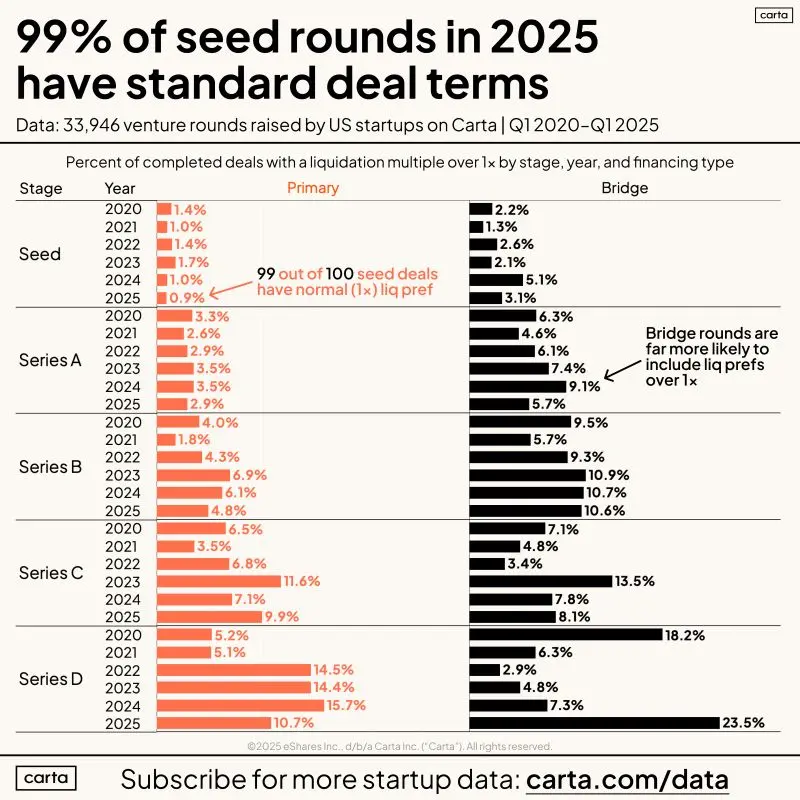
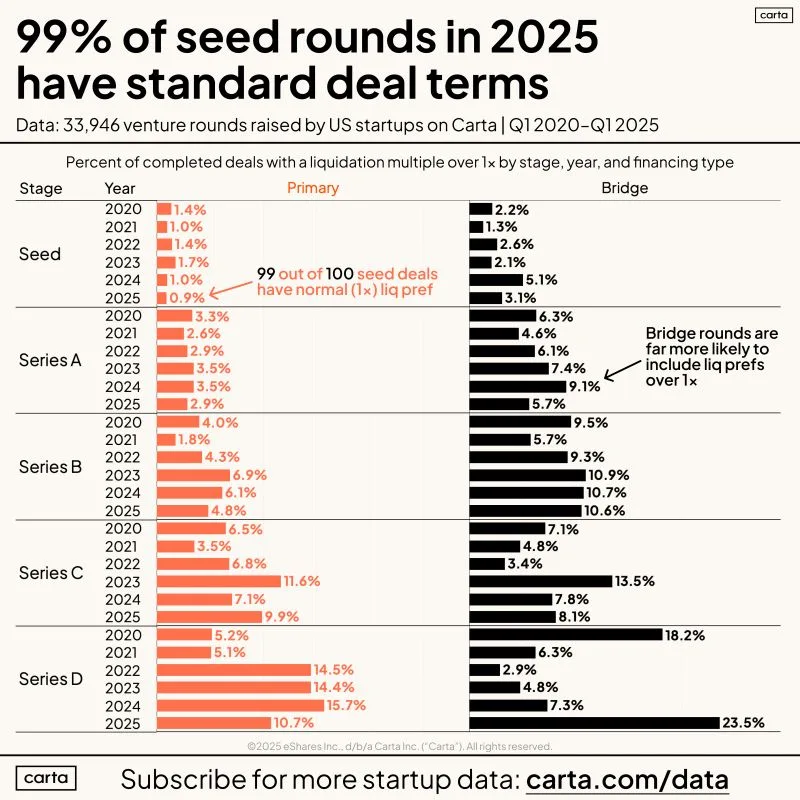
Founders - if the seed round you're raising has more than 1x liquidation multiple, don't take the deal.
Quick glossary here of some useful terms:
𝗟𝗶𝗾𝘂𝗶𝗱𝗮𝘁𝗶𝗼𝗻 𝗽𝗿𝗲𝗳𝗲𝗿𝗲𝗻𝗰𝗲: guarantee that preferred shareholders are paid first after an exit event, thereby optimizing for receiving a minimum return on their invested capital.
𝗟𝗶𝗾𝘂𝗶𝗱𝗮𝘁𝗶𝗼𝗻 𝗺𝘂𝗹𝘁𝗶𝗽𝗹𝗲: these define the amount the investor will get paid back before anyone else receives any cash. The standard is 1x (meaning if the investor put in $10 million, they get their $10 million back before others get paid out).
There's some fear-mongering going on out there by folks who don't like VC as an industry (and hey, I get it, not a perfect asset class).
But the idea that many seed or Series A deals are getting signed with terrible terms included is nonsense.
Venture investors and founders have actually come to some significant alignment on what constitutes a "normal" deal these days. Normal looks like: 1x liquidation multiple, non-participating, with no cumulative dividends.
This doesn't mean that deals that heavily favor investors are gone forever. They just appear in different places now.
1. Bridge rounds are FAR more likely to have difficult deal terms than primary deals. Which makes sense - you're usually raising a bridge because something hasn't gone to plan.
2. Later stage rounds see more onerous deal terms than early stage deals. Also makes sense given these companies are closer to exits with more predictable (fingers crossed) financial data.
BTW, this to me makes it clear that planning to raise a bridge or extension is not a great plan. You may end up having to accept terms you'd hope to avoid. Better a bridge than a shut down, of course, but not great.
Most early stage VCs are being good actors. Standard dilution (20% or so), standard deal terms, standard control rights (1 board seat for the lead).
Standards make money flow faster.
#startups #founders #liqpref #dealterms

DISCLOSURE: This communication is on behalf of eShares, Inc. dba Carta, Inc. ("Carta"). This communication is for informational purposes only, and contains general information only. Carta is not, by means of this communication, rendering accounting, business, financial, investment, legal, tax, or other professional advice or services. This publication is not a substitute for such professional advice or services nor should it be used as a basis for any decision or action that may affect your business or interests. Before making any decision or taking any action that may affect your business or interests, you should consult a qualified professional advisor. This communication is not intended as a recommendation, offer or solicitation for the purchase or sale of any security. Carta does not assume any liability for reliance on the information provided herein. © 2026 Carta. All rights reserved. Reproduction prohibited.