
Founders: what type of equity will you give your startup employees?
I've gotten this question a lot over the past few weeks while working with accelerator cohorts and other early-stage founders.
It can seem like a simple choice, but want to lay out some differences between kinds of startup equity that can have major implications for your employees (and their tax bills) down the road.
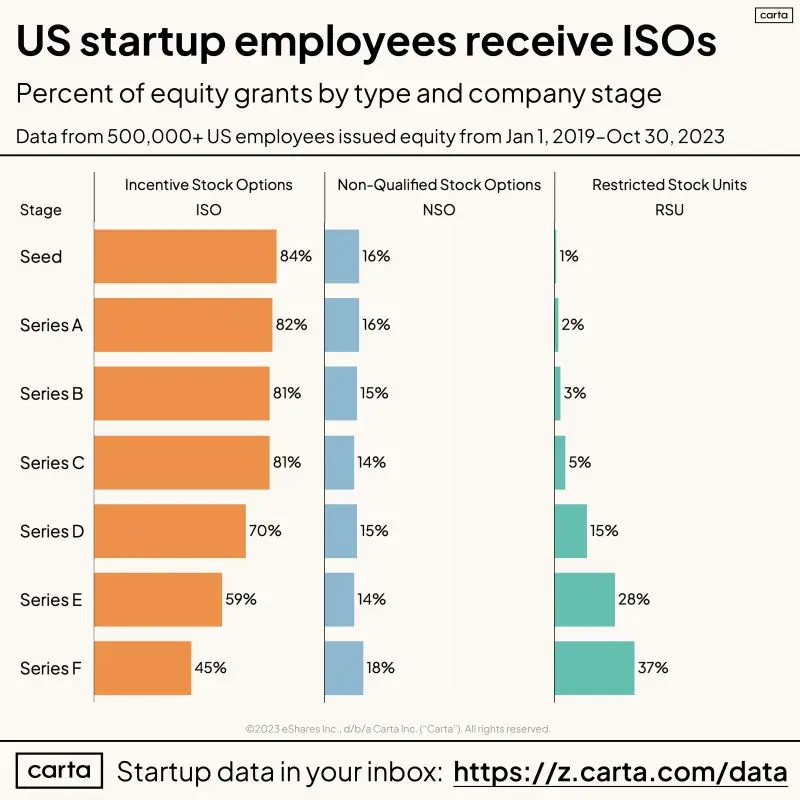
So - in the vast majority of cases, you'll give your employees Incentive Stock Options (ISOs).
A few useful points about each type:
𝗜𝗦𝗢
They represent the right to buy a set number of shares at a fixed price, usually called a strike price, or exercise price
These will have a vesting schedule. Usually that is a 4-year vest with a 1-year cliff
Typically only taxed when you eventually sell the shares, not at exercise (some exceptions here)
Typically come with a 10-year timeframe before expiration (unless you leave the company then it shortens to a 90-day window to make an exercise choice - yikes)
𝗡𝗦𝗢
Very similar to the ISO, except it doesn't qualify for the special tax treatment and is usually taxed both at exercise and at final sale (which is why ISO is preferred)
𝗥𝗦𝗨
Not actually a stock "option", this form of equity is simply a promise from your employer to give you shares of the company’s stock (or the cash equivalent) on a future date—as soon as you meet certain conditions
Because you don't have to pay to exercise, you also don't get to choose when the equity arrives - meaning you pay ordinary income tax on the shares whenever they vest
This automatic tax moment is why most companies only issue RSUs at very late stage
Now - what do founders get? They often issue themselves RSAs, or Restricted Stock Awards, aka Founder Shares.
With RSAs, founders own the shares on the date they accept the grant and satisfy any purchase price requirements, but the shares will still be subject to vesting conditions.
I think the past year or so is a good illustration of why waiting to switch to RSUs matters. Many companies are now valued at less than they were in 2021 - meaning if the employees had been issued RSUs, they may have paid income tax on an asset that is currently worth a lot less.
Most advisors / consultants / other company builders that are not founders or employees receive NSOs.
Happy hiring!
#cartadata #ISOs #NSOs #startupequity #compensation #RSUs #startups

DISCLOSURE: This communication is on behalf of eShares, Inc. dba Carta, Inc. ("Carta"). This communication is for informational purposes only, and contains general information only. Carta is not, by means of this communication, rendering accounting, business, financial, investment, legal, tax, or other professional advice or services. This publication is not a substitute for such professional advice or services nor should it be used as a basis for any decision or action that may affect your business or interests. Before making any decision or taking any action that may affect your business or interests, you should consult a qualified professional advisor. This communication is not intended as a recommendation, offer or solicitation for the purchase or sale of any security. Carta does not assume any liability for reliance on the information provided herein. © 2026 Carta. All rights reserved. Reproduction prohibited.