Real data on startup ownership for founders, employees, new investors, and old investors from 14,000+ US cap tables.
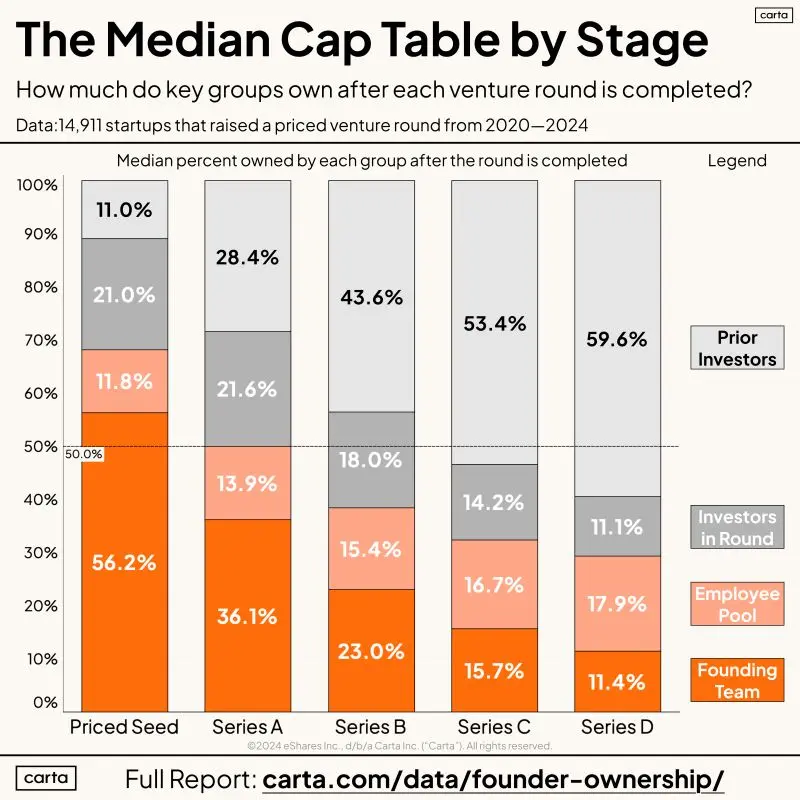
Before jumping into the stages, it's important to remember these are 𝗺𝗲𝗱𝗶𝗮𝗻𝘀. Each individual cap table is a special snowflake with no two percentages alike. Also note that we didn't show advisors or board members in this simplified view.
S͟e͟e͟d͟ ͟S͟t͟a͟g͟e͟
Before a priced seed round, many founders will have raised pre-seed or angel funding on SAFEs. That becomes that "old" investors in this stage.
A typical seed round will sell ~20% to new investors.
The employee pool hovers between 10-12%.
S͟e͟r͟i͟e͟s͟ ͟A͟
Another 20% or so sold to new investors (note that "new investors" in these labels can include old investors who take their pro rata).
Basically 50/50 on ownership between investors on one side and founders + employees on the other following a Series A.
S͟e͟r͟i͟e͟s͟ ͟B͟
Investors typically take majority ownership control between them.
Employee pool expands to 15%, founders share drops to 23%
S͟e͟r͟i͟e͟s͟ ͟C͟
New investors continue to take a smaller slice of pie (this time around 14%).
In the median startup, employees now own more (collectively) than the founding team.
S͟e͟r͟i͟e͟s͟ ͟D͟
Founder ownership on median sits just above 11%.
𝗪𝗵𝗮𝘁 𝘀𝘁𝗮𝗻𝗱𝘀 𝗼𝘂𝘁?
1. Employee option pools do not start at 20%. They begin in the 10% range and then expand by a point or two with every primary fundraise.
2. Just because founders own less than 50% does not mean investors have control. The employee pool is a mitigating factor. Also employees really do not have voting rights until they vest and exercise their shares (meaning in practice many never have voting rights).
3. VC is expensive capital (in terms of equity).
#startups #founders #ESOP #VC #fundraising #ownership
Link to the full report with WAY more data for you: https://lnkd.in/gC2Y-xfR

DISCLOSURE: This communication is on behalf of eShares, Inc. dba Carta, Inc. ("Carta"). This communication is for informational purposes only, and contains general information only. Carta is not, by means of this communication, rendering accounting, business, financial, investment, legal, tax, or other professional advice or services. This publication is not a substitute for such professional advice or services nor should it be used as a basis for any decision or action that may affect your business or interests. Before making any decision or taking any action that may affect your business or interests, you should consult a qualified professional advisor. This communication is not intended as a recommendation, offer or solicitation for the purchase or sale of any security. Carta does not assume any liability for reliance on the information provided herein. © 2026 Carta. All rights reserved. Reproduction prohibited.