The biggest question around startups today: how much money do you 𝗮𝗰𝘁𝘂𝗮𝗹𝗹𝘆 𝗻𝗲𝗲𝗱 to build a generational business?
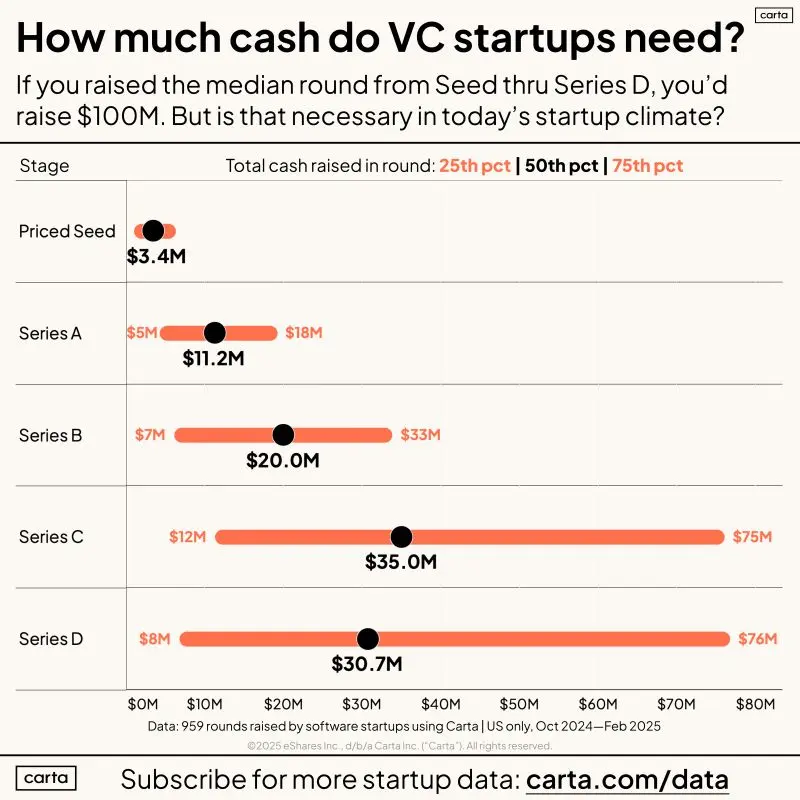
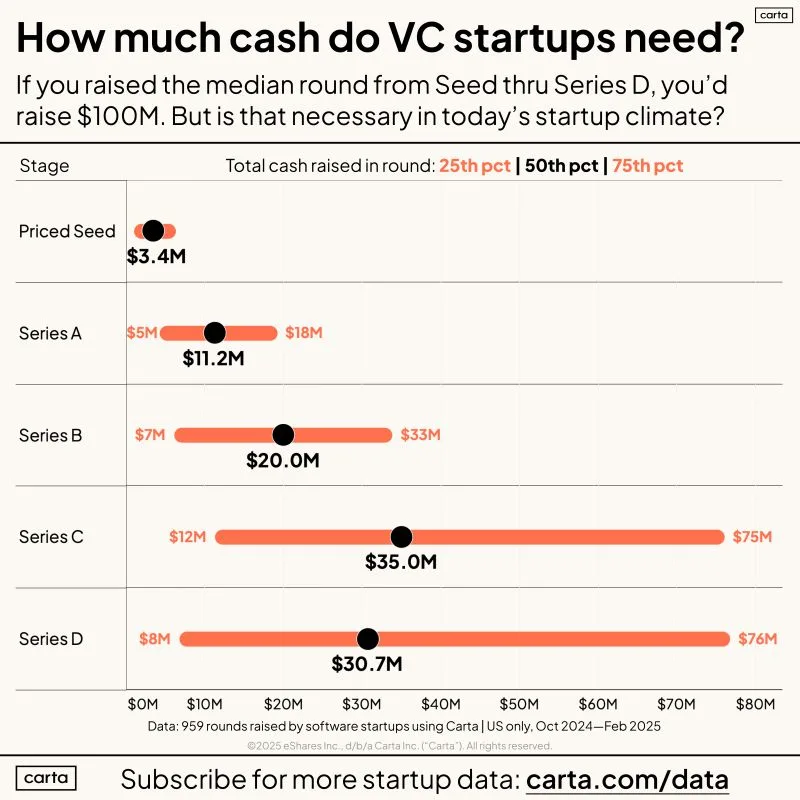
If you just look at software startups (so leaving out Hardware, Biotech, etc), the data below shows how much VC-backed companies are raising per round.
Add it all up, from Seed through Series D, and you get $100M.
But do startups, especially those building with AI, really need that much money?
𝗔𝗿𝗴𝘂𝗺𝗲𝗻𝘁𝘀 𝗙𝗼𝗿
Money solves money problems. In spaces that are becoming more and more crowded by the day, capital can help you stand out from the 100 other software solutions.
Investments from brand-name VCs help with hiring, with enterprise contracts, with new investors.
The cost of building a company is going down, but what you used to spend on payroll you now spend on compute and distribution.
𝗔𝗿𝗴𝘂𝗺𝗲𝗻𝘁𝘀 𝗔𝗴𝗮𝗶𝗻𝘀𝘁
Midjourney has never raised a round and makes hundreds of millions in revenue (insert all other examples).
Less funding = less dilution = more equity for founders (and hopefully early employees).
Getting to profitability early on in a company's lifecycle, with or without lots of funding, increases founder optionality in terms of growth paths.
No perfect path. But it's got to be good for startups overall to see so many founders choosing their own capital journey as opposed to the binary "Bootstrap vs VC" that dominated in prior years.
#startups #founders #fundraising #VC #bootstrap

DISCLOSURE: This communication is on behalf of eShares, Inc. dba Carta, Inc. ("Carta"). This communication is for informational purposes only, and contains general information only. Carta is not, by means of this communication, rendering accounting, business, financial, investment, legal, tax, or other professional advice or services. This publication is not a substitute for such professional advice or services nor should it be used as a basis for any decision or action that may affect your business or interests. Before making any decision or taking any action that may affect your business or interests, you should consult a qualified professional advisor. This communication is not intended as a recommendation, offer or solicitation for the purchase or sale of any security. Carta does not assume any liability for reliance on the information provided herein. © 2026 Carta. All rights reserved. Reproduction prohibited.