How often do valuations increase in startup rounds?
Well, in normal times, it's the default. You raise more funds at a higher valuation, the company has progressed, everybody pops champagne then gets back to it.
In recent years that default has been challenged.
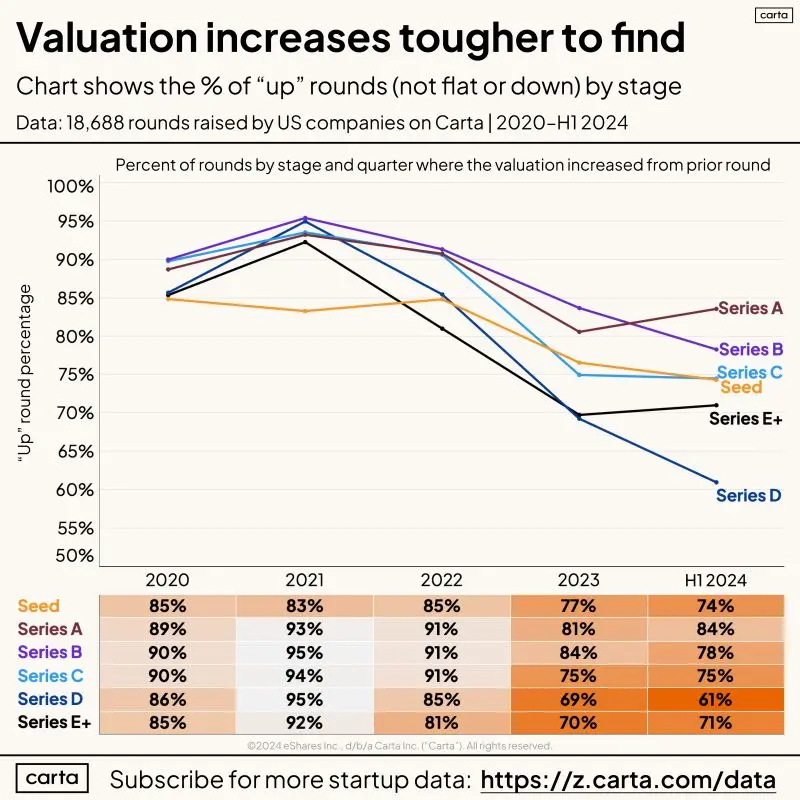
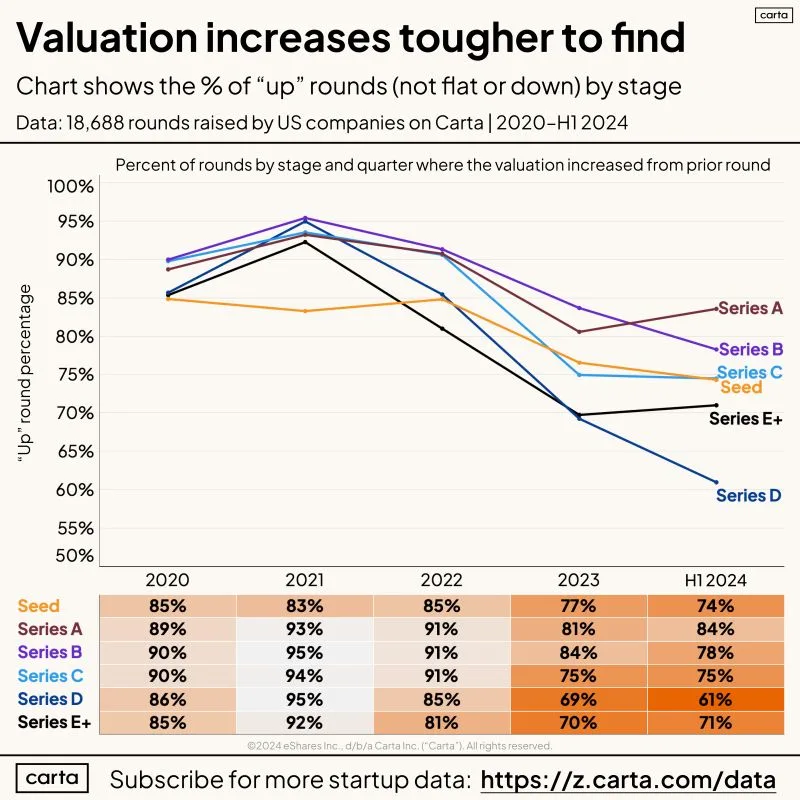
Chart below show the percentage of rounds where the valuation increased from the round prior. Basically anything that wasn't a down round and flat round. Data split by stage and quarter.
In 2021 the up round was the only thing going. Every stage had an up round percentage of over 90% (except seed).
So far in 2024, the up round has been more elusive. Up rounds percentages range from 61% at the low end (Series D) to 84% at the high end (Series A).
So founders - everyone is struggling to find that next great round.
A note on the Seed data here, which I found pretty fascinating. Up rounds on Seed usually mean that the valuation of the seed round surpassed the valuation cap of the post-money SAFE the pre-seed was raised on.
So this shows that valuation exceeds val cap about 80% of the time, though a little lower lately.
Will that hold as more founders use SAFEs for pre-seed and seed? Interesting question to watch!
#startups #valuations #venturecapital

DISCLOSURE: This communication is on behalf of eShares, Inc. dba Carta, Inc. ("Carta"). This communication is for informational purposes only, and contains general information only. Carta is not, by means of this communication, rendering accounting, business, financial, investment, legal, tax, or other professional advice or services. This publication is not a substitute for such professional advice or services nor should it be used as a basis for any decision or action that may affect your business or interests. Before making any decision or taking any action that may affect your business or interests, you should consult a qualified professional advisor. This communication is not intended as a recommendation, offer or solicitation for the purchase or sale of any security. Carta does not assume any liability for reliance on the information provided herein. © 2026 Carta. All rights reserved. Reproduction prohibited.