Everyone hates VC round names. What the hell is a "Series A" anyway?
We should just state the amount of capital being raised and get on with our lives...right?
Not so fast.
I agree overall that round names can be confusing and arbitrary. Just not convinced they are entirely useless.
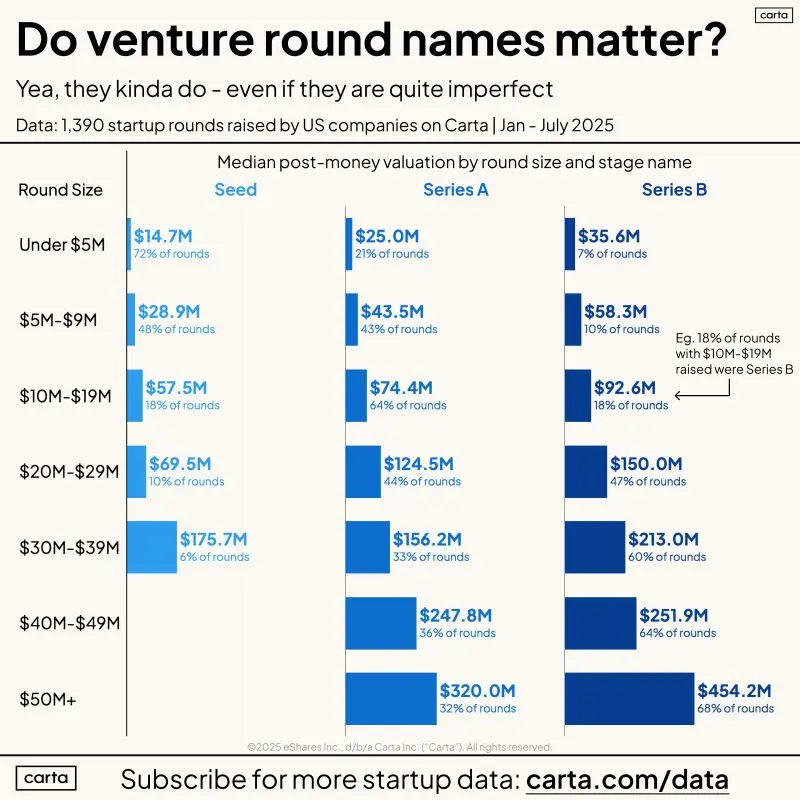
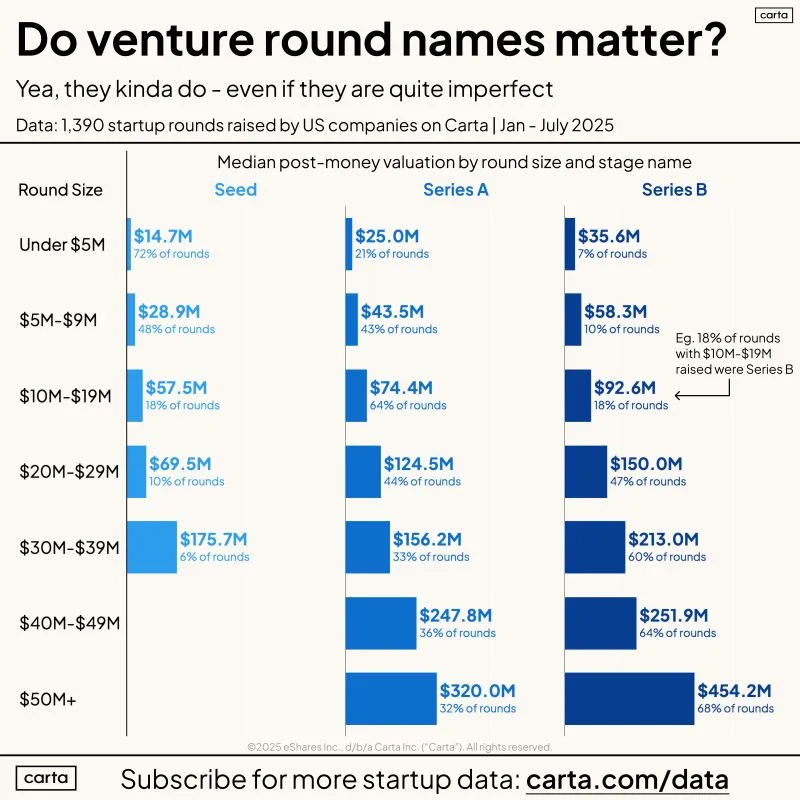
Data below shows a bar table of two different criteria. Each row shows the amount of money raised in a round and the columns are for Seed / Series A / Series B. No bridges or funny business, just primary venture rounds.
What does this show? That companies raising the same amount of money have different post-money valuations depending on the round name.
Eg. If a seed-stage round raises $15M, that company is likely valued at $58M post-money. Whereas if a Series B company does so, the startup is typically worth $93M.
Why?
1. The companies that are raising Series B have likely raised more capital over multiple rounds than the earlier stages. So the valuation 𝘀𝗵𝗼𝘂𝗹𝗱 be higher accounting for the excess capital already on the books.
2. The later the stage, the higher the traction / underlying business metrics needed to justify the next round (typically).
3. Some round name fraud happening? Founders do sometimes choose to raise a "seed" when they've already raised significant capital in order to stand out relative to their peers.
Overall, look, there is no perfect system for this stuff unless lots more info is public. Would love to say "startups raising the 2nd institutional round with $10M already raised are valued at X" but good luck getting all that data into the public realm.
And investors still think of themselves in stage-name terms. For better or worse, Series A investors compete with other Series A investors for the best deals.
Stuck with these alphabet conventions awhile longer, I'm afraid.
#startups #Seed #SeriesA #SeriesB #founders

DISCLOSURE: This communication is on behalf of eShares, Inc. dba Carta, Inc. ("Carta"). This communication is for informational purposes only, and contains general information only. Carta is not, by means of this communication, rendering accounting, business, financial, investment, legal, tax, or other professional advice or services. This publication is not a substitute for such professional advice or services nor should it be used as a basis for any decision or action that may affect your business or interests. Before making any decision or taking any action that may affect your business or interests, you should consult a qualified professional advisor. This communication is not intended as a recommendation, offer or solicitation for the purchase or sale of any security. Carta does not assume any liability for reliance on the information provided herein. © 2026 Carta. All rights reserved. Reproduction prohibited.