When should founders quit?
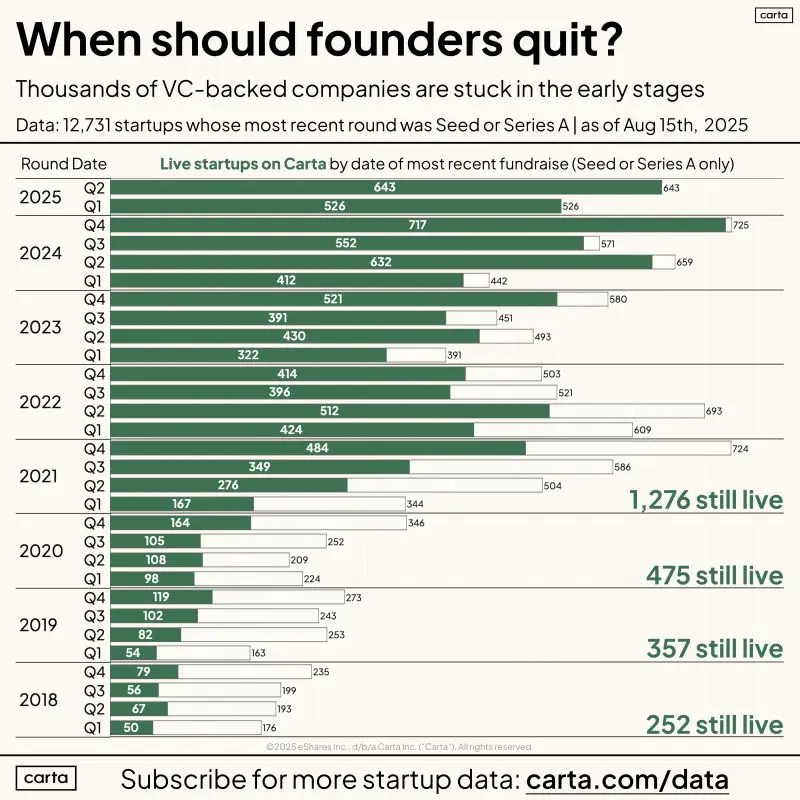
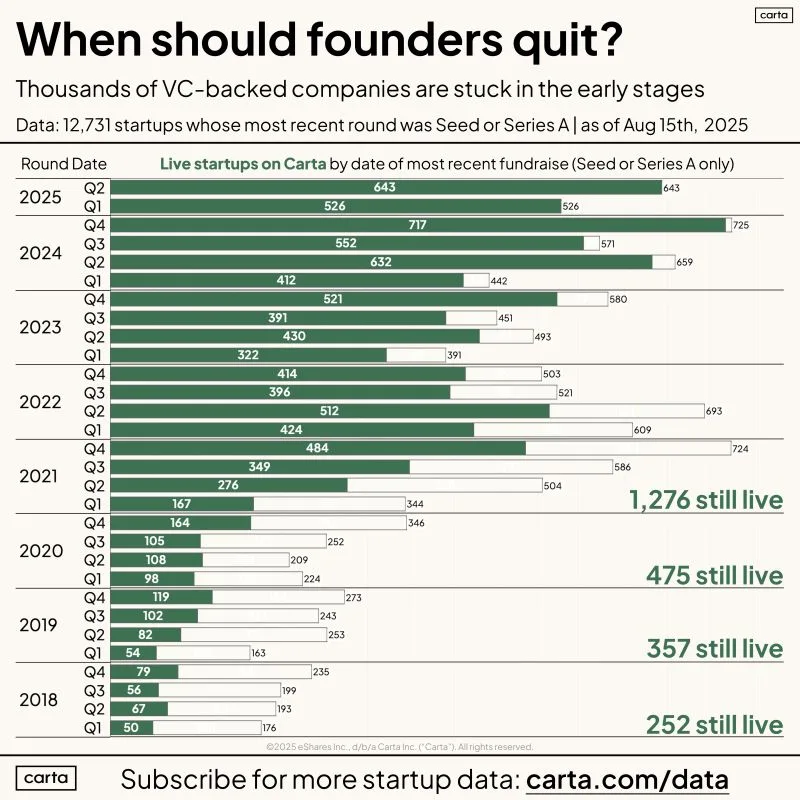
Take a look at the data below. The date in each row is when Seed or Series A startups completed their most recent fundraise.
Raised in 2025, 2024, or 2023, on track.
Raised in 2022...it's been 3.5 years. Keep pushing.
Raised in 2021...it's been 4.5 years. Hmmm...
Raised in 2020 or earlier, where are we going?
Now of course there are caveats. Here are a few:
Maybe some of the early-stage companies that raised in say 2018 have become profitable businesses that require no more VC cash. I kinda doubt that's a high percentage, but possible.
Maybe some of these companies are one more pivot away from breaking into success.
Maybe the initial round was quite large and is being spent building a major moat (technical, hardware, scientific, etc).
I certainly don’t have the right answer here, but as the startup world seems to be turning faster and faster I find myself wondering about the talented founders continuing to put their shoulders into potentially broken wheels.
Elad Gil told South Park Commons in 2023:
“I do think there’s a bit of a myth in Silicon Valley that you should keep grinding no matter what and it’s just about perseverance, and I think that’s really bad advice… In general, things that work tend to work pretty fast and usually that’s within the first year of launch.”
But what about the famous pivot?
“When people pivot, they tend to pivot locally. They don’t tend to pivot across markets. And that’s a huge mistake because you get stuck in some local maxima… I think usually if the thing isn’t working and you decide to pivot, it’s often wise to rethink everything from the ground up. And it’s hard if you’ve raised a lot of money and have a big team.”
In a world moving at AI speed, what's the "right" amount of time to try an idea? And how do you judge when enough is enough?
Last thought: we celebrate both "never quit" and "failure is good" in Silicon Valley. Sometimes those ideas are in conflict!
#startups #founders #whentoquit

DISCLOSURE: This communication is on behalf of eShares, Inc. dba Carta, Inc. ("Carta"). This communication is for informational purposes only, and contains general information only. Carta is not, by means of this communication, rendering accounting, business, financial, investment, legal, tax, or other professional advice or services. This publication is not a substitute for such professional advice or services nor should it be used as a basis for any decision or action that may affect your business or interests. Before making any decision or taking any action that may affect your business or interests, you should consult a qualified professional advisor. This communication is not intended as a recommendation, offer or solicitation for the purchase or sale of any security. Carta does not assume any liability for reliance on the information provided herein. © 2026 Carta. All rights reserved. Reproduction prohibited.