Why the hell does every startup sell 20% in their seed rounds?
Because the dilution is dictated by the needs of the fund, not the needs of the founder.
(and yes, I realize it's not every company, chill).
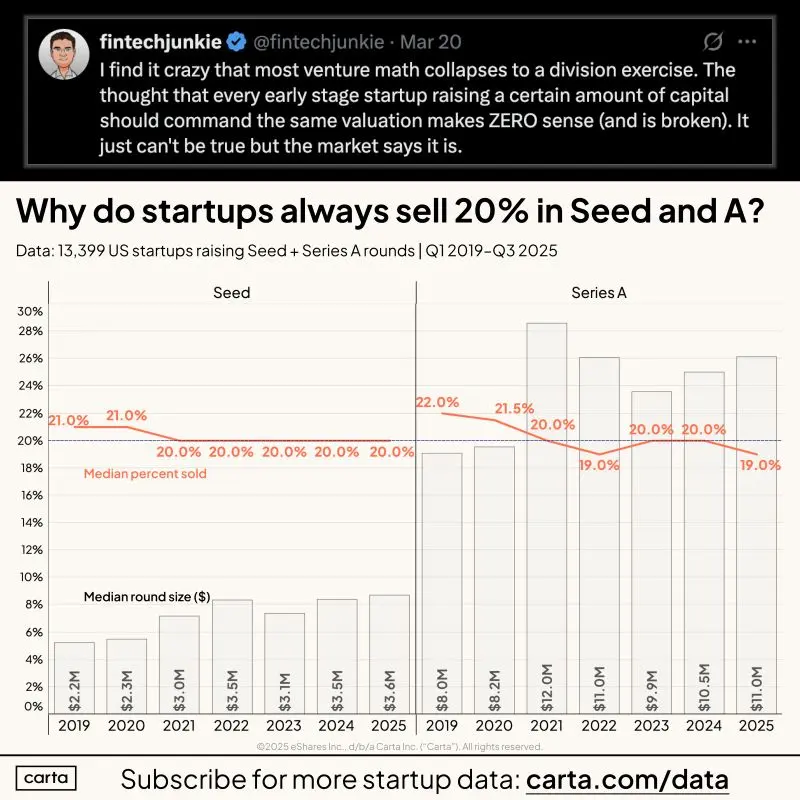
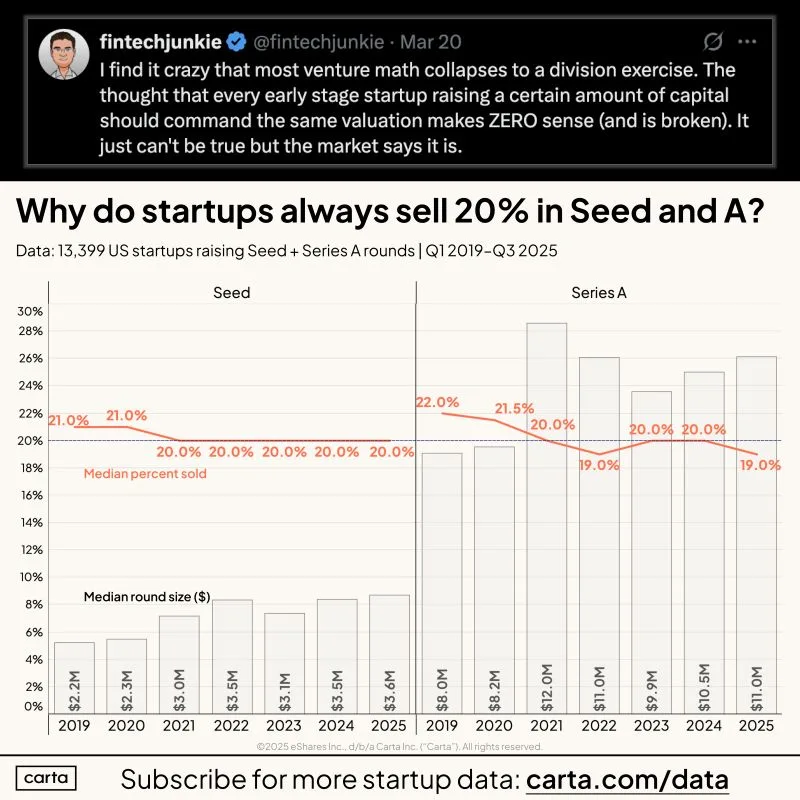
Appreciate this perspective from Frank Rotman who finds it crazy that most venture deals resolve back to a simple division exercise. That division, btw, is 𝗖𝗮𝘀𝗵 𝗥𝗮𝗶𝘀𝗲𝗱 / 𝗣𝗼𝘀𝘁-𝗠𝗼𝗻𝗲𝘆 𝗩𝗮𝗹𝘂𝗮𝘁𝗶𝗼𝗻 = 𝗣𝗲𝗿𝗰𝗲𝗻𝘁 𝗦𝗼𝗹𝗱.
And look at the data below - even as the round sizes shift across tons of different kinds of startups, the dilution remains locked around 20%. Especially at Seed.
Two separate dynamics happening:
The amount of capital needed for each business has got to be highly varied. But round sizes are not nearly as diverse as they "should" be. Meaning companies are having trouble knowing how much money they really need, which is a hard question!
The investors need to own a certain percentage of the company to make all the fund math work. Do they 𝗿𝗲𝗮𝗹𝗹𝘆 need to own that much? What if they don't lead the round, so they are more at the whim of the leads' needs? There are lots of models that could work in venture.
Key thing if you're a founder: you do not 𝗻𝗲𝗲𝗱 to sell 20% of your company in a seed round. You can raise a tiny seed! You can raise a massive one! You can highly dilute or merely titrate your equity. It's all possible.
But the VCs will often have rules around what they need to own, and that may dictate your fundraise more than it should.
#startups #VC #founders

DISCLOSURE: This communication is on behalf of eShares, Inc. dba Carta, Inc. ("Carta"). This communication is for informational purposes only, and contains general information only. Carta is not, by means of this communication, rendering accounting, business, financial, investment, legal, tax, or other professional advice or services. This publication is not a substitute for such professional advice or services nor should it be used as a basis for any decision or action that may affect your business or interests. Before making any decision or taking any action that may affect your business or interests, you should consult a qualified professional advisor. This communication is not intended as a recommendation, offer or solicitation for the purchase or sale of any security. Carta does not assume any liability for reliance on the information provided herein. © 2026 Carta. All rights reserved. Reproduction prohibited.