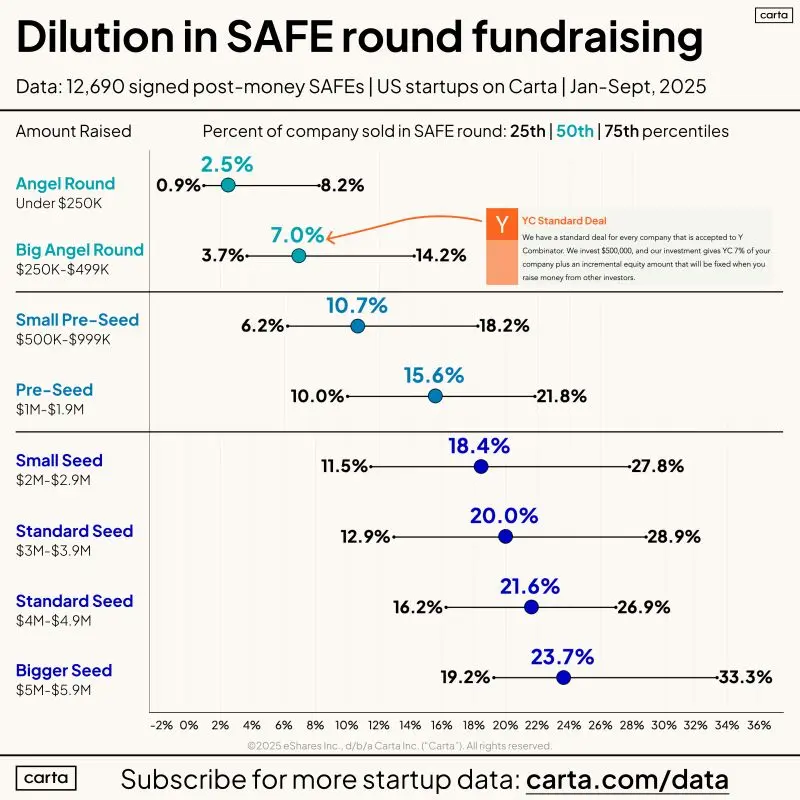
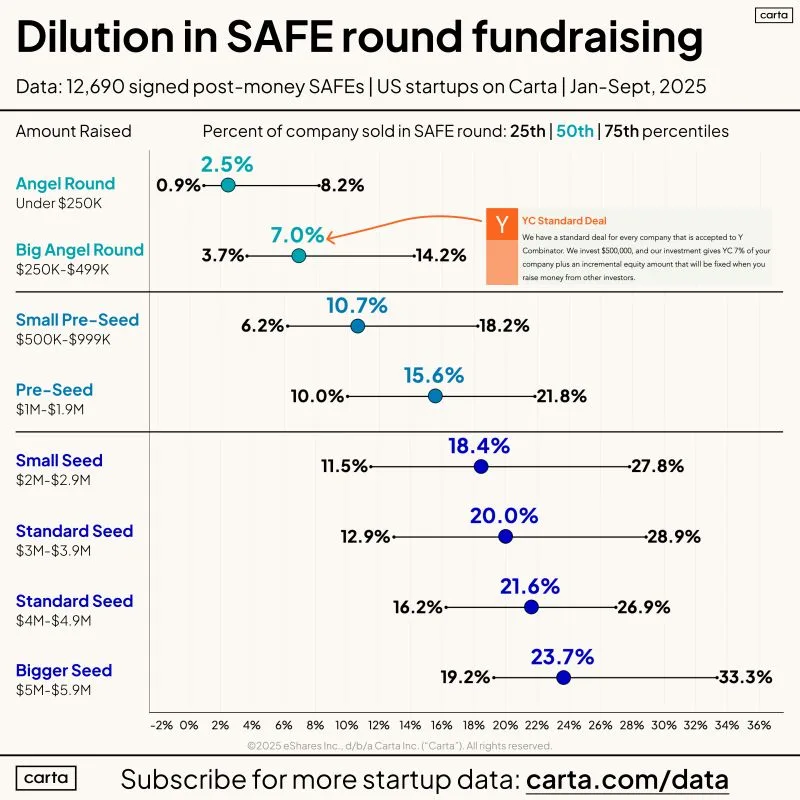
The YC deal: $500,000 for 7% of the startup. Is this a good deal?
And yes, I know there are some technical details with the YC deal, it's actually two separate SAFEs, etc.
But look at the broader data: in 2025, the median equity sold for $500K is indeed 7%.
Meaning the YC deal is very much in line with the market.
Data below looks at the expected dilution from startups raising on post-money SAFEs so far this year.
I say expected because if you're raising on SAFEs, you get the money today and you convert the investor into an equity-holder whenever you raise a priced round — which could be tomorrow or 2 years from now.
Big note: most founders do 𝗻𝗼𝘁 do all of these rounds. Do 1, skip all of them, do your own thing!
𝗞𝗲𝘆 𝗧𝗮𝗸𝗲𝗮𝘄𝗮𝘆𝘀
1. Dilution tends to grow as the amount raised gets bigger. Fairly obvious that you'll sell more the company for $1 million than you would for $100,000.
2. The median is useful, but the ranges across all of these stages are pretty wide. Deals get done at different prices for different people (and yes, it is about the people rather than the business at this stage, by and large).
3. If you're raising $1 million today from US VCs, expect to sell around 10% of your startup.
4. The round names are mostly just my guesses, but they do reflect the kind of investor involved. Angels play below $500K, pre-seed funds from $500K-$2M, and seed funds about $2M. Lots of line crossing and blurring though.
5. I often get the question - "Is YC a good deal"? Obviously it depends on your business and what you need, but on a purely economic basis it's right in line with dilution from a large angel round. Not bad!
Getting ahead of two objections:
Yes, this data is heavily influenced by AI startups and SF startups. Why? Because there are lot more deals happening in SF.
Founders should not refuse to take a deal with higher dilution if it's the only path towards capital they need. Make the deals you must to keep the business alive!
Shout in the comments for a link to our fresh State of Pre-Seed report with tons more data on the earliest venture companies.

DISCLOSURE: This communication is on behalf of eShares, Inc. dba Carta, Inc. ("Carta"). This communication is for informational purposes only, and contains general information only. Carta is not, by means of this communication, rendering accounting, business, financial, investment, legal, tax, or other professional advice or services. This publication is not a substitute for such professional advice or services nor should it be used as a basis for any decision or action that may affect your business or interests. Before making any decision or taking any action that may affect your business or interests, you should consult a qualified professional advisor. This communication is not intended as a recommendation, offer or solicitation for the purchase or sale of any security. Carta does not assume any liability for reliance on the information provided herein. © 2026 Carta. All rights reserved. Reproduction prohibited.