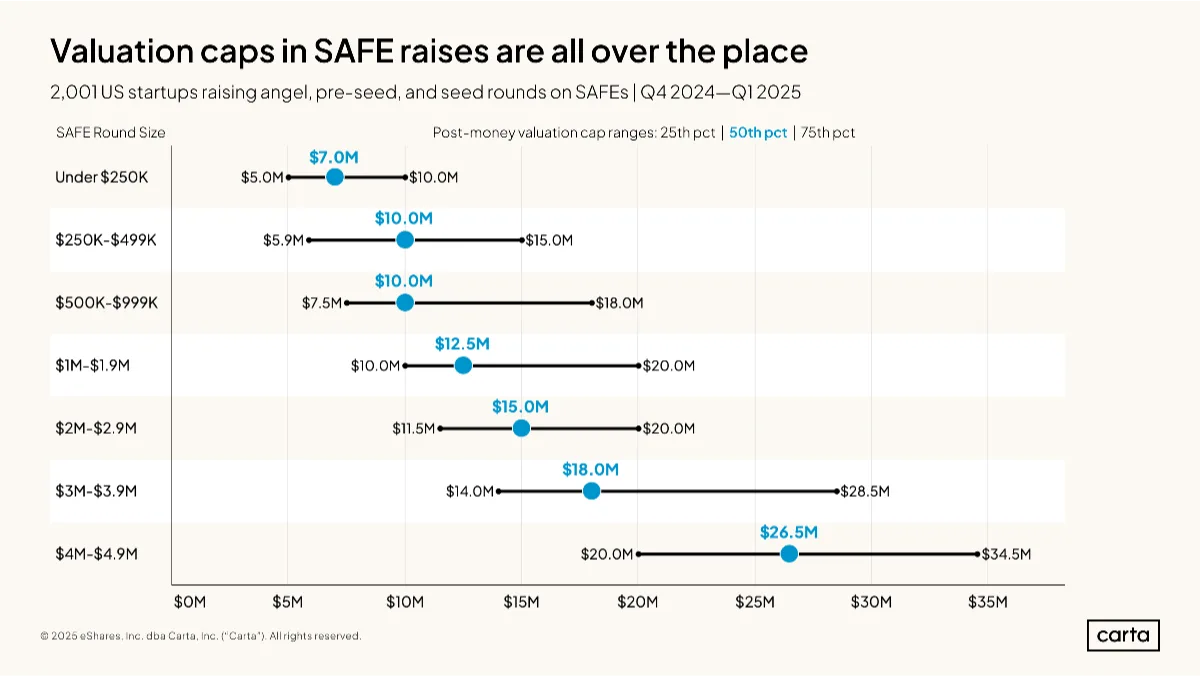
What should my valuation (cap) be?
It's probably the most common question I get from early-stage founders. And I feel a little bashful when I have to reply, "it kinda depends". Not super helpful.
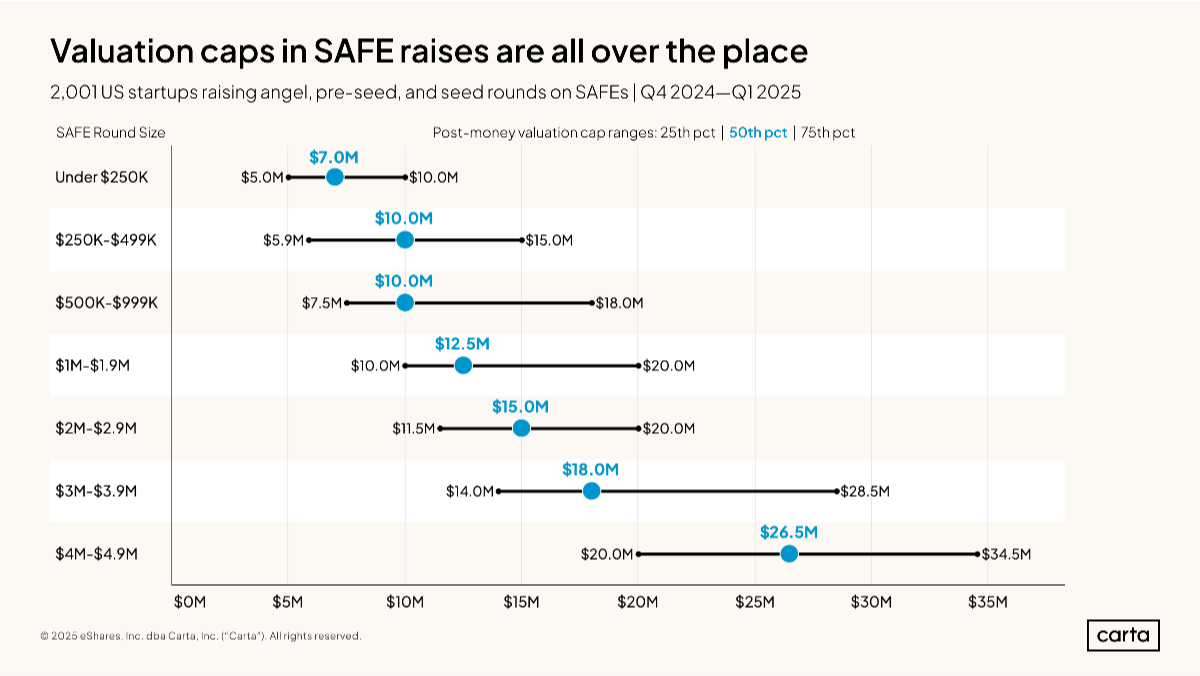
A couple of general points hold true, however. First, valuation caps tend to rise alongside the round size. This makes sense as you don't want to overdilute the business this early on.
Second, the valuation caps tend to settle on big, round numbers. This is because valuation caps are not valuations. They don't get debated in the same way, the diligence is usually much lower, and the agreement between founders and investors is more about ensuring upside rather than a judgement on the company's actual value.
This simplification in stated figures actually causes more confusion for many since the space is so opaque. You'll hear of founders raising $500K at a $10M cap…or $1M at a $10M cap…or $2.5M at a $10M cap. So what's "market"?
As usual in startups, but more acutely in these early days, it's all about founder demand. If you are a founder in high demand, you can command better terms. If not, you won't.
Unfair? Undoubtedly.
But that's the game today.
Onwards!
Subscribe here if you're new to the Data Minute. Forwarding encouraged!
Peter Walker

DISCLOSURE: This communication is on behalf of eShares, Inc. dba Carta, Inc. ("Carta"). This communication is for informational purposes only, and contains general information only. Carta is not, by means of this communication, rendering accounting, business, financial, investment, legal, tax, or other professional advice or services. This publication is not a substitute for such professional advice or services nor should it be used as a basis for any decision or action that may affect your business or interests. Before making any decision or taking any action that may affect your business or interests, you should consult a qualified professional advisor. This communication is not intended as a recommendation, offer or solicitation for the purchase or sale of any security. Carta does not assume any liability for reliance on the information provided herein. © 2026 Carta. All rights reserved. Reproduction prohibited.